
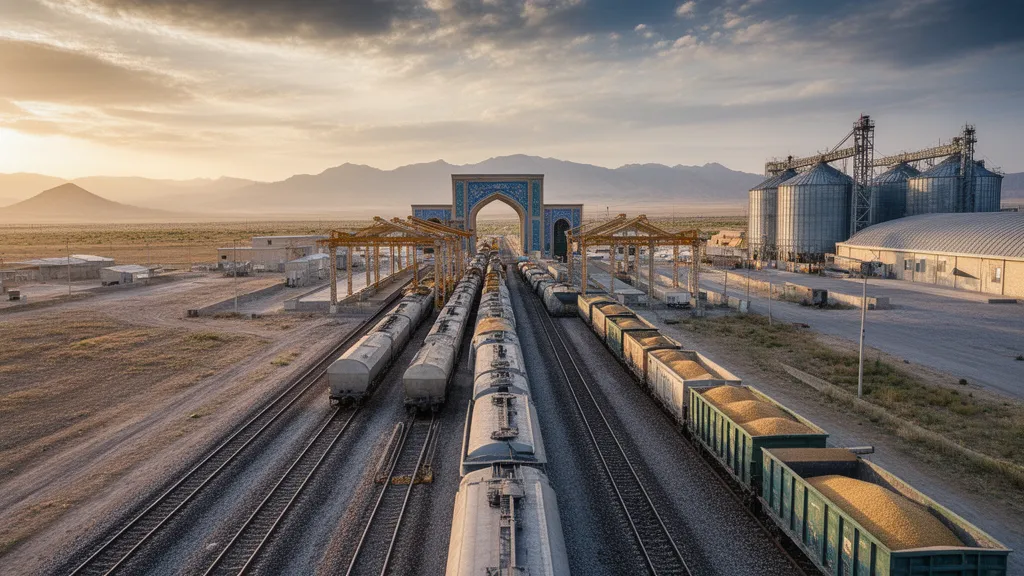
- Dry Port No. 5 is now operational on the Hairatan–Mazar-i-Sharif railway line, handling its first train and expanding regional freight capacity.
- A planned 1,650-meter railway extension at Naybobad station is set to boost freight car throughput and reduce idle time.
- Enhanced rail infrastructure may gradually shift some Central Asian grain and oilseed flows away from Black Sea routes, with neutral-to-positive implications for regional freight markets.
Uzbekistan–Afghanistan Dry Port Expansion
Uzbekistan Railways has launched Dry Port No. 5 in Mazar-i-Sharif, Afghanistan, marking a key milestone in the development of the Hairatan–Mazar-i-Sharif railway corridor. The facility successfully processed its first train last week, confirming operational readiness for expanded cargo handling and improved freight flows between the two countries.
During a high-level meeting, Uzbekistan Railways CEO Zufar Narzullaev and Mullah Abdulghani Barodar, Afghanistan’s Deputy Prime Minister for Economic Affairs, agreed on further rail infrastructure upgrades. The core project is the construction of an additional 1,650-meter railway line near Naybobad station, which is expected to increase the number of freight cars that can be processed simultaneously and reduce downtime along the corridor.
Afghan authorities have pledged to ensure timely receipt and unloading of cargo through the enhanced rail and terminal infrastructure. These steps aim to strengthen cargo turnover between Central Asia and Afghanistan, supporting more reliable and higher-volume trade flows.
Implications for Black Sea Freight Markets
The commissioning of Dry Port No. 5 and the planned line extension at Naybobad carry neutral-to-positive implications for Black Sea freight markets. By providing an alternative logistics corridor for Central Asian grain and oilseed exports into Afghanistan, the upgraded route could gradually redirect a portion of cargo volumes that might otherwise transit through Black Sea ports.
In the near term, the impact is likely to remain limited due to Afghanistan’s constrained import capacity and broader regional trade conditions. Nonetheless, traders should track whether increased rail efficiency translates into higher wheat and vegetable oil deliveries into Afghanistan, which could marginally influence competition with Black Sea exporters in select Central Asian destination markets.
Source: Market Data
Leave a Reply