
- New route established: Kazakhstan successfully shipped over 15,000 tons of wheat to Vietnam in 2025 via a multimodal rail-sea corridor through China.
- Diversified export corridors: The new route reduces Kazakhstan’s reliance on traditional Black Sea export channels for wheat.
- Logistics cooperation: Kazakhstan’s JSC NC KTZ and Vietnam Railways agreed to expand freight volumes and enhance transport and logistics collaboration.
- Market tone: Impact is currently neutral to marginally bullish for Kazakh wheat, with upside dependent on future volume growth.
Kazakhstan–Vietnam Wheat Corridor Established
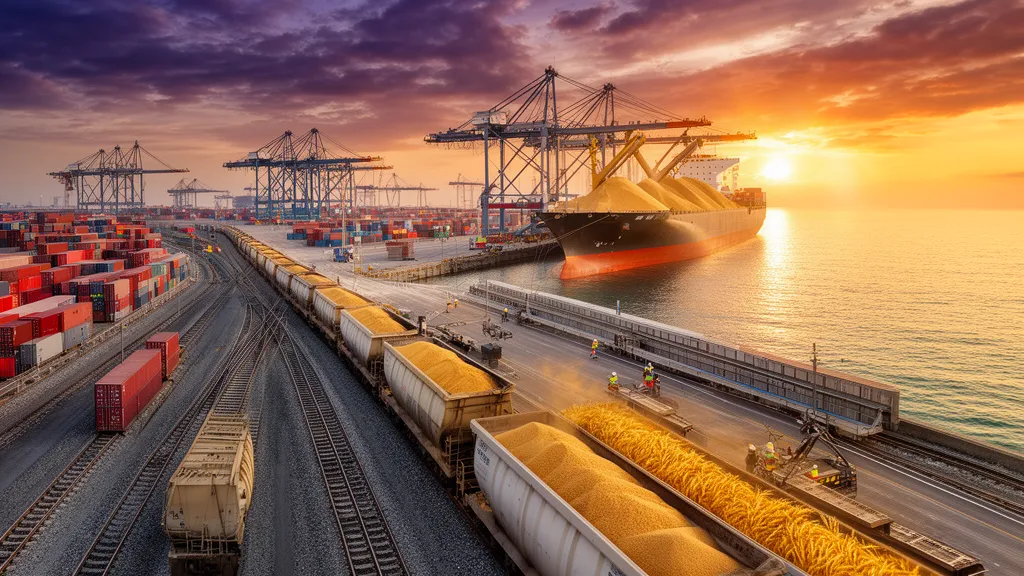
Kazakhstan has opened a new rail-sea export corridor to Vietnam, completing a test shipment of over 15,000 tons of wheat in 2025. The pilot shipment confirms the operational viability of this alternative route to Asian markets, adding resilience to Kazakhstan’s export logistics.
The grain originated from three stations in the Akmola region—Azat, Akkol, and Kokshetau—before moving by rail through the Dostyk and Altynkol border crossings into China. From there, cargo traveled to the Chinese port of Lianyungang, where it was transshipped onto vessels bound for Haiphong port in Vietnam.
Logistics and Bilateral Cooperation
Following the successful test, Kazakhstan’s national railway company, JSC NC KTZ, and Vietnam Railways held high-level talks to deepen bilateral freight cooperation. Chairman Talgat Aldybergenov and CEO HoAng Gia Khanh confirmed their intention to increase shipping volumes and improve conditions for shippers through enhanced transport and logistics coordination.
Both rail operators view the Lianyungang transshipment hub as a strategic node, enabling smooth integration between overland rail from Central Asia and maritime services into Southeast Asia, particularly Vietnam.
Market Impact and Outlook
The immediate market impact is assessed as neutral to marginally bullish for Kazakh wheat. While the 15,000-ton volume is modest relative to established Black Sea flows, the key development is the proof-of-concept for a scalable corridor. As volumes increase, Kazakhstan could capture additional market share in Vietnam, which has historically relied on Australian, Russian, and Ukrainian wheat.
For Black Sea traders, this corridor represents emerging competition in Asian destinations, especially if Kazakhstan can manage transport costs along the China–Lianyungang–Haiphong route. Market participants should monitor forthcoming announcements on shipment volumes and any changes in logistics tariffs that could improve Kazakhstan’s price competitiveness into Southeast Asia.
Source: Market Data
Leave a Reply