
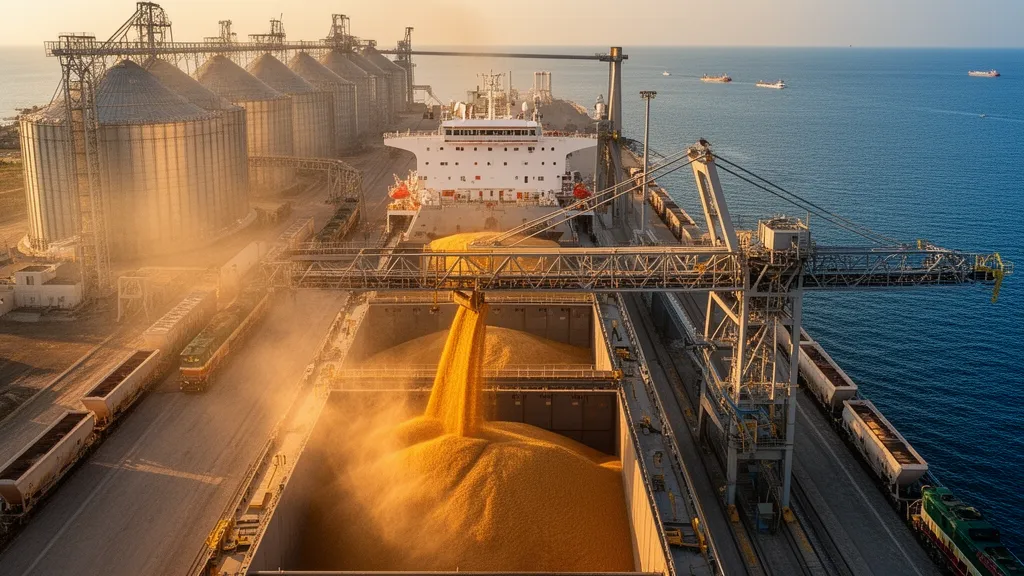
- Ukrainian freight: Capacity recovery underway via additional diesel locomotives, but power infrastructure damage keeps rail-to-port flows constrained and schedules fragile.
- Russian grain exports: November shipments up 5% YoY to 6.3 million tons, driven by strong Turkish and Iranian wheat demand and expanded Turkish barley imports.
- Black Sea logistics: Rostov Region moved 1.4 million tons of grain in November, with 778,000 tons via Port Kavkaz, underscoring the strategic role of Azov–Black Sea routes.
- Freight outlook: Neutral to slightly bearish for Ukrainian rail capacity near term; bullish for Black Sea grain and dry bulk freight demand tied to Turkish and Iranian tenders.
Market Update
Ukrzaliznytsia is working to normalize freight train traffic to Ukrainian ports after systematic attacks on rail energy infrastructure disrupted operations. The operator is deploying additional diesel locomotives and resources to restore power supply on critical freight corridors, aiming to stabilize rail-to-port flows despite continued vulnerability of the grid.
On December 18, Oleksandr Nosulko, head of Ukrzaliznytsia’s freight service, met with port industry representatives in Odesa to coordinate operations and raise traffic volumes. Cargo owners were advised to plan shipments in line with current capacity and to adhere strictly to agreed schedules to reduce congestion and bottlenecks on key export routes.
Russian grain exports showed solid momentum in November 2024. Total grain shipments reached 6.3 million tons, up 300,000 tons (5%) versus November 2023, according to the Russian Grain Union. Wheat volumes rose to 5.6 million tons, a 7.8% year-on-year increase, reinforcing Russia’s competitive position in core import markets around the Black Sea and the Middle East.
Turkey emerged as a major growth driver, lifting wheat purchases to 970,000 tons in November, around 3.5 times last year’s level following removal of the prior import ban. Iran bought 883,000 tons of Russian wheat compared with no purchases in November 2023, while Egypt maintained stable demand at 729,000 tons, only 3.5% lower year-on-year. Barley exports to Turkey surged nearly 13-fold to 177,500 tons after Ankara raised its combined corn and barley import quota to 1 million tons.
The Rostov Region exported 1.4 million tons of grain and grain products in November, up 2.8% year-on-year. Of this, 655,000 tons were shipped directly from regional seaports, while 778,000 tons were handled via transshipment at Port Kavkaz. Main destinations included Turkey, Georgia, and Albania, underscoring the continued importance of Azov–Black Sea logistics channels for regional grain flows.
Data Summary
| Metric | November 2024 | November 2023 | Change |
|---|---|---|---|
| Total Russian grain exports | 6.3 million tons | 6.0 million tons | +5.0% |
| Russian wheat exports | 5.6 million tons | ≈5.19 million tons | +7.8% |
| Wheat to Turkey | 970,000 tons | ≈277,000 tons | ~3.5× |
| Wheat to Iran | 883,000 tons | 0 tons | New buyer |
| Wheat to Egypt | 729,000 tons | ≈755,000 tons | -3.5% |
| Barley to Turkey | 177,500 tons | ≈13,650 tons | ~13× |
| Rostov Region grain exports (total) | 1.4 million tons | ≈1.36 million tons | +2.8% |
| Rostov exports via regional seaports | 655,000 tons | n/a | n/a |
| Rostov transshipment via Port Kavkaz | 778,000 tons | n/a | n/a |
Freight Market Implications
Neutral to slightly bearish for Ukrainian rail freight: The shift to diesel traction and ongoing repairs support gradual capacity recovery but signal continued vulnerability to power disruptions. Exporters should expect potential delays, prioritize flexible loading windows, and closely coordinate rail and port operations in Odesa and other key hubs.
Bullish for Black Sea grain flows: Strong Russian wheat and barley exports to Turkey, Iran, and Egypt, combined with elevated Rostov and Port Kavkaz volumes, underpin robust demand for Black Sea dry bulk tonnage. Freight operators should track Turkish and Iranian tender activity as primary sources of incremental demand on traditional Black Sea export routes.
Source: Market Data
Leave a Reply