
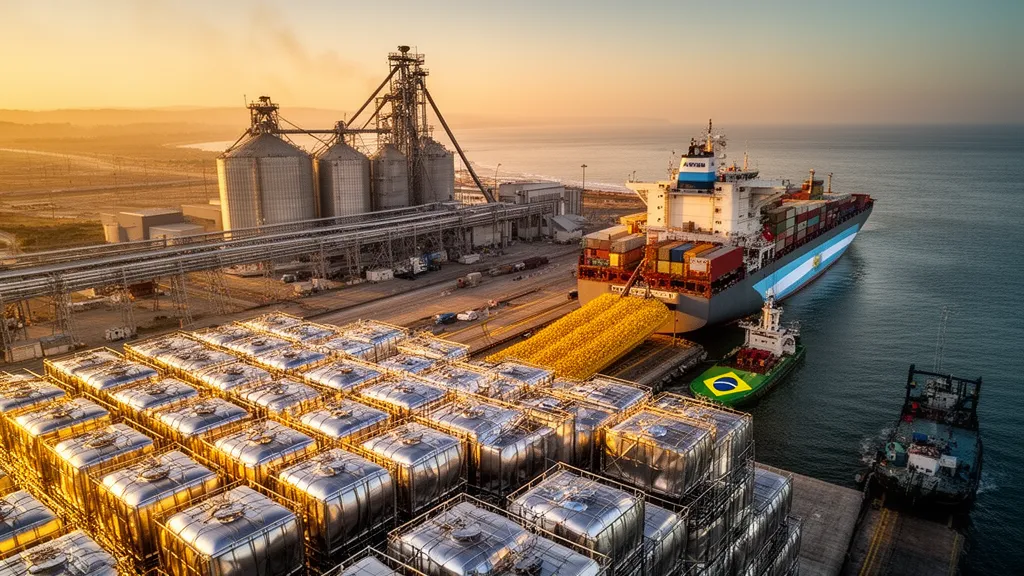
- Global exports down 13%: Soybean oil shipments from five major exporters totaled 5.55 mln tons in Oct–Apr 2025/26, 13% below last year, driven largely by a sharp drop in US volumes.
- US supply disruption: US April exports collapsed to 20,000 tons from 159,000 tons a year earlier, pulling overall global trade lower despite robust Argentine and Brazilian shipments.
- Brazil and Argentina offset some losses: Argentina held dominant market share with 610,000 tons shipped in April and 3.61 mln tons year-to-date, while Brazil more than doubled its April exports versus last year.
- India demand softens: India remained the top buyer at 2.76 mln tons in Oct–Apr, but imports were still 10% below the prior year, signaling weaker core demand.
- Black Sea outlook: neutral to slightly bearish: Ukraine’s volumes remain below last year and face pressure from South American competition, although potential tightening in global vegoil supplies could give some price support.
Global Soybean Oil Export Performance – April 2025
| Exporter | April 2025 Exports (000 tons) | April 2024 Exports (000 tons) |
|---|---|---|
| Argentina | 610 | 609 |
| Brazil | 208 | 99 |
| United States | 20 | 159 |
| Ukraine | 47 | 24 |
| Paraguay | 63 | – |
| Total (5 exporters) | 947 | 972 |
Cumulative Exports – Marketing Year to Date (Oct 2025–Apr 2026)
| Exporter | 2025/26 Exports (mln tons) | 2024/25 Exports (mln tons) |
|---|---|---|
| Argentina | 3.61 | 4.12 |
| Brazil | 0.92 | – |
| Paraguay | 0.33 | – |
| Ukraine | 0.30 | 0.33 |
| United States | 0.39 | 0.86 |
| Total (5 exporters) | 5.55 | 6.38 |
Demand Landscape
On the demand side, India remained the dominant buyer of soybean oil from the five major exporters, taking 2.76 mln tons in Oct–Apr, around 10% less than in the same period last year. At the same time, imports from North Africa, the European Union, and selected Central and South American countries increased, partially offsetting weaker Indian purchases. Argentina also expanded into the Canadian market, likely supplying soybean oil for biodiesel feedstock rather than traditional food-use channels.
Market Update and Outlook
Oil World data show that global soybean oil trade slowed in April 2025 as total exports from Argentina, Brazil, the US, Ukraine, and Paraguay fell to 947,000 tons from 972,000 tons a year earlier. The most pronounced change came from the United States, where exports dropped to just 20,000 tons versus 159,000 tons last April, reflecting supply disruptions and tighter domestic availability.
Argentina maintained broadly stable April shipments at 610,000 tons, consolidating its position as the key global supplier with around 65% of the five-country total. Brazil significantly exceeded expectations with 208,000 tons shipped compared with only 99,000 tons a year before, highlighting strong export competitiveness and ample crush-driven supplies.
For the marketing year to date, combined exports from the five countries reached just 5.55 mln tons, 13% below last year’s level. Argentina’s volumes declined from 4.12 mln to 3.61 mln tons, while US exports more than halved from 0.86 mln to 0.39 mln tons. Brazil, Paraguay, and Ukraine together partly compensated for these losses but were unable to restore total shipments to prior-year levels.
Analysts expect global soybean oil exports from these suppliers to stay below last year through at least September 2026, even if Argentine crushing and export programs seasonally recover. Underlying tightness in global vegetable oil balances should lend some support to international prices but will be moderated by demand rationing and substitution across different vegoils.
Black Sea Market Impact: Neutral to Slightly Bearish
Ukraine’s soybean oil exports reached 47,000 tons in April, almost double March levels but still modest relative to global flows. Cumulative exports of 300,000 tons in Oct–Apr, compared with 330,000 tons last year, underline the ongoing competitive pressure from South American origins, especially Argentina and Brazil.
Potential tightening in global vegetable oil supplies into September 2026 could provide some upside for Black Sea prices, but Argentina’s dominant share and Brazil’s strong performance cap the scope for a sustained rally. At the same time, evolving trade flows toward biodiesel feedstock markets, such as Canada, may create new outlets for Ukrainian soybean oil beyond traditional food-use destinations in Asia and the Middle East.
Source: Market Data
Leave a Reply