
- Cost Advantage: Proposed Turkmenistan freight route could cut transit costs by $8/ton versus the current Uzbekistan corridor.
- Scale Potential: New logistics complex at Bolashak station is designed to handle 1–2 million tons of grain and flour annually.
- Savings Impact: Projected annual savings of $8–16 million for Kazakh exporters if targeted volumes are realized.
- Route Diversification: Kazakhstan–Turkmenistan–Afghanistan/Iran corridor would reduce reliance on existing Central Asian transit routes.
- Market Signal: Neutral to moderately bullish for Kazakhstan grain flows, contingent on infrastructure build‑out and policy support.
Kazakhstan Transit Cost Comparison
| Route | Estimated Transit Cost (USD/ton) |
Per-Ton Savings vs. Uzbekistan | Potential Annual Volume | Estimated Annual Savings |
|---|---|---|---|---|
| Uzbekistan Corridor | $55 | $0 | 1–2 million tons | Baseline (no savings) |
| Turkmenistan Corridor | $47 | $8 | 1–2 million tons | $8–16 million |
Market Update
The Union of Grain Processors of Kazakhstan has proposed developing an alternative freight corridor through Turkmenistan for grain and flour exports, targeting annual logistics savings of $8–16 million. The plan, submitted to government agencies and highlighted by the Association of Kazakhstan Freight Rail Carriers, aims to address cost and efficiency constraints in current Central Asian export routes.
At present, most Kazakh grain and flour bound for Afghanistan moves via Uzbekistan at an estimated $55 per ton. The proposed Turkmenistan route offers a freight rate of about $47 per ton, delivering an $8 per ton reduction. Applied to projected flows of 1–2 million tons annually, this gap equates to potential savings in the range of $8–16 million per year.
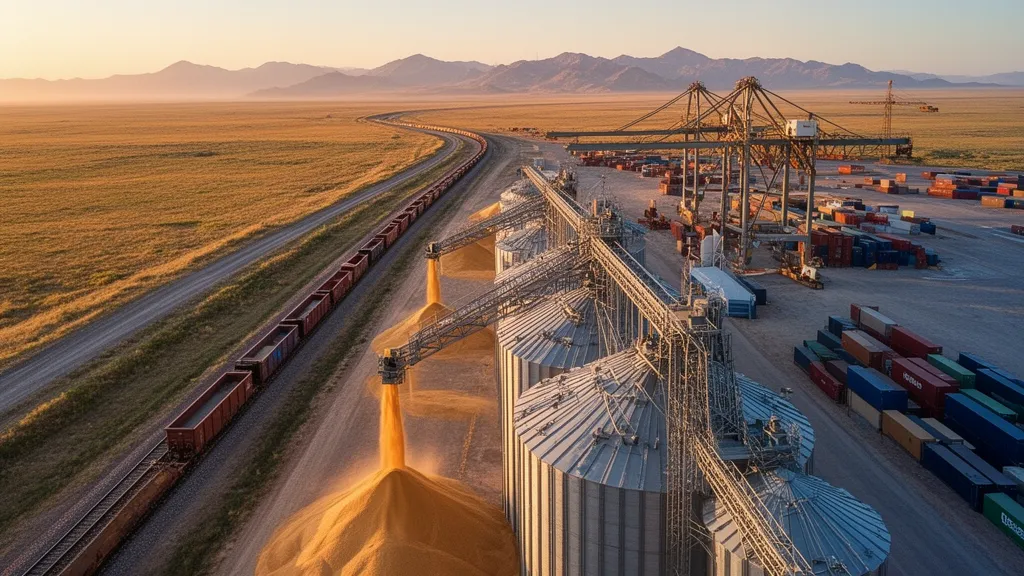
The Union identifies infrastructure bottlenecks at Bolashak station as the main factor limiting use of the Turkmenistan corridor. The proposal therefore centers on a multifunctional logistics transshipment complex, including facilities for handling flour and processed products, bulk grain infrastructure, container yards, temporary storage warehouses, and integrated customs and digital systems.
Strategically, the initiative would help establish a Kazakhstan–Turkmenistan–Afghanistan and Iran corridor, reducing dependence on existing routes and expanding market access for Kazakh grain exporters into southern destinations.
Analysis
Neutral to moderately bullish for Kazakhstan grain flows. The proposal signals meaningful potential to optimize freight costs for Central Asian grain exports, though timing remains uncertain and contingent on infrastructure investments at Bolashak and supportive regulatory decisions.
If implemented, lower logistics costs could enhance the price competitiveness of Kazakh flour and grain in Afghan and Iranian markets, supporting higher export volumes and improved margins for exporters. At the same time, the plan underscores persistent structural challenges in Central Asian freight infrastructure, which continue to cap regional trade efficiency.
Traders and logistics stakeholders should monitor the government’s response, financing decisions, and the construction timeline for the proposed logistics complex. Realization of the indicated $8/ton cost advantage would be a material positive for Kazakhstan’s export economics into southern corridors.
Source: Market Data
Leave a Reply