
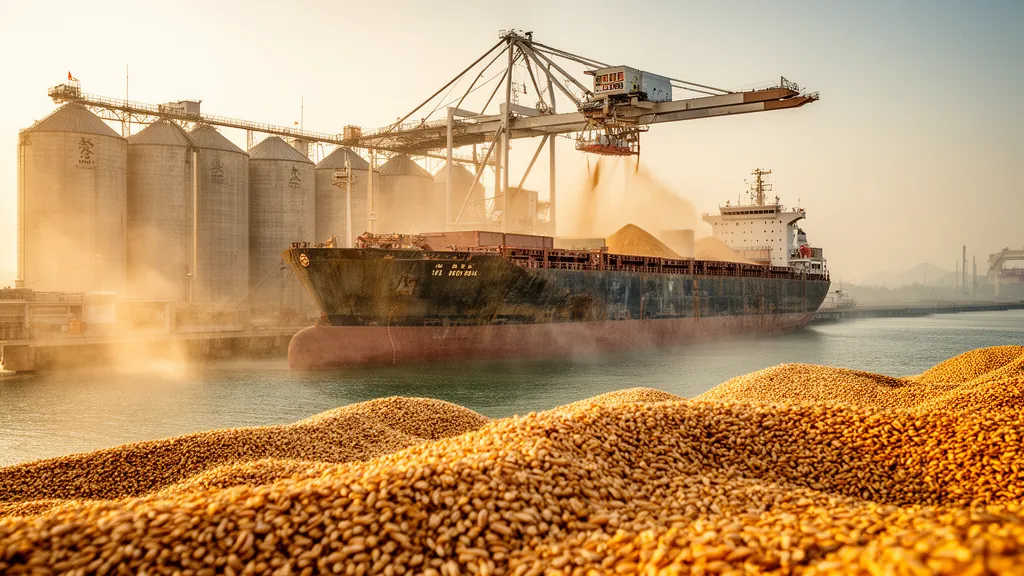
- South Korea secures 130,000 tons of feed wheat via private deals with Cofco, bypassing traditional tender procedures.
- Price signals around $290/ton C&F set a reference level for Asian feed wheat values with September delivery.
- Russian wheat explicitly excluded alongside China, Pakistan, Argentina, and Denmark, underscoring ongoing access challenges for Black Sea exporters.
- Neutral-to-bearish implications for Black Sea origins as demand is met through alternative suppliers under restricted origin terms.
South Korea Feed Wheat Deals Overview
Two South Korean feed buyers, Major Feedmill Group (MFG) and Feed Leaders Committee (FLC), finalized private purchase agreements totaling about 130,000 tons of feed wheat with Chinese grain operator Cofco. The volume will be shipped in two consignments of roughly 55,000–65,000 tons each, with both cargoes scheduled to arrive in South Korea during September.
Price and Delivery Details
| Buyer | Volume (tons) | Base Price (C&F) | Port Unloading | Total C&F + Unloading | Arrival Window |
|---|---|---|---|---|---|
| MFG | 55,000–65,000 | $289.75/ton | $1.75/ton | $291.50/ton | By 10 September |
| FLC | 55,000–65,000 | $290.99/ton | $1.75/ton | $292.74/ton | By 20 September |
| Total | ~130,000 | ~$290/ton (C&F benchmark) | $1.75/ton | ~$292/ton | September 2024 |
The agreed prices around $290 per ton C&F, plus $1.75 per ton for port unloading, highlight current valuation levels for imported feed wheat into South Korea for September positions. These private deals effectively set a short-term benchmark for Asian feed wheat trades.
Origin Restrictions and Market Impact
Contract terms allow wheat from any origin except China, Pakistan, Argentina, Denmark, and the Russian Federation. The explicit exclusion of Russian wheat underscores ongoing commercial and logistical challenges for Black Sea exporters targeting Asian feed buyers. While the transactions confirm firm demand in Asia, the origin constraints and use of private negotiations limit participation from some of the region’s traditionally competitive suppliers, creating a neutral-to-bearish backdrop for Black Sea price competitiveness in this demand segment.
Source: Market Data
Leave a Reply