
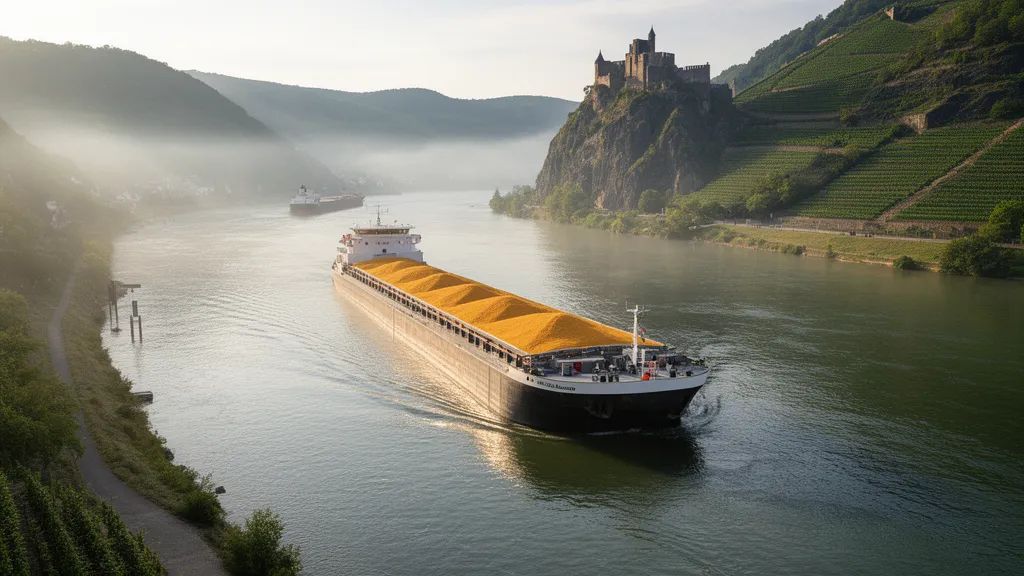
- Recent rainfall has restored navigable water levels on the Rhine, allowing ships to operate at or near full capacity along most of the route.
- April low water forced reduced cargo loads and split shipments, sharply increasing freight costs for cargo owners.
- Normal loading capacity has returned at key bottleneck Kaub, with the remaining Cologne section expected to normalize by the weekend.
- Logistics normalization slightly improves competitiveness of European grain versus Black Sea origins in Rhine-accessible markets.
- Overall impact on Black Sea export demand is limited, as Rhine traffic mainly supports intra-European distribution.
Rhine River Freight Operations Back to Normal
Freight transport on Germany’s Rhine River has largely returned to normal after rainfall raised water levels, easing the shallow conditions that disrupted operations in April. The Rhine is a key artery for moving grain and agricultural commodities within Europe, and the earlier low-water levels had prevented vessels from sailing fully laden, constraining capacity and slowing flows.
During the disruption, ship operators introduced additional surcharges to offset reduced cargo volumes per voyage. Cargo owners were forced to split shipments across multiple vessels to move the same tonnage, driving up overall logistics costs and complicating scheduling along the corridor.
As of May 15, trader reports indicate that normal loading capacity has been restored along nearly the entire Rhine. The historically shallow Kaub section, a critical bottleneck, is now navigable for fully loaded vessels. Only the Cologne area remains constrained, with water levels there expected to normalize by the upcoming weekend, which should restore full capacity across the entire waterway.
Market Impact and Regional Competitiveness
The normalization of Rhine freight is neutral to slightly positive for the broader European grain market and indirectly relevant for the Black Sea region. Lower inland freight costs reduce the total delivered price for grain and other commodities into Rhine-connected demand centers, supporting regional European origins in tenders and spot demand.
During the April low-water period, elevated Rhine logistics costs temporarily improved the relative appeal of seaborne supplies, including some Black Sea origins, for certain buyers. With surcharges removed and full vessel loading restored, that short-lived logistics advantage fades. Nonetheless, the structural role of the Rhine remains focused on intra-European distribution rather than directly competing with deep-sea Black Sea export routes, limiting any significant shift in overall Black Sea export demand.
Looking ahead, freight normalization should help stabilize basis levels and improve execution reliability for European shippers, but is unlikely on its own to materially alter global grain trade flows or pricing trends out of the Black Sea.
Source: Market Data
Leave a Reply