
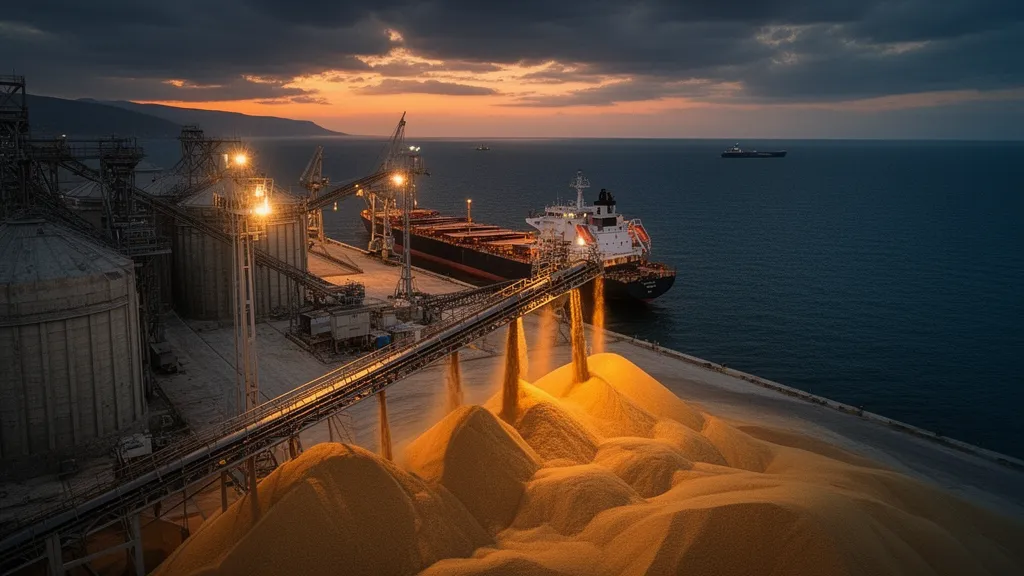
- Bearish: Russian grain exports fell 33% year-on-year in early January, with wheat, corn, and barley volumes all sharply lower.
- Bearish: Number of exporting companies dropped to a five-year low and active ports were nearly halved, exposing severe logistical and financial constraints.
- Neutral to Bearish: Russian wheat maintains a modest price discount to French and U.S. origins, but medium-term export growth is capped by river depth and fleet shortages on key routes.
- Bearish for Black Sea, Supportive for Rivals: Concentration of export destinations and port activity raises execution risk and may shift incremental demand toward competing suppliers.
Russian Grain Export Performance (Jan 1–20)
Russian grain exports totaled 1,307,000 tons from January 1–20, a 33% decline from 1,965,000 tons in the same period a year earlier, according to Russian Grain Union data. Wheat exports reached 1,159,000 tons, down 21.1% year-on-year. Corn volumes dropped to 101,000 tons, a 58.4% decrease, while barley shipments fell to 48,400 tons, down 5.3 times versus last season.
| Commodity | Period | Volume (tons) | YoY Change |
|---|---|---|---|
| Grain (total) | Jan 1–20 | 1,307,000 | -33.0% |
| Wheat | Jan 1–20 | 1,159,000 | -21.1% |
| Corn | Jan 1–20 | 101,000 | -58.4% |
| Barley | Jan 1–20 | 48,400 | 5.3x lower |
Export Destinations and Market Geography
Export geography contracted materially, with Russian wheat shipped to only 12 countries versus 28 at the same time last season. Egypt remained the largest buyer at 328,000 tons (-8.6% year-on-year), followed by Turkey at 204,000 tons (up 5.8-fold) and Sudan at 125,000 tons as a new destination. Additional new markets included Morocco and Angola, each taking 30,000 tons of wheat.
| Destination | Commodity | Volume (tons) | YoY Change / Status |
|---|---|---|---|
| Egypt | Wheat | 328,000 | -8.6% |
| Turkey | Wheat | 204,000 | Up 5.8x |
| Sudan | Wheat | 125,000 | New market |
| Morocco | Wheat | 30,000 | New market |
| Angola | Wheat | 30,000 | New market |
| Various (12 countries total) | Wheat | — | Down from 28 countries last season |
Port Activity and Logistics
Port performance diverged sharply across regions. Novorossiysk increased throughput to 763,700 tons (+22.6%), consolidating its role as the primary outlet. In contrast, volumes at Rostov-on-Don fell 60% to 115,000 tons, Astrakhan halved to 81,700 tons, and roadstead transshipment collapsed 7.5 times to 81,500 tons. The number of active exporting companies dropped to 16, a five-year low, while active ports shrank from 23 to 12, underscoring mounting logistical and financial stress in the export chain.
| Port / Channel | Volume (tons) | YoY Change |
|---|---|---|
| Novorossiysk | 763,700 | +22.6% |
| Rostov-on-Don | 115,000 | -60.0% |
| Astrakhan | 81,700 | -50.0% |
| Roadstead transshipment | 81,500 | Down 7.5x |
| Baltic Sea ports (Leningrad Region) | 108,000 | Higher by end-2025 (primarily wheat) |
Price Levels and Competitiveness
Russian wheat remains price-competitive versus other major origins. Grade 4 wheat traded at $227.5/ton FOB Novorossiysk, preserving a $4.5/ton discount to French wheat at $232/ton and roughly in line with U.S. wheat at $227/ton. Producer prices stood at 13,360 rubles/ton, equivalent to $171.7/ton. Despite lower volumes, this pricing structure supports Russia’s value proposition in key importing markets.
| Origin / Product | Price | Basis |
|---|---|---|
| Russian wheat (Grade 4) | $227.5/ton | FOB Novorossiysk |
| French wheat | $232/ton | FOB |
| U.S. wheat | $227/ton | FOB |
| Russian producer price | 13,360 RUB/ton (≈$171.7/ton) | Ex-producer |
Infrastructure and River Logistics Constraints
Rosselkhozbank highlighted the Volga River corridor as a critical bottleneck for moving surplus grain. The Astrakhan–Caspian route alone is estimated to require 80–140 bulk carriers, while up to 700 vessels could be needed for Yeysk–Azov operations. Current infrastructure suffers from insufficient river depth and a shortage of suitable fleet capacity, limiting Russia’s ability to divert flows away from congested or constrained Black Sea channels.
| Route | Estimated Vessel Requirement | Key Constraint |
|---|---|---|
| Astrakhan–Caspian | 80–140 bulk carriers | River depth, fleet shortage |
| Yeysk–Azov | Up to 700 vessels | Fleet availability, infrastructure |
Position in Asian Flour Markets
In flour exports to China, Russia retained second place by revenue, generating $20.3 million, down from $29.9 million in 2024. Japan led with $43.2 million, and France ranked third with $12.8 million. While Russia’s volumes into China softened, its position in the hierarchy of suppliers remains structurally important.
| Supplier to China (Flour) | Revenue | Status |
|---|---|---|
| Japan | $43.2 million | 1st |
| Russia | $20.3 million | 2nd (down from $29.9m in 2024) |
| France | $12.8 million | 3rd |
Market Outlook and Sentiment
The sharp reduction in exporting companies, active ports, and early-January volumes signals a bearish backdrop for Russian Black Sea exports in the near term. Concentrated export geography heightens execution and policy risk, even as Russia maintains a modest price discount versus European and U.S. origins. Planned development of the Volga and alternative routes is aimed at easing constraints, but the scale of fleet requirements suggests only gradual relief, capping Russia’s export growth potential and supporting relative demand for competing suppliers.
Source: Market Data
Leave a Reply