
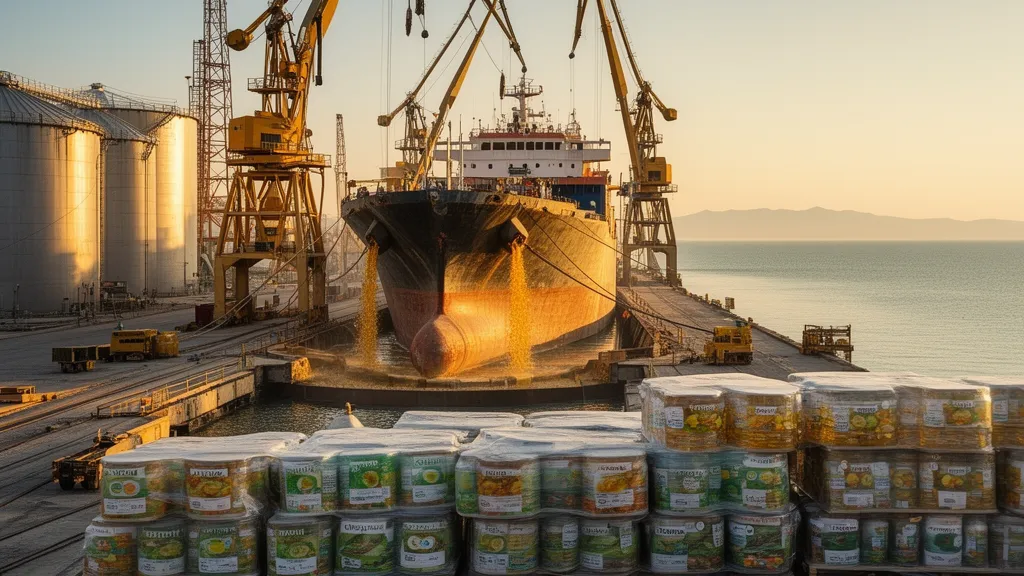
- New Caspian route: Kazakhstan has opened a regular export corridor for vegetable oils to Iran via Aktau, with initial rapeseed and sunflower oil cargoes of 5,000 tons each.
- Capacity potential: Aktau port can support 150,000–200,000 tons of vegetable oil shipments per year, providing a scalable outlet for Kazakh exports.
- Strong Iranian demand: Iran imports about 1.5 million tons of vegetable oils annually within total oil and meal imports of 3.5 million tons, creating room for Kazakh volumes.
- Policy support: Preferential customs treatment under the EEU–Iran free trade agreement underpins the corridor’s competitiveness.
- Freight impact: The shift is neutral to moderately bullish for Black Sea freight, easing some pressure on traditional routes without materially disrupting the broader market.
Kazakhstan’s New Caspian Export Corridor
Kazakhstan has established the Caspian Sea as a viable export route for vegetable oils to Iran, with two successful shipments from the port of Aktau. The first vessel carrying 5,000 tons of rapeseed oil completed loading on April 4 in about 2.5 days, purchased by Iranian buyer Kourosh Food Industry from a major Kazakh oil mill. A second vessel with 5,000 tons of sunflower oil departed on May 13, confirming repeat demand for the route.
The port of Aktau can handle three to four vessels per month, translating into an annual export capacity of roughly 150,000–200,000 tons of vegetable oil. Over the last three years Kazakhstan shipped more than 100,000 tons of oil and fat products to Iran, but 94% of that volume was meal rather than refined oils, indicating significant scope to increase higher-value oil exports.
Iranian Demand and Trade Framework
According to NAPMC Chairman Yadykar Ibragimov, Iran’s combined imports of vegetable oils and meal reach around 3.5 million tons annually, including approximately 1.5 million tons of vegetable oils. The trade is supported by preferential customs treatment under the Eurasian Economic Union–Iran free trade agreement, which enhances the competitiveness of Kazakh-origin supplies relative to other exporters.
Looking ahead, Kazakh exports of vegetable oil and meal to Iran could exceed 500,000 tons per year. This would materially advance the sector’s objective of generating more than USD 1 billion in foreign exchange earnings by 2026–2028, as higher volumes of value-added products move through the Caspian corridor.
Freight Market Implications
The opening of the Caspian route is neutral to moderately bullish for Black Sea freight markets. By diverting part of Kazakhstan’s vegetable oil flows away from traditional Black Sea outlets, the new corridor modestly reduces competition for vessel capacity on established routes. However, projected volumes of 150,000–200,000 tons per year remain small relative to total Black Sea vegetable oil trade, so the impact is incremental rather than transformative.
Logistics and chartering teams should track whether the corridor’s early success encourages other Central Asian exporters to develop similar Caspian-based options. A broader shift of regional flows could tighten Black Sea vessel supply over the medium term, with corresponding effects on freight demand and rate dynamics.
| Flow / Capacity | Volume (tons) | Notes |
|---|---|---|
| First rapeseed oil cargo (Aktau–Iran) | 5,000 | Loaded April 4 (≈2.5 days), sold to Kourosh Food Industry |
| Second sunflower oil cargo (Aktau–Iran) | 5,000 | Loaded May 13, confirms repeat importer demand |
| Aktau port annual vegetable oil capacity | 150,000–200,000 | Based on 3–4 vessels per month |
| Kazakh oil & fat exports to Iran (last 3 years) | >100,000 | 94% was meal, 6% oil |
| Iran annual vegetable oil & meal imports | ≈3,500,000 | Includes ≈1,500,000 tons of vegetable oils |
| Potential Kazakh oil & meal exports to Iran | >500,000 | Target volume in coming years |
Source: Market Data
Leave a Reply