
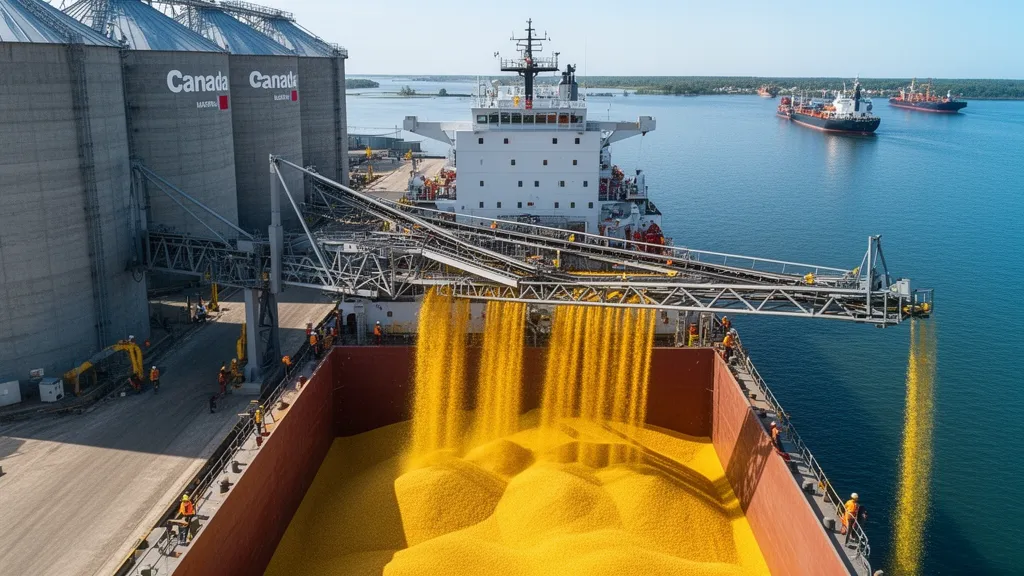
- Canadian exports surge: Canola shipments reached 1 million tonnes in March 2025, with Q1 2025 exports up 10% year-on-year at 2.6 million tonnes.
- China demand recovers: March exports to China hit 369,000 tonnes, an 11‑month high, following reduced import duties under a new bilateral trade agreement.
- EU inflows still elevated: Pre‑normalization price discounts drove record Canadian canola shipments to the EU of 660,000 tonnes in January‑March (+40% y‑o‑y).
- Trade flows reshaped: Normalized Canada‑China trade redirects supply away from Europe and Asia, altering global oilseed and rapeseed competitiveness.
- Logistics risk in Middle East: The Strait of Hormuz blockade disrupts UAE import, processing, and re‑export of rapeseed oil and meal, adding regional uncertainty.
Canadian Canola Export Performance
Canadian canola exports have accelerated sharply in early 2025 on the back of improved market access to China and competitive pricing strategies in other destinations. March 2025 shipments totaled 1 million tonnes, the strongest monthly performance in 17 months, according to Oil World. This pushed cumulative January‑March 2025 exports to 2.6 million tonnes, a 10% increase versus the same period in 2024.
Early indications suggest export momentum has carried into April, with volumes estimated between 900,000 and 1 million tonnes. Substantial tonnage continues to flow to China, underlining the rapid normalization and expansion of this trade corridor.
| Period / Destination | Metric | Volume (tonnes) | Change vs. prior year |
|---|---|---|---|
| March 2025 – Total Canadian canola exports | Monthly shipments | 1,000,000 | Highest in 17 months |
| Q1 2025 – Total Canadian canola exports | Cumulative shipments (Jan–Mar) | 2,600,000 | +10% y‑o‑y |
| March 2025 – Exports to China | Monthly shipments | 369,000 | 11‑month high |
| Jan–Mar (pre‑trade normalization) | Exports to EU | 660,000 | +40% y‑o‑y |
| April 2025 – Total Canadian exports (est.) | Monthly shipments | 900,000–1,000,000 | Preliminary range |
China, EU and Alternative Market Dynamics
The reduction in Chinese import duties on Canadian canola in early March 2025 has rapidly restored China as a key outlet for Canadian seed. The March export volume of 369,000 tonnes to China marks the highest level in 11 months, signaling a strong recovery in bilateral trade and shifting the competitive landscape for other suppliers.
Before trade normalization, Canadian exporters relied on price discounts to stimulate demand in other regions. This strategy led to record shipments to the European Union, reaching 660,000 tonnes in January‑March and posting a 40% year‑on‑year increase. Canada also recorded significant export growth to Japan, Pakistan, and the UAE, leveraging its competitive pricing to capture market share while access to China was constrained.
Logistics and Middle Eastern Trade Disruptions
Despite earlier gains, trade flows into the Middle East now face headwinds. The blockade of the Strait of Hormuz is disrupting the UAE’s role as an import, processing, and re‑export hub for rapeseed oil and meal. These logistical constraints are likely to reduce near‑term Canadian and other origin inflows to the UAE and may reconfigure regional trade routes as buyers seek alternative supply chains and origins with more secure freight passages.
Implications for Black Sea Rapeseed
The re‑opening of the Canada‑China corridor is neutral to bearish for Black Sea rapeseed. As more Canadian canola is absorbed by Chinese demand, Canadian presence in alternative markets such as the EU could moderate from the record levels seen during the dispute period. This may temporarily ease direct competitive pressure on Black Sea exporters in Europe.
However, Canadian canola remains a potent competitor in European crush markets, particularly if freight and pricing conditions are favorable. At the same time, uncertainty around grain and oilseed movements through the Strait of Hormuz may bolster the relative attractiveness of Black Sea origins for some Middle Eastern and nearby buyers, supporting alternative export channels and partially offsetting the increased competition from Canada in Europe.
Source: Market Data
Leave a Reply