- Record Output: Global rapeseed and canola meal production is projected at an all-time high of 47.3 million tonnes in 2025/26, up 1.8 million tonnes year-on-year and well above the 5-year average.
- EU Demand Strength: EU-27 rapeseed meal consumption climbs to 7.8 million tonnes in Oct–Mar 2025/26 (+0.9 million tonnes YoY), underpinned by stronger domestic supply and increased imports from Canada.
- Feed Substitution: In Germany, rapeseed meal use in compound feed rises 13% to 1.24 million tonnes, displacing soybean meal whose share falls by 3%.
- Price Implications: Overall impact is neutral to slightly bearish for Black Sea rapeseeds as EU demand is largely satisfied by EU and Canadian supply, though robust feed demand supports broader rapeseed values.
Global Rapeseed Meal Market Update
Global rapeseed and canola meal production in the 2025/26 season is forecast at an unprecedented 47.3 million tonnes, up 1.8 million tonnes from the prior year and substantially above the 5-year average of 42 million tonnes. This expansion reflects strong crushing activity and favorable availability of rapeseed across key producing regions.
Consumption is also trending higher. Global rapeseed meal use is estimated to expand by 0.6–0.7 million tonnes in October–December 2025, with first-quarter 2026 consumption projected to be roughly 0.2 million tonnes above the same period in 2025. Cumulatively, the first six months of the 2025/26 season are expected to reach a record 23.5 million tonnes versus 22.7 million tonnes a year earlier.
Regional Demand and Trade Flows
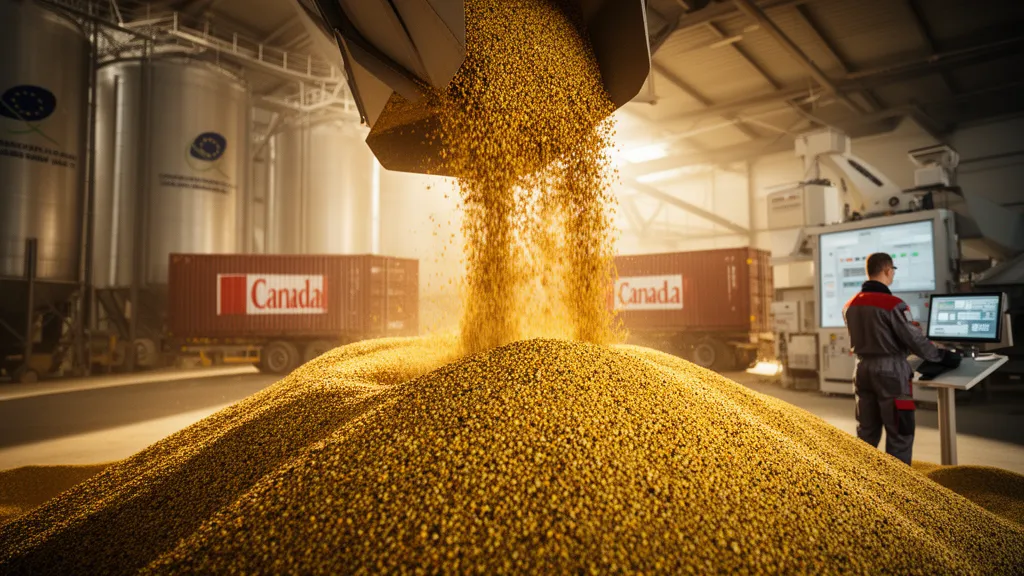
The EU-27 remains the main driver of demand growth. Rapeseed meal consumption in the bloc reached 7.8 million tonnes in October–March 2025/26, an annual gain of 0.9 million tonnes. This increase has been supported by stronger domestic production and sizeable import flows, particularly from Canada, reinforcing the EU–Canada supply corridor.
Germany illustrates the ongoing substitution trend in compound feed. Rapeseed meal usage in German feed formulations rose 13% to 1.24 million tonnes, while soybean meal’s share declined by 3%. This shift reflects both competitive pricing and nutrition-driven formulation changes favoring locally available rapeseed meal over imported soymeal.
Supply–Demand Balance Indicators
| Indicator | 2024/25 | 2025/26 | Change |
|---|---|---|---|
| Global rapeseed & canola meal production (million tonnes) | 45.5 | 47.3 | +1.8 |
| Global 5-year average production (million tonnes) | 42.0 | 2025/26 is +5.3 vs avg | |
| Global meal consumption, Oct–Mar (million tonnes) | 22.7 | 23.5 | +0.8 |
| EU-27 meal consumption, Oct–Mar (million tonnes) | 6.9 | 7.8 | +0.9 |
| Germany rapeseed meal use in compound feed (million tonnes) | 1.10 | 1.24 | +13% |
Price Sentiment and Outlook
The current balance is neutral to slightly bearish for Black Sea rapeseeds. While record meal output underscores robust crushing demand globally, incremental EU demand is being met mainly through domestic EU production and Canadian imports. This limits the scope for Black Sea origins to secure premium rapeseed meal business into Europe.
Nonetheless, the ongoing substitution of soybean meal with rapeseed meal in feed rations, particularly in Germany, provides structural support to rapeseed meal consumption. This trend, combined with record usage levels, should underpin overall rapeseed complex values even if regional spreads for Black Sea origins face headwinds.
Source: Market Data
Leave a Reply