
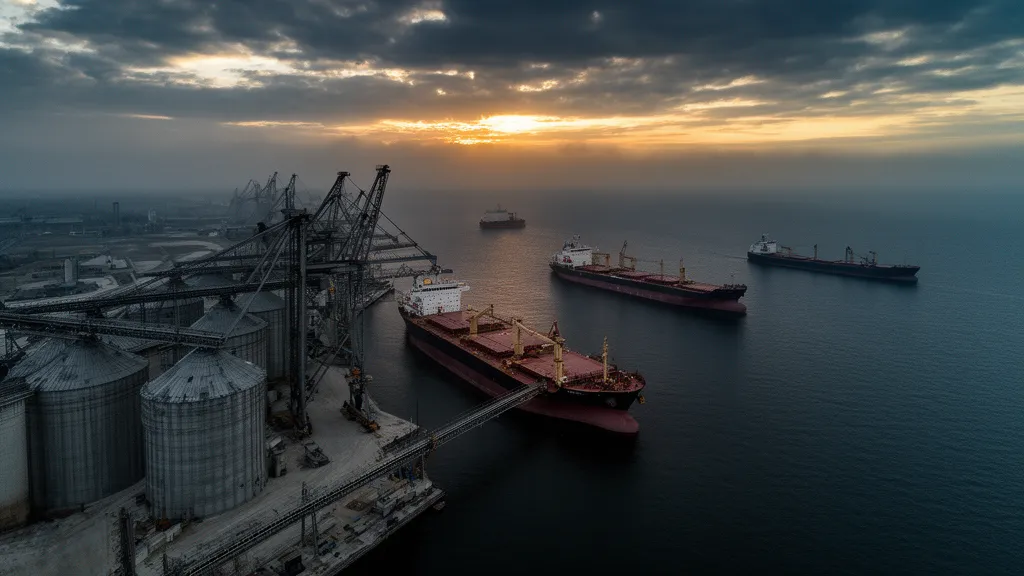
- Maritime dependence: Around 90% of Ukrainian exports rely on seaborne logistics, underscoring the critical role of secure port access.
- Security & economy link: NIBULON CEO Andriy Vadatursky framed maritime security as a core pillar of Ukraine’s economic resilience.
- Mykolaiv bottleneck: Unblocking the Mykolaiv port hub is viewed as essential to restoring freight flows and maintaining export capacity.
- Market tone: Ongoing Black Sea access constraints keep the near-term outlook neutral to bearish for freight operations and logistics costs.
Market Update
NIBULON CEO Andriy Vadatursky addressed maritime security challenges at the first meeting of the Strategic Advisory Group at the Security Architecture Forum, stressing that secure maritime corridors are foundational to Ukraine’s economic resilience. He noted that approximately 90% of Ukrainian exports depend on maritime logistics infrastructure, placing Black Sea port access at the center of the country’s economic stability.
The discussion framed control over maritime routes as both a defense imperative and a direct prerequisite for sustaining economic activity. Forum participants examined a broader security architecture that goes beyond military defense to cover the restoration of critical infrastructure, preservation of human capital, and maintenance of stable governance under wartime conditions.
NIBULON emphasized the strategic importance of unblocking the Mykolaiv port hub to secure continuous freight operations and protect export capacity. Restoring throughput at Mykolaiv is seen as a key step in alleviating pressure on other Black Sea ports and stabilizing Ukraine’s maritime export flows.
Analysis
Neutral to Bearish for near-term freight operations. The continued focus on unblocking Mykolaiv highlights persistent access constraints across Ukraine’s Black Sea port infrastructure. With roughly 90% of exports routed via maritime channels, any prolonged disruption at major hubs like Mykolaiv exacerbates bottlenecks, elevates freight costs, and complicates logistics planning.
For traders and logistics coordinators, this environment implies sustained reliance on alternative export corridors and potential premium pricing for limited shipping capacity from operational Ukrainian ports. Until concrete progress is made on reopening Mykolaiv and reinforcing maritime security, risk premia and planning uncertainty are likely to remain elevated.
Source: Market Data
Leave a Reply