
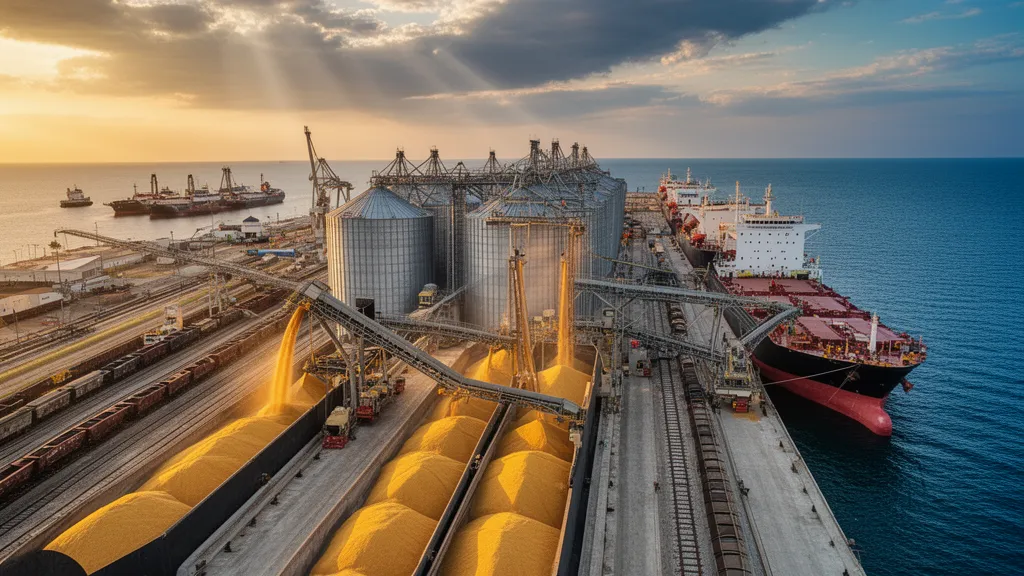
- Strong grain exports: Russian grain transshipment surged 39.4% year-on-year in Q1 2026 to 13.1 million tonnes, underscoring robust export demand and improved port efficiency.
- Mixed cargo performance: Mineral fertilizer volumes fell 3.8% and bulk food cargo dropped 4.1%, partially offsetting gains from grain within overall port activity.
- Muted overall growth: Total cargo turnover at Russian seaports edged up just 0.6% to 210.1 million tonnes, highlighting that grain strength is not yet broad-based across all segments.
- Logistics implications: Rising grain flows and weaker fertilizer traffic may shift port priorities toward grain, affecting vessel allocation, terminal congestion, and scheduling for other bulk cargos.
Market Update
Russian seaports saw a sharp rise in grain transshipment in Q1 2026, handling 13.1 million tonnes versus the same period in 2025, according to the Association of Sea Trade Ports of the Russian Federation. This corresponds to a 39.4% year-on-year increase in grain freight volumes.
The grain strength contrasted with softer performance in other cargo categories. Mineral fertilizer transshipment declined 3.8% to 11.6 million tonnes in January–March 2026, while bulk food cargo volumes fell 4.1% to 1.4 million tonnes over the same period.
Overall cargo turnover across all Russian seaports expanded only marginally, rising 0.6% year-on-year to 210.1 million tonnes in Q1 2026 compared with the first quarter of 2025.
Key Volume Metrics
| Cargo Segment | Q1 2026 Volume (million tonnes) | Y/Y Change (%) |
|---|---|---|
| Grain | 13.1 | +39.4% |
| Mineral Fertilizers | 11.6 | -3.8% |
| Bulk Food Cargo | 1.4 | -4.1% |
| Total Seaport Cargo Turnover | 210.1 | +0.6% |
Analysis
The near-40% jump in grain transshipment highlights robust Russian export activity and strong competitiveness in the Black Sea grain market at the start of 2026. This surge likely reflects ample harvest carryover, attractive pricing, and better utilization of port infrastructure, pointing to improved operational efficiency at key export terminals.
For traders and logistics coordinators, higher grain volumes imply sustained demand for freight capacity and the potential for tighter vessel availability at Russian ports during peak shipment windows. In contrast, declining fertilizer and bulk food cargo volumes may temporarily ease pressure on some terminals, prompting a reallocation of port resources and berthing priorities toward grain flows.
Overall cargo turnover is growing only modestly, indicating that strength remains concentrated in the grain segment. Market participants should factor in possible congestion around grain-loading facilities, while fertilizer and other bulk shippers may need to adjust scheduling and routing strategies to accommodate evolving port dynamics.
Source: Market Data
Leave a Reply