
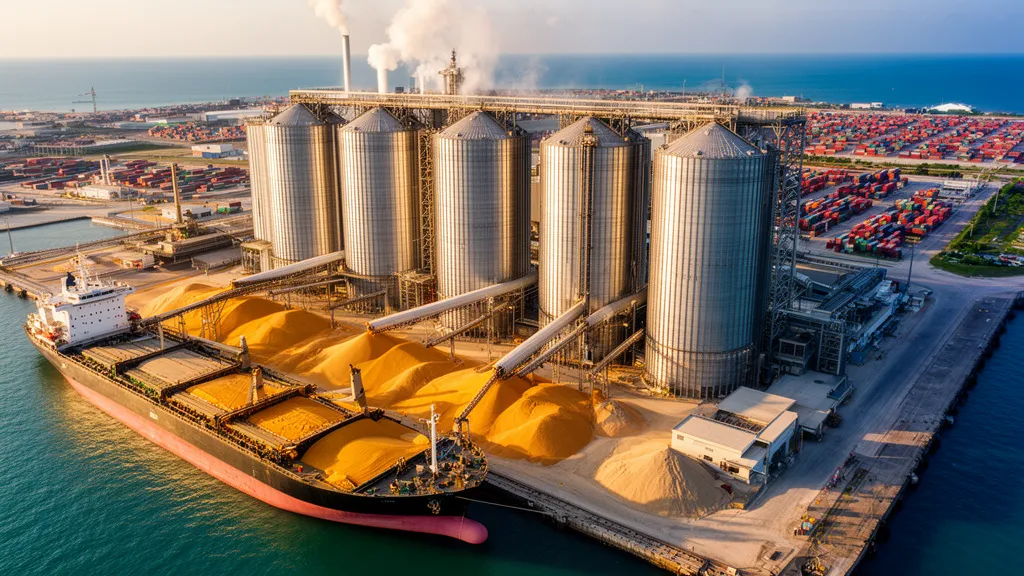
- Capacity boost: Vietnam Agribusiness has doubled its soybean processing capability to 7,800 tonnes per day with a $100 million second crushing line.
- Domestic coverage: The plant will supply around 2 million tonnes of soybean meal annually, covering roughly 30% of Vietnam’s feed protein demand.
- Trade flow impact: Expanded Vietnamese demand will likely favor South American soybeans, marginally pressuring Black Sea oilseed and meal exporters.
Vietnam Soybean Crushing Expansion
Vietnam Agribusiness (VAL), a joint venture between Bunge Global and Wilmar International, has commissioned its second soybean extraction line at the Phu My 1 Industrial Park. The $100 million project adds 4,000 tonnes per day of processing capacity to the existing line, which has been operational since 2011.
With the expansion, total crushing capacity now reaches 7,800 tonnes per day, equivalent to around 2.6 million tonnes of soybeans per year at full utilization. The upgraded complex is designed to produce nearly 2 million tonnes of soybean meal and more than 500,000 tonnes of crude soybean oil annually, serving both domestic users and export markets.
The facility includes eight storage silos with a combined capacity of 120,000 tonnes and integrates energy-efficient technologies such as waste heat recovery and closed-loop water circulation. According to VAL General Director Nguyen Minh Vi, the expansion is calibrated to support Vietnam’s livestock sector, which has grown by approximately 3–5% per year over the past two decades.
Key Operational Metrics
| Metric | Value |
|---|---|
| New crushing capacity (second line) | 4,000 tonnes/day |
| Total crushing capacity (plant) | 7,800 tonnes/day |
| Annual soybean processing (at full capacity) | 2.6 million tonnes/year |
| Annual soybean meal output | ~2.0 million tonnes/year |
| Annual crude soybean oil output | >500,000 tonnes/year |
| Storage capacity (silos) | 120,000 tonnes |
| Share of Vietnam’s feed protein demand covered | ~30% |
| Estimated project cost | $100 million |
Market Impact and Trade Flows
The commissioning of VAL’s second crushing line is neutral to slightly bearish for Black Sea soybean and competing oilseed suppliers. Vietnam’s expanded demand for soybean feedstock—around 2.6 million tonnes per year—will be met primarily from the Americas, reinforcing existing South American supply chains into Southeast Asia.
Stronger Vietnamese domestic production of soybean meal reduces the country’s reliance on imported protein meals and covers roughly 30% of internal feed protein needs. This shift may marginally constrain export opportunities for Black Sea sunflower meal and rapeseed meal into Vietnam, as local buyers pivot toward competitively priced, domestically crushed soybean meal.
At the regional level, the expansion underscores Southeast Asia’s structural dependence on South American soybeans. While overall global soybean demand is supported by this additional crush capacity, Black Sea-origin soybeans and alternative meals may face tighter margins and increased competition in the Vietnamese market.
Source: Market Data
Leave a Reply