
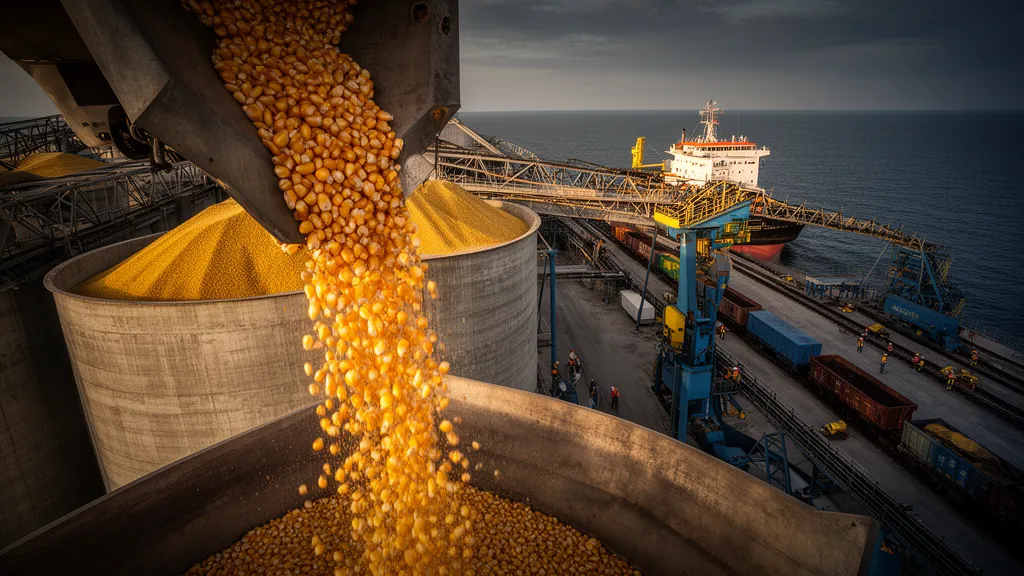
Ukrainian Corn Prices Drop as Holiday Demand Softens; China Signals Long-Term Market Shift
- Ukrainian corn down: Feed corn bids eased by UAH 100–300/t this week to UAH 8,100–9,600/t CPT amid weaker export demand and pre-holiday trader caution.
- China’s expansion: Beijing targets an extra 50 million tons of grain, mainly corn and soybeans, aiming to sharply cut soybean import dependence over the next decade.
- Logistics support floor: Domestic logistical constraints and limited Ukrainian supply are preventing a sharper correction in local prices.
- Long-term pressure risk: Successful Chinese self-sufficiency could weigh on global corn and soybean prices, intensifying competition for Black Sea exporters.
Market Update
Ukrainian feed corn prices continued to soften this week, with bids sliding to UAH 8,100–9,600/t CPT as of December 26. This represents a decline of UAH 100–300/t versus the previous week, driven largely by weaker export market interest and a typical slowdown in trader activity ahead of the New Year holidays. Despite these pressures, structural logistical challenges and constrained on-farm grain availability are limiting the downside, preventing a deeper price correction for now.
In the global context, China’s National Development and Reform Commission (NDRC) has announced an ambitious plan to lift grain output by around 50 million tons, with corn and soybeans at the core of the strategy. In 2025, China is set to produce roughly 301.2 million tons of corn versus only 23.9 million tons of soybeans, underscoring the current imbalance and heavy reliance on imported oilseeds.
The program is designed to narrow China’s soybean supply gap, with authorities targeting a reduction in soybean import dependence from about 90% to 30% over the next ten years. Alongside boosting corn and soybean output, the initiative includes the expansion of high-quality forage crops such as silage corn and alfalfa, underpinned by strict arable land protection and efficiency measures.
Price Snapshot: Ukrainian Feed Corn
| Commodity | Location / Basis | Price Range | Weekly Change | Date |
|---|---|---|---|---|
| Feed Corn | Ukraine, CPT | UAH 8,100–9,600/t | −UAH 100–300/t | 26 Dec |
Analysis
Short-term (Ukrainian Corn): The tone is neutral to slightly bearish. The recent UAH 100–300/t decline is broadly consistent with seasonal year-end patterns as exporters and domestic buyers reduce activity before the holidays. However, persistent logistical bottlenecks and a relatively tight physical supply are providing support, preventing a steeper sell-off. Market participants should closely watch post-holiday demand, any improvement or disruption in export corridor capacity, and freight dynamics, as these factors will likely determine whether prices stabilize or resume their downward trend into January.
Long-term (Global Corn & Soybeans): China’s drive to expand grain and oilseed self-sufficiency introduces a potentially bearish undertone for international exporters over the coming decade. If Beijing effectively scales up domestic corn and soybean production and cuts soybean import dependence from 90% to 30%, global exportable surpluses could increase, putting structural pressure on prices. For Black Sea corn exporters, reduced Chinese import demand would mean fiercer competition in alternative markets, particularly in Southeast Asia, the Middle East and North Africa. While the implementation horizon is long and gradual, producers in the Black Sea region may increasingly need to compete on price and reliability, diversify destination markets, and optimize logistics to maintain market share.
For soybean exporters in the Americas, China’s strategy poses a more direct risk, but any shift in Chinese corn import behavior will also reverberate across global feed grain flows. A more self-sufficient China could reroute trade patterns, potentially opening opportunities for Black Sea origins in non-Chinese destinations where competition from traditional suppliers may ease.
Source: Market Data
Leave a Reply