
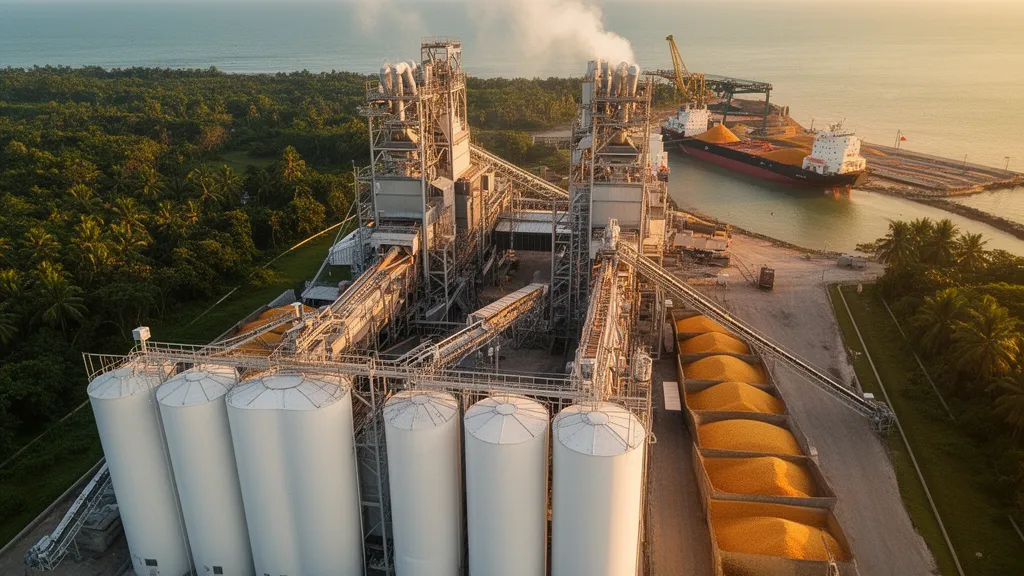
- VAL’s $100M second crushing line lifts total daily capacity to 7,800 tonnes, solidifying Vietnam’s role as a major regional soybean processor.
- Annual output of 2 million tonnes of soybean meal and 500,000 tonnes of crude oil will cover ~30% of Vietnam’s feed demand and curb dependence on imported meal.
- Market impact is neutral to bearish for Black Sea soybean meal exporters, but additional demand for 2.6 million tonnes of soybeans may support Black Sea origination if price-competitive.
Bunge-Wilmar JV Doubles Vietnam Soybean Crushing Capacity
Vietnam Agribusiness Ltd. (VAL), a joint venture between Bunge Global SA and Wilmar International Ltd., has commissioned a second soybean crushing line at the Phu My 1 Industrial Park. The new $100 million line adds 4,000 tonnes per day of crushing capacity, taking the complex’s total daily capacity to 7,800 tonnes, alongside eight storage silos totaling 120,000 tonnes.
The facility employs automated technologies from Desmet, Crown, and Bühler, covering the full value chain from cleaning and preparation through extraction. With both lines operating, VAL can process up to 2.6 million tonnes of soybeans annually, producing close to 2 million tonnes of soybean meal and more than 500,000 tonnes of crude soybean oil for domestic and export markets.
Production Capacity and Output
| Metric | Capacity / Output |
|---|---|
| Existing line (since 2011) | 3,800 tonnes/day (implied) |
| New line (2024 expansion) | 4,000 tonnes/day |
| Total daily crushing capacity | 7,800 tonnes/day |
| Annual soybean processing capacity | 2.6 million tonnes |
| Annual soybean meal output | ~2.0 million tonnes |
| Annual crude soybean oil output | >500,000 tonnes |
| Silo storage capacity | 120,000 tonnes |
| Share of Vietnam’s feed demand | ~30% (soybean meal coverage) |
| Project capex | $100 million |
The expanded complex is positioned to supply about 30% of Vietnam’s domestic animal feed demand via soybean meal, supporting a livestock sector that has grown 3–5% annually over the past two decades. Crude soybean oil output will target both local refiners and regional export buyers.
Market Impact: Neutral to Bearish for Black Sea Soybean Meal
For global trade flows, the increase in Vietnam’s crushing capacity is neutral to bearish for Black Sea soybean meal exporters. As VAL meets a larger share of domestic demand with locally crushed meal, import volumes of finished meal into Vietnam and potentially neighboring markets could decline, pressuring Black Sea and other external suppliers.
However, the facility’s 2.6 million tonnes per year raw soybean requirement introduces a sizeable, recurring demand center. Black Sea origin soybeans may capture a portion of this demand if they remain competitive against Brazilian and U.S. supplies on a freight-adjusted basis. Traders should closely track VAL’s procurement strategy and origin mix as the plant ramps toward full utilization through 2024–2025.
Source: Market Data
Leave a Reply