
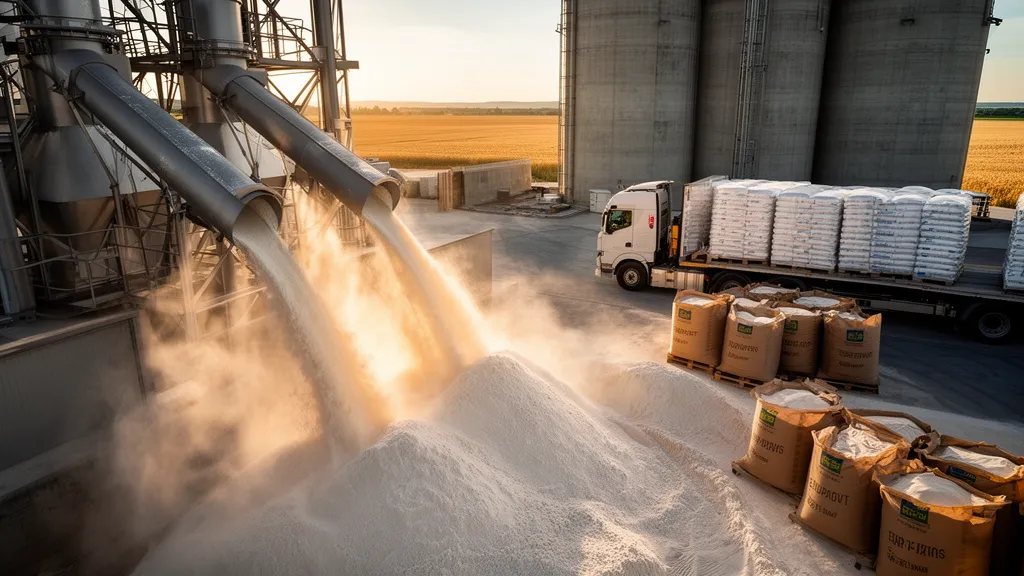
- Dedicated EU quota: Ukraine secures its first separate annual tariff quota of 30,000 tons for flour exports to the EU starting in 2025.
- High utilization likelihood: 2024 exports of ~26,000 tons to the EU suggest the 30,000-ton quota is likely to be fully used.
- Moderately bullish milling outlook: Regulatory certainty supports long-term planning and modestly increases domestic wheat processing demand.
- Future upside in 2028: Scheduled quota review may expand export opportunities for Ukrainian value-added grain products.
Ukraine Secures EU Flour Export Quota
Ukraine has secured its first separate annual tariff quota for flour exports to the European Union, allowing 30,000 tons to enter the bloc starting in 2025. The decision was announced by Rodion Rybchynsky, Director of the Boroshnomeli Union of Ukraine, during the XVII International Conference "Doing Agribusiness in Ukraine" on December 11.
This dedicated quota marks a shift from previous ad-hoc arrangements, providing greater regulatory clarity for exporters and enabling longer-term commercial planning in the Ukrainian milling sector.
Current Export Dynamics
Over the first eleven months of 2024, Ukrainian flour exports to the EU reached approximately 26,000 tons. Key destination markets include Germany, the Czech Republic, Spain, and Italy. Given that current volumes already approach the new quota, industry participants expect near-full utilization once the 30,000-ton limit takes effect in 2025.
| Metric | Value | Period |
|---|---|---|
| EU flour tariff quota for Ukraine | 30,000 tons | Annual, from 2025 |
| Ukraine flour exports to EU | ~26,000 tons | Jan–Nov 2024 |
| Estimated milling wheat needed | 40,000–42,000 tons | Annual, to supply quota |
| Scheduled quota review | Potential revision | 2028 |
Sector Impact and Outlook
The development is neutral to moderately bullish for Ukraine’s milling sector. The quota delivers regulatory certainty and stabilizes access to EU markets, supporting investment and long-term supply contracts. However, the 30,000-ton volume is only a modest expansion beyond existing trade flows, limiting immediate upside.
For grain traders, the quota implies incremental domestic demand for milling wheat in the range of 40,000–42,000 tons annually, which could marginally tighten Ukraine’s exportable wheat balance. The planned 2028 quota review is a key medium-term catalyst that may open larger EU market access for Ukrainian value-added grain products and reinforce the Black Sea region’s role in processed grain trade.
Source: Market Data
Leave a Reply