
- Bullish: Kazakhstan’s 2026–2028 roadmap targets over $1 billion in annual fat and oil exports, backed by infrastructure and processing investment, while Siberian oilseed shipments surge 43%.
- Bearish: Russia’s record 139 million ton grain harvest faces severe logistics bottlenecks and quality mismatches, limiting export potential and complicating Black Sea flows.
Kazakhstan Oilseed Export Roadmap
Kazakhstan has launched its 2026–2028 Roadmap for Fat and Oil Export Development, unveiled on December 11 in Astana. The plan aims to lift annual fat and oil export turnover above $1 billion by 2028, targeting bottlenecks in raw material availability, logistics infrastructure, and on-farm storage.
Backed by the International Trade Centre and EU funding through the Ready4Trade Central Asia project, the roadmap prioritizes raising the share of processed goods to 70% of total exports, accelerating cropland diversification into oilseeds, and expanding reception and storage capacity at producer level.
Kazakhstan is already among the top 10 global sunflower oil exporters and one of the top three suppliers of sunflower meal to the EU, shipping to more than 20 countries. Enhanced infrastructure, including Trans-Caspian routes, is set to strengthen its competitive positioning against traditional Black Sea origins.
Russia’s Record Harvest and Logistics Constraints
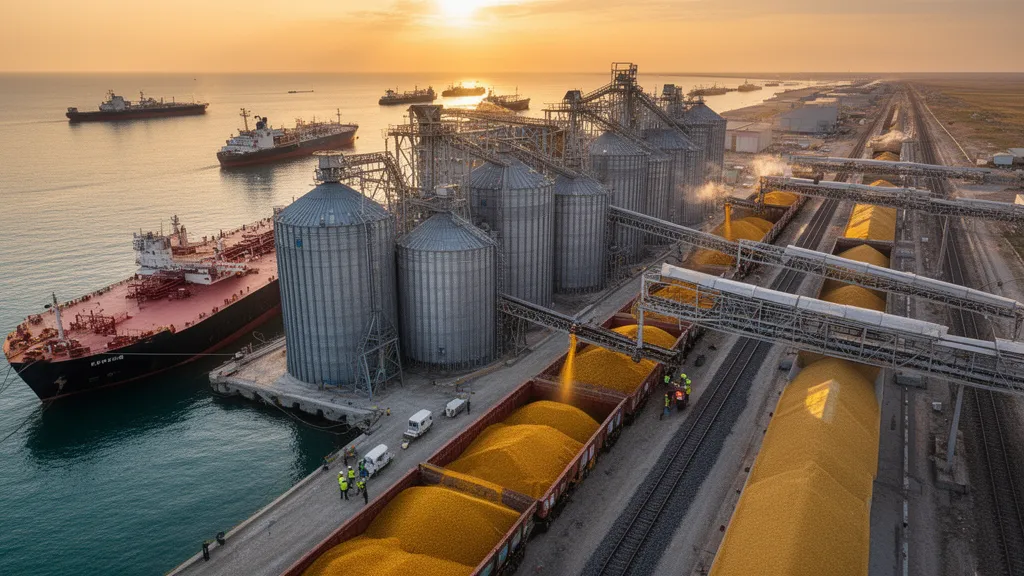
Russia’s 2025 grain harvest is estimated at 139 million tons, including 88.5–89 million tons of wheat and a record 16 million tons of corn, according to IKAR CEO Dmitry Rylko. Despite this, export potential is constrained by logistics, as southern export-oriented regions are contributing their smallest share of total shipments since the early 2000s.
Limited southern capacity is forcing grain movements from the Central Region, Volga, Urals, and Siberia to port terminals, tightening internal freight and adding costs. Quality complications further cloud the export outlook: drought in southern Russia has pushed wheat protein levels above the standard 11.5–12.5% export specs, requiring active blending with lower-protein grain from other regions.
Siberian Grain and Oilseed Export Dynamics
The Siberian Federal District exported 3.1 million tons of grain and processed products through November 29. Within this total, grain shipments fell 20% to 1.3 million tons, while oilseed exports jumped 43% to 874,000 tons and legumes rose 30% to 385,000 tons, underscoring a shift toward higher-value and diversified crop flows.
Altai Krai has emerged as the leading grain exporter within Siberia, shipping 582,000 tons (+35% year-on-year), equivalent to 45% of the district’s total grain exports. Key destinations include Kazakhstan, China, Kyrgyzstan, Mongolia, and Vietnam, with China’s purchases from Altai Krai up 19% and overall imports from Siberia up 5%, reinforcing a structural tilt toward eastward trade routes.
Key Volumes and Growth Metrics
| Region / Segment | Metric | 2025 Volume | YoY Change |
|---|---|---|---|
| Russia (Total Grain) | Grain harvest | 139 million tons | N/A |
| Russia (Wheat) | Wheat harvest | 88.5–89 million tons | N/A |
| Russia (Corn) | Corn harvest (record) | 16 million tons | N/A |
| Siberian Federal District | Total grain & processed exports | 3.1 million tons | N/A |
| Siberian Federal District | Grain exports | 1.3 million tons | -20% |
| Siberian Federal District | Oilseed exports | 874,000 tons | +43% |
| Siberian Federal District | Legume exports | 385,000 tons | +30% |
| Altai Krai (Siberia) | Grain exports | 582,000 tons | +35% |
| Altai Krai Share of Siberia | Share of district grain exports | 45% | N/A |
| Kazakhstan (Target) | Annual fat & oil export turnover by 2028 | >$1 billion | Roadmap goal |
| Kazakhstan (Processing) | Share of processed goods in exports | 70% | Roadmap goal |
Market Impact and Outlook
The combination of Kazakhstan’s targeted oilseed expansion and surging Siberian oilseed exports points to intensifying competition in global vegetable oil and meal markets, particularly into the EU and across the wider Black Sea complex. Investments in Trans-Caspian and alternative corridors may gradually redirect Central Asian flows away from Russian routes, eroding traditional transit advantages.
For grains, Russia’s logistics constraints and the need to blend high-protein southern wheat with lower-protein supplies elsewhere add operational risk and complexity for exporters and international buyers. While the record harvest is structurally bearish for medium-term supply, localized transport bottlenecks and quality issues are likely to keep regional basis levels volatile and sustain the recent diversification toward eastern and Central Asian outlets.
Source: Market Data
Leave a Reply