
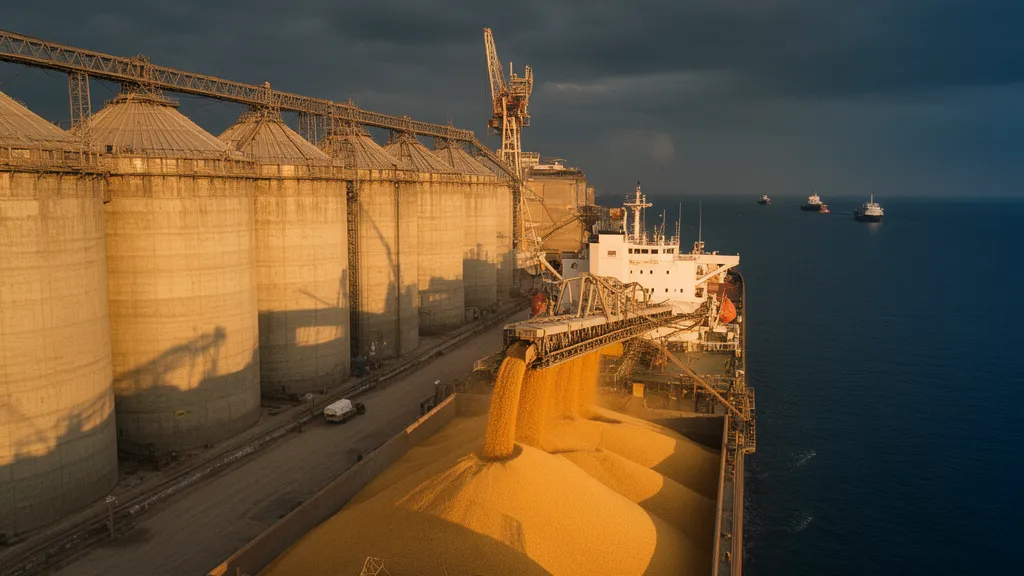
- Prices: Ukrainian milling wheat fell to USD 210-219/ton CPT across major ports as of December 10, 2025.
- Russia: 2025 wheat harvest estimates increased to 88.5-89 million tons, adding export competition.
- Logistics: Military disruptions in Ukraine and inland transport constraints in Russia continue to pressure margins and flows.
- Sentiment: Overall Black Sea wheat market tone remains bearish amid ample global supply and subdued demand.
Ukrainian Wheat Market Update
Ukrainian milling wheat prices extended their decline this week, reflecting a combination of weak export demand and constrained farmer selling. Grade 3 wheat at Greater Odessa ports eased by USD 1/ton to USD 211-219/ton CPT, while Danube port quotations slipped USD 1-3/ton to USD 210-218/ton CPT. Many producers remain hesitant to commit volumes at current price levels, limiting liquidity despite softer values.
Operational risks continue to weigh on Ukrainian logistics. Russian military strikes periodically disrupt overland routes and port infrastructure, leading to intermittent shutdowns and higher risk premiums. These disruptions cap export program visibility and complicate forward sales, even as prices drift lower.
Russian Production and Export Outlook
Russia’s Institute for Agricultural Market Studies (IKAR) raised its 2025 wheat harvest forecast to 88.5 million tons, with upside to 89 million tons, reinforcing expectations of abundant Black Sea supply. Total grain and legume output is projected at 139 million tons, including roughly 16 million tons of corn. This larger crop underpins Russia’s continued presence as a dominant global wheat supplier.
However, IKAR highlights that converting this production into exports will be challenging. A historically low share of output in export-oriented southern regions necessitates longer inland hauls to reach port terminals, significantly increasing logistics costs. These constraints may temper Russia’s ability to aggressively discount FOB values, even with large available supplies.
Key Price and Volume Indicators
| Region / Commodity | Price / Volume | Change vs. Previous Week | Notes |
|---|---|---|---|
| Ukraine Grade 3 wheat — Greater Odessa (CPT) | USD 211-219/ton | -USD 1/ton | Lower on weak demand and cautious farmer selling |
| Ukraine milling wheat — Danube ports (CPT) | USD 210-218/ton | -USD 1-3/ton | Pressure from subdued export activity |
| Russia 2025 wheat harvest (projection) | 88.5-89 million tons | Revised higher | Supports continued strong export availability |
| Russia total grains & legumes (projection) | 139 million tons | — | Includes ~16 million tons of corn |
Global and Regional Market Drivers
Black Sea wheat values are also pressured by broader global developments. USDA’s December balance sheets indicate higher worldwide wheat production, reinforcing a comfortable supply backdrop. Additional competition stems from Russian wheat’s established market share and the impact of reduced Argentine export duties, which enhance the competitiveness of Southern Hemisphere origins.
In this environment, Ukrainian wheat’s price discount versus Russian origin has narrowed, eroding one of the region’s traditional advantages. While Russian inland logistics costs may limit how far FOB prices can fall, the combination of high available volumes and subdued import demand continues to weigh on regional benchmarks.
Market Sentiment and Trading Implications
Market Sentiment: Bearish. The interplay of softer Ukrainian prices, expanding Russian production, and comfortable global stocks sets a negative tone for Black Sea wheat. Traders and risk managers should closely track farmer selling behavior, execution capacity at ports, and any escalation in logistical disruptions, as these factors will shape basis levels and nearby spreads in the weeks ahead.
Source: Market Data
Leave a Reply