
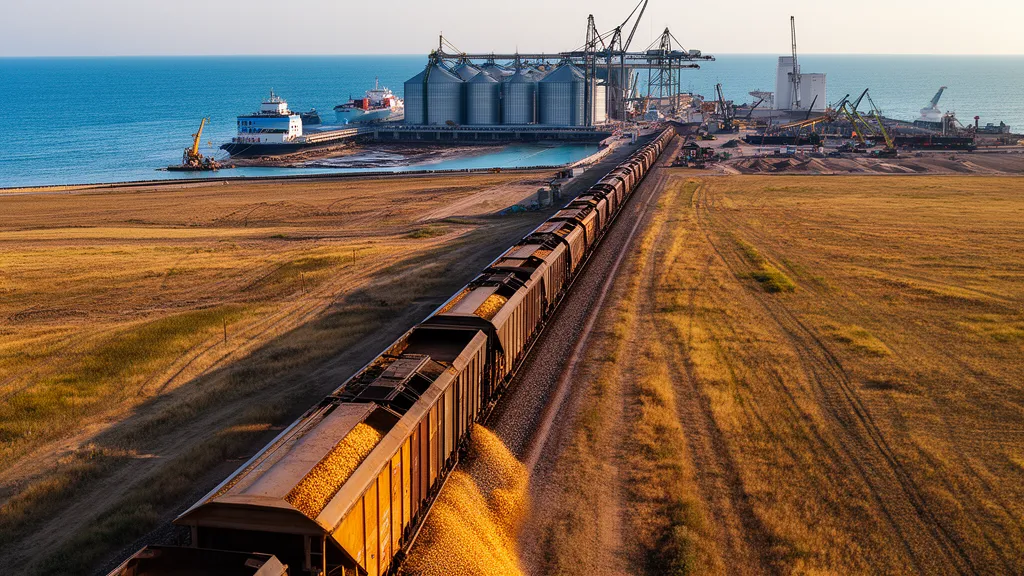
- Bullish: Rail freight between Kazakhstan and Uzbekistan surged 36% y/y to 13 million tonnes in the first four months of 2026, reinforcing the Trans-Caspian corridor’s role in grain and oilseed exports.
- Bullish: Completed dredging at Kuryk and ongoing upgrades at Aktau port are set to expand Caspian export capacity and offer competitive alternatives to congested Black Sea routes.
- Bullish: A decade-long 76% increase in bilateral rail volumes underpins sustained demand for diversified logistics routes serving Black Sea–linked grain flows.
- Watch: Execution risks around synchronizing rail and port investments could delay the full benefits for regional exporters and logistics coordinators.
Kazakhstan-Uzbekistan Rail Partnership Deepens
Kazakhstan Railways (KTZ) and Uzbekistan Railways have intensified coordination on boosting transportation capacity to the Caspian ports of Aktau and Kuryk, aiming to match rapidly growing freight volumes with upgraded infrastructure.
In a recent meeting, KTZ Chairman Talgat Aldybergenov and Uzbekistan Railways Chairman Zufar Narzullaev focused on synchronizing rail and port investments to support expanding trade and transit flows across Central Asia and toward Caspian export outlets.
Freight Volume Growth and Corridor Expansion
| Metric | 2015 | 2025 | Change |
|---|---|---|---|
| Rail freight between Kazakhstan and Uzbekistan (million tonnes) | 19 | 33 | +76% over 10 years |
| Transit volumes through Uzbekistan (million tonnes) | 7 | 18 | +11 million tonnes |
| Period | Bilateral Freight Volume | Y/Y Change |
|---|---|---|
| Jan–Apr 2025 | ~9.6 million tonnes | — |
| Jan–Apr 2026 | 13 million tonnes | +36% |
Rail transportation between Kazakhstan and Uzbekistan rose from 19 million tonnes in 2015 to 33 million tonnes in 2025, marking a 76% increase over a decade. Transit volumes via Uzbekistan also climbed strongly, from 7 million tonnes to 18 million tonnes, underscoring the corridor’s growing regional significance.
The growth trend accelerated in early 2026, with bilateral freight reaching 13 million tonnes in the first four months, a 36% year-on-year increase versus the same period in 2025.
Infrastructure Projects: Rail and Port Upgrades
On the rail side, KTZ plans to complete the strategic Darbaza–Maktaaral line in 2026, enhancing connectivity between Kazakhstan and Uzbekistan and improving access to Caspian-bound routes.
On the port side, dredging operations at Kuryk have been finalized, expanding draft capacity and enabling larger volumes to move through the terminal. Parallel infrastructure improvements at Aktau are scheduled for completion by December 2026, further lifting the Caspian Basin’s export capability.
Market Impact for Grain and Oilseed Flows
For Black Sea grain exporters and logistics coordinators, enhanced rail-to-port connectivity across the Caspian Basin offers additional routing options, particularly for Central Asian wheat and oilseeds that traditionally depend on Azov–Black Sea ports.
The sharp 36% rise in early-2026 freight volumes indicates robust demand for Trans-Caspian capacity. As Aktau and Kuryk upgrades come online, exporters could benefit from more competitive freight rates and diversified outlets to markets such as Azerbaijan and Iran, especially during peak harvest periods when Black Sea terminals are congested.
Overall, the coordinated Kazakhstan–Uzbekistan rail expansion and Caspian port development are supportive for regional export flows, potentially easing bottlenecks and improving pricing power for Black Sea–linked grain and oilseed shipments.
Source: Market Data
Leave a Reply