
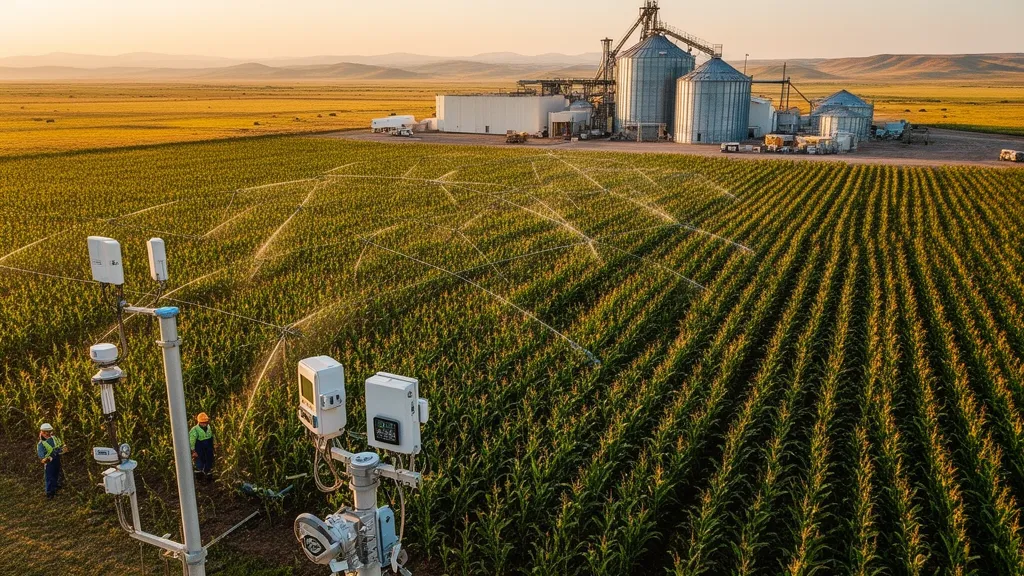
- Bullish: Kazakhstan is adding up to 10,000 hectares of irrigated corn and safflower, leveraging AI-driven irrigation and new processing capacity to capture regional demand growth.
- Bearish: Additional 40,000–50,000 tons of regional corn supply by 2030 could pressure Black Sea corn export premiums to Iran and Central Asian destinations.
Kazakhstan Corn Expansion Overview
Two major investment projects in southeastern Kazakhstan are converting 10,000 hectares of pasture into irrigated corn production, marking a significant expansion of the country’s export-oriented grain capacity. The initiatives combine digital agriculture, irrigation infrastructure, and downstream processing to target high-growth markets in Central Asia, China, and Iran.
Project Details and Investment Scale
Harvest Agro is investing 18.2 billion tenge across 4,500 hectares in the Kalzhat village of the Uyghur district. The company is deploying automated irrigation, digital soil diagnostics, moisture sensors, and AI-based crop monitoring systems to optimize yields and water use. Between 2026 and 2029, the project is expected to reach an annual output of 20,000 tons of corn and 4,500 tons of safflower, largely destined for export.
Assem Kaljat LLP has already converted 2,500 hectares of pasture into irrigated corn production, currently cultivating 12 hybrid varieties. Existing output serves domestic buyers and export customers in Uzbekistan, Iran, and China, including starch manufacturers, feed mills, poultry producers, and pharmaceutical firms. The company is planning around $23 million in additional investment to build three facilities: a corn primary processing and storage plant, a PVC pipe production plant, and a drip irrigation system manufacturing plant, further integrating the value chain.
Export Markets and Processing Focus
The combined projects are geared toward supplying regional demand for corn in the starch, feed, poultry, and pharmaceutical sectors. Export flows are expected to concentrate on Central Asian partners, China, and Iran. By pairing production growth with investments in storage, processing, and irrigation equipment manufacturing, Kazakhstan aims to capture more margin from corn-based products while strengthening regional food and industrial input security.
Market Impact and Price Implications
With 10,000 hectares moving into irrigated production, Kazakhstan could add approximately 40,000–50,000 tons of corn to regional supply by 2030. This increase, together with new onshore processing capacity, may reduce import dependence for corn-based industrial products in Central Asia and parts of the Middle East. From a price perspective, the additional origin competition is neutral to slightly bearish for Black Sea corn export premiums into Iran and Central Asian markets over the medium term, as buyers gain an alternative regional source with improving logistics and processing capabilities.
| Project / Metric | Value | Notes |
|---|---|---|
| Total land under development | 10,000 ha | Pasture converted to irrigated corn and oilseeds |
| Harvest Agro area | 4,500 ha | Kalzhat village, Uyghur district |
| Harvest Agro corn output (target) | 20,000 tons/year | Planned for 2026–2029 period |
| Harvest Agro safflower output (target) | 4,500 tons/year | Export-oriented |
| Harvest Agro investment | 18.2 billion KZT | Digital agriculture and irrigation systems |
| Assem Kaljat converted area | 2,500 ha | Already shifted from pasture to irrigated corn |
| Assem Kaljat planned CAPEX | ≈$23 million | Three processing and manufacturing facilities |
| Expected added regional corn supply by 2030 | 40,000–50,000 tons | Estimated incremental volume |
Strategic and Regional Context
The emphasis on water-efficient irrigation technology responds to chronic water constraints in Central Asia. By pairing irrigated production with PVC and drip irrigation manufacturing, Kazakhstan is positioning itself as both a grain supplier and a regional hub for irrigation solutions. This vertically integrated approach supports long-term yield stability and could facilitate further acreage expansion if market conditions remain favorable.
Source: Market Data
Leave a Reply