
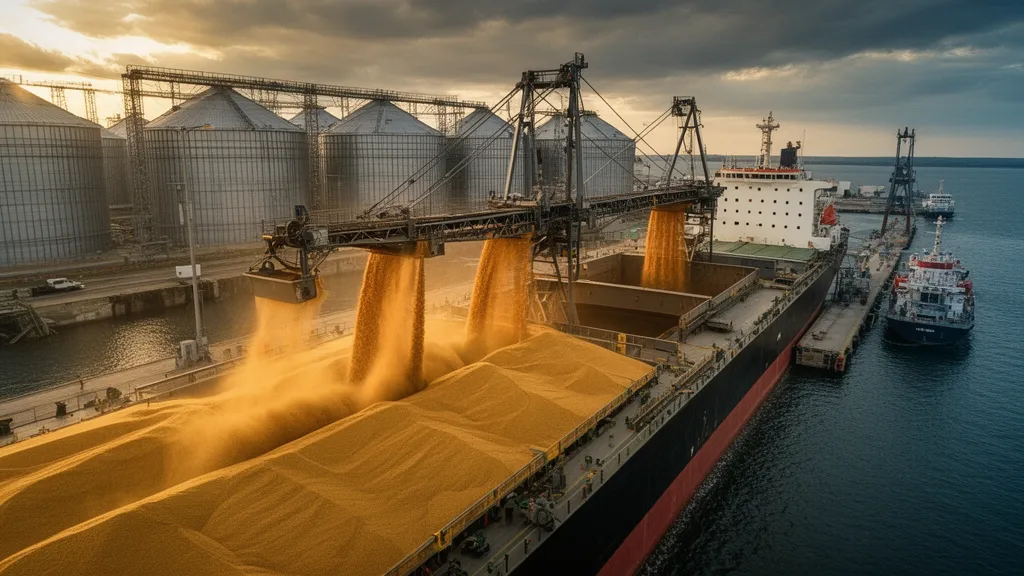
- Export Surge: Russian soybean meal exports jumped 91% year-on-year in Q1 2026 to 230,000 tonnes, the second-highest Q1 on record.
- Regional Demand: CIS markets absorbed 68% of volumes, led by Uzbekistan (70,000 tonnes) and Belarus (50,000 tonnes), while Turkey and China saw multi-fold growth.
- Capacity Expansion: Increased crushing capacity and shifts from sunflower/rapeseed to soy processing created a domestic surplus, pushing additional meal into export channels.
- Trade Flow Shift: Competitive Russian pricing is challenging traditional South American supply into Central Asia and the Middle East, reshaping regional soymeal trade routes.
Russian Soybean Meal Export Performance in Q1 2026
Russia exported 230,000 tonnes of soybean meal in January–March 2026, a 91% increase versus Q1 2025 and 34% higher than Q4 2025. According to the federal center "Agroexport" under the Ministry of Agriculture, this marks the second-highest Q1 export volume on record and underscores Russia’s growing role in the international soymeal market.
Export Structure by Region and Key Buyers
CIS countries dominated the Q1 2026 export structure, accounting for roughly 68% of total soybean meal shipments. Uzbekistan imported about 70,000 tonnes and Belarus 50,000 tonnes, confirming their status as core regional demand centers. Outside the CIS, Turkey and China recorded particularly sharp increases, with Turkish imports expanding 3.1 times and Chinese volumes up 11.7 times year-on-year. Iran posted modest growth amid evolving regional geopolitical conditions, while Morocco received its first significant volumes of Russian soybean meal, signaling a new destination in North Africa.
Drivers Behind the Export Surge
The surge in exports reflects a step-change in Russian oilseed processing dynamics. Expanded domestic soybean availability this season allowed crush facilities to ramp up throughput, including plants that have historically focused on sunflower and rapeseed but have now shifted part of their capacity to soybeans. New crushing capacity additions generated a surplus of soybean meal in the domestic market, requiring increased export flows to prevent excessive downward pressure on both soybean and meal prices.
Competitive raw soybean pricing has enabled Russian processors to maintain export parity even in the face of elevated logistics costs to more distant markets such as the Middle East, North Africa, and East Asia. This cost advantage underpins Russia’s growing presence in markets traditionally supplied by South American origins.
Implications for Regional Trade and Logistics
The acceleration in Russian soybean meal exports is reshaping Black Sea–centered trade routes. Sustained flows to Central Asian and Middle Eastern buyers could pressure regional meal prices and gradually shift purchasing patterns away from established exporters. For logistics coordinators, the diversification into Morocco and the expansion of Turkish and Chinese demand highlight new routing opportunities beyond traditional CIS lanes, potentially increasing vessel utilization on Black Sea–Mediterranean and Black Sea–Asia corridors.
Market participants should track whether Q1’s elevated pace can be maintained through the rest of 2026. Continued strength in Russian meal exports would reinforce Russia’s position as a structural rather than opportunistic supplier, with direct implications for regional price benchmarks and competitive dynamics across the soymeal complex.
Key Export Metrics Overview
| Indicator | Q1 2026 | Comparison | Change |
|---|---|---|---|
| Total soybean meal exports | 230,000 tonnes | vs Q1 2025 | +91% |
| Total soybean meal exports | 230,000 tonnes | vs Q4 2025 | +34% |
| Share to CIS markets | ~68% | of total Q1 2026 exports | Higher regional concentration |
| Exports to Uzbekistan | 70,000 tonnes | Q1 2026 | Strong demand hub |
| Exports to Belarus | 50,000 tonnes | Q1 2026 | Stable CIS buyer |
| Exports to Turkey | n/a (volume not disclosed) | vs Q1 2025 | 3.1x growth |
| Exports to China | n/a (volume not disclosed) | vs Q1 2025 | 11.7x growth |
Source: Market Data
Leave a Reply