
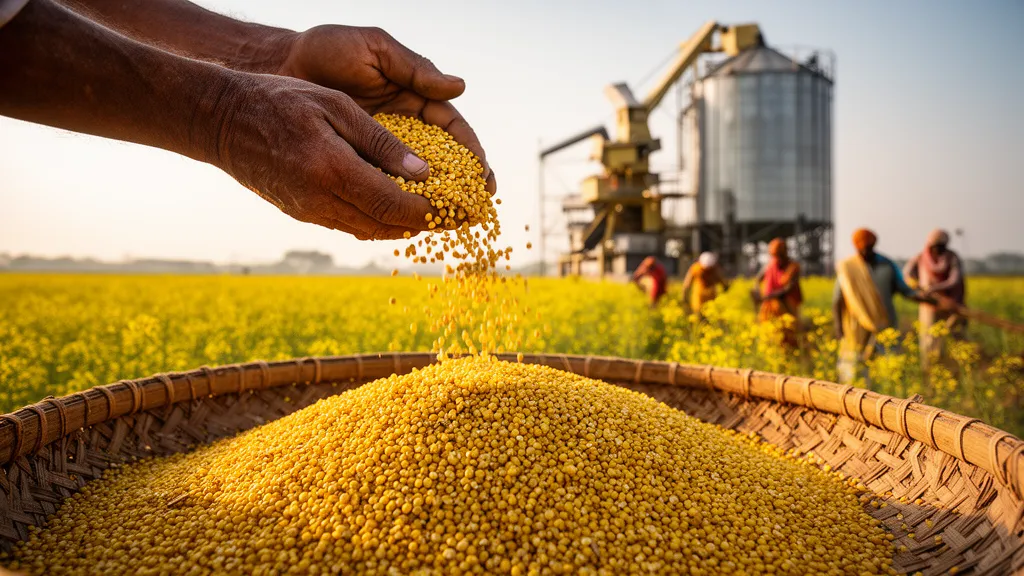
- Price surge: Indian rapeseed prices rose about 9% in March, holding near the MSP and boosting farmer sales to private processors.
- Export demand: Chinese rapeseed meal purchases from India jumped from 24,040 tonnes to 771,400 tonnes year-on-year (Apr–Feb), supporting crush margins.
- Record crop: India projects a record 2026 rapeseed harvest of 11.94 million tonnes, up 3.6% year-on-year, reinforcing domestic supply security.
- Macro driver: Stronger global vegetable oil prices linked to biofuel demand and geopolitical tensions in Iran are lifting domestic oilseed values.
- Black Sea impact: Neutral to slightly bearish for Black Sea exporters as India leans on domestic rapeseed while China’s demand reshapes meal trade flows.
Indian Rapeseed Market Update
Indian rapeseed prices climbed roughly 9% during March, defying the usual seasonal weakness typically seen as new-crop supplies reach the market. Despite increased availability, spot prices are holding close to the government-set minimum support price (MSP) of 6,200 rupees per 100 kg, incentivizing active farmer selling to private processors instead of public procurement channels.
This price resilience reflects robust demand for both rapeseed oil and meal, as crushers respond to profitable margins and steady offtake in domestic and export markets. Farmers are taking advantage of the firm pricing environment to accelerate marketing of the new crop, improving liquidity in the physical market.
Price and Production Snapshot
| Indicator | Latest Level | Change / Context |
|---|---|---|
| Rapeseed price (India) | Near 6,200 INR / 100 kg (MSP) | ≈ +9% in March vs. prior month |
| India 2026 rapeseed harvest | 11.94 million tonnes | +3.6% year-on-year (record crop) |
| Chinese imports of Indian rapeseed meal (Apr 2025–Feb 2026) | 771,400 tonnes | Up from 24,040 tonnes year-on-year (~30x increase) |
Drivers Behind the Rally
The March price increase runs counter to historic trends, when fresh supplies would normally pressure values lower. This year, international vegetable oil prices have risen sharply amid expectations of stronger biofuel usage and heightened geopolitical risks linked to Iran. Indian oilseed prices, including rapeseed, have followed this global upswing, keeping crush margins attractive.
China’s buying has been a crucial pillar of support. SEA data show that Chinese imports of Indian rapeseed meal surged to 771,400 tonnes in the April 2025–February 2026 period, from just 24,040 tonnes a year earlier. This roughly thirty-fold increase is pulling more seed into crushing, reinforcing the link between export demand and domestic farmgate prices.
Structural Shifts in India’s Oilseed Balance
India is projecting a record 2026 rapeseed harvest of 11.94 million tonnes, up 3.6% year-on-year. Combined with robust processing activity, this larger crop is helping the country gradually trim its reliance on imported palm, soybean, and sunflower oils, which still account for nearly one-third of total vegetable oil consumption.
Higher domestic rapeseed output and crush capacity support the government’s broader objective of enhancing self-sufficiency in edible oils. As more local seed is processed into oil and meal, India can substitute a portion of refined oil imports while simultaneously expanding its footprint in the global protein meal market, particularly in Asia.
Implications for Black Sea Exporters
The implications for Black Sea markets are assessed as neutral to slightly bearish. On one hand, India’s record rapeseed production and active crushing program reduce its prospective import requirements for sunflower, soybean, and other vegetable oils, which could marginally constrain demand for Black Sea sunflower oil over time.
On the other hand, China’s strong appetite for Indian rapeseed meal may divert some of its procurement away from traditional suppliers, including Black Sea origins. This introduces additional competition in key Asian meal markets. Nonetheless, the overall impact on the Black Sea complex is expected to remain limited, as India’s policy focus is primarily on stabilizing domestic supply chains and reducing import dependence rather than competing aggressively in export markets.
Source: Market Data
Leave a Reply