
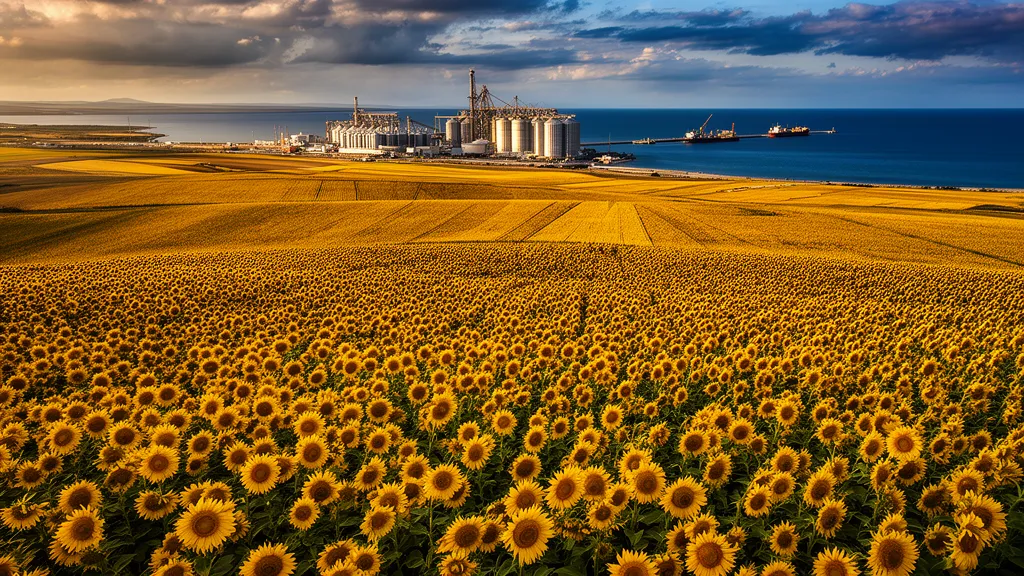
- Bearish sunflower seeds prices: Global production projected to rise about 10% to 62–63 million tonnes in 2026/27 MY, creating potential oversupply.
- Black Sea dominance: Russia and Ukraine together could harvest 32.5–34 million tonnes, more than half of global output, strengthening their pricing power.
- Acreage expansion: World sunflower area forecast to hit a record 34.1 million hectares as farmers shift away from fertilizer-intensive crops like corn.
- EU output growth: Higher planted area could lift EU production to 9.6–9.7 million tonnes, roughly 1 million tonnes above last year.
- Structural oversupply risk: Ongoing crop-switching towards sunflower suggests sustained high acreage even if input costs ease.
Global Sunflower Seeds Production Outlook
Oil World projects that global sunflower seeds production could reach a record 62–63 million tonnes in the 2026/27 marketing year under normal weather conditions, surpassing the previous peak of 59.4 million tonnes recorded in 2023/24. This would be a significant 10.9% increase versus the current season’s estimated 56.9 million tonnes, signaling ample supply ahead.
The expansion is being driven by a global shift in cropping patterns as farmers move away from fertilizer-intensive crops such as corn toward sunflower and soybeans. As a result, global sunflower planted area is forecast to climb to an all-time high of 34.1 million hectares in 2026/27, up from 32.8 million hectares in the previous season.
Regional Production Breakdown
In the European Union, sunflower area is expected to increase by about 0.2 million hectares this spring to reach 4.9 million hectares. France, Hungary, Bulgaria, and Spain are expected to lead this expansion. The larger planted area could lift EU sunflower seeds production to 9.6–9.7 million tonnes, around 1 million tonnes above last year’s harvest.
The largest gains are projected in the Black Sea region. Russia’s sunflower crop is forecast at 20–21 million tonnes, while Ukraine is targeting 12.5–13 million tonnes for the 2026/27 season. Combined output of 32.5–34 million tonnes from these two origins would represent more than half of projected global production, cementing the region’s role as the primary driver of world sunflower seeds and sunflower oil trade flows.
| Region / Season | 2023/24 MY | 2025/26 MY (Current) | 2026/27 MY Forecast |
|---|---|---|---|
| Global Production (million tonnes) | 59.4 | 56.9 | 62–63 |
| Global Area (million hectares) | 32.8 | 32.8 | 34.1 |
| EU Production (million tonnes) | ≈8.6–8.7 | ≈8.6–8.7 | 9.6–9.7 |
| EU Area (million hectares) | 4.7 | 4.7 | 4.9 |
| Russia Production (million tonnes) | n/a | n/a | 20–21 |
| Ukraine Production (million tonnes) | n/a | n/a | 12.5–13 |
| Russia + Ukraine Share of Global (%) | n/a | n/a | >50% |
Market Impact and Price Outlook
Bearish for sunflower seeds prices. The projected supply build-up, led by record or near-record crops in Russia, Ukraine and the EU, is likely to exert downward pressure on both sunflower seeds and sunflower oil prices. With Russia and Ukraine together potentially accounting for over half of global output, their export policies, logistics, and pricing strategies will remain the key benchmarks for the international market.
The ongoing shift away from fertilizer-dependent crops implies that sunflower acreage may remain elevated even if fertilizer prices ease. This dynamic introduces a structural oversupply risk into the 2026/27 marketing year and possibly beyond, unless demand growth in food and biofuel sectors accelerates or weather-related losses curb production.
Source: Market Data
Leave a Reply