
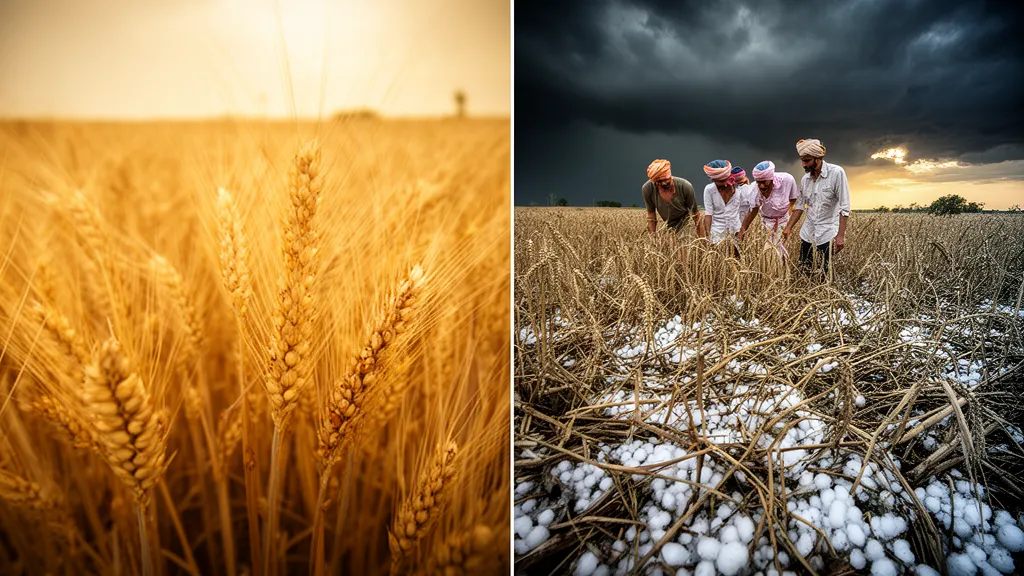
- Production outlook: India’s 2026 wheat harvest is expected to exceed last year’s output but come in below initial estimates.
- Weather impact: Late-February heatwave and subsequent hail-accompanied rains have damaged crops and raised grain quality concerns.
- Global balance: Any shortfall in Indian exportable surplus could be mildly supportive for Black Sea wheat demand, though India remains far from becoming a major importer.
- Official stance: The Indian government still projects a record 120.21 million tonnes of wheat production for the current season.
Indian Wheat Production Outlook
Indian market participants have revised down their expectations for the 2026 wheat harvest, citing adverse weather during key growth stages. Despite this downward revision, output is still projected to exceed the previous year’s levels, underscoring a generally robust production profile.
The country endured a heatwave in late February that stressed the crop, followed by rainfall that partially alleviated moisture deficits. However, in several growing regions the rain was accompanied by hail, causing localized yield losses and raising concerns over test weight, protein, and overall grain quality.
Official Forecast and Market Implications
Despite private-sector revisions, the Indian government maintains its forecast of a record 120.21 million tonnes of wheat production for the current season. At this level, India remains broadly self-sufficient, with limited risk of shifting into a net-importer role under normal conditions.
Nevertheless, any reduction from earlier, more optimistic estimates could curb India’s capacity to resume meaningful wheat exports. If quality downgrades are confirmed in hail-affected regions, buyers seeking higher-grade wheat may increasingly look to alternative origins.
Impact on Black Sea Wheat
The adjustment in India’s production outlook is assessed as neutral to slightly bullish for Black Sea wheat. A smaller or lower-quality exportable surplus from India would help support demand for Black Sea origins from traditional importers in the Middle East, Africa, and South Asia.
However, with Indian production still projected at record levels, the upside for Black Sea exports is likely to be incremental rather than transformative. India is unlikely to emerge as a significant net importer, limiting the broader impact on global balance sheets. Traders should monitor forthcoming crop progress updates and pre-harvest surveys for clearer signals on yield and quality.
Source: Market Data
Leave a Reply