
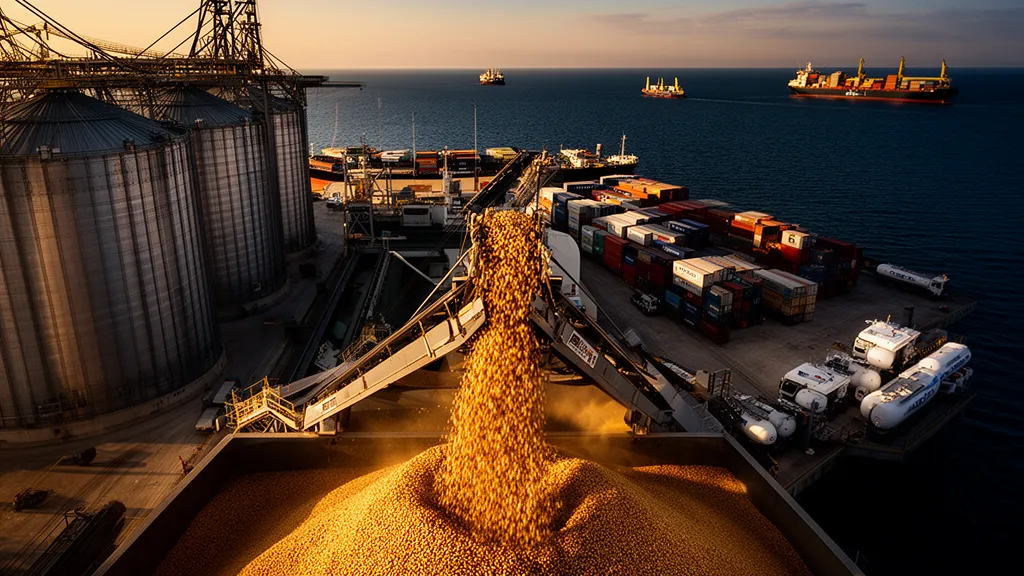
- Resilient agriculture: Non-commodity exports, including agricultural products, increased their share of total exports from 35.2% to 36.4%, partially offsetting weakness in the mineral sector.
- Weaker trade surplus: Kazakhstan’s trade surplus shrank 33.3% to $14.2 billion as exports fell 3.2% while imports rose 7.4%, pressuring the current account and the tenge.
- Rising import demand: Agricultural imports grew by $695.4 million, driven by fats and oils, dairy, cocoa, and beverages, signaling strong domestic demand beyond local supply capacity.
- Commodity price drag: A $3.3 billion decline in mineral sector exports and a $968.7 million fall in vehicle exports weighed on overall trade performance amid a roughly 20% drop in Brent crude.
- Freight implications: Higher agricultural imports and potentially more competitive Kazakh grain exports suggest mixed but active prospects for Black Sea freight flows.
Market Update: Kazakhstan Trade and Agriculture in 2025
Kazakhstan’s foreign trade turnover reached $143.9 billion in 2025, up 1.3% year-on-year, according to the Association of Financiers of Kazakhstan. Despite this modest growth, the country’s trade balance deteriorated sharply, with the surplus narrowing from $21.3 billion to $14.2 billion, a contraction of 33.3%.
The mineral sector, still the core of Kazakhstan’s export base, saw a $3.3 billion decline in export revenues. This was largely driven by weaker global price conditions, as Brent crude fell by nearly 20% over the year. Vehicle exports also contracted markedly, losing $968.7 million, compounding the drag from the energy sector.
Overall exports decreased by 3.2%, while imports expanded by 7.4%. Within this shift, there was a notable structural rebalancing: the share of non-commodity exports rose from 35.2% to 36.4%. This indicates comparatively stronger performance from agricultural and processed goods exports relative to traditional commodity segments.
On the import side, demand for animal and plant products was particularly strong, increasing by $695.4 million. This category includes cocoa, fats and oils, dairy products, and beverages, underscoring Kazakhstan’s growing reliance on external supply for higher value-added food and agrifood products. Vehicles led overall import growth with an increase of $3.0 billion, followed by chemical products at $652.7 million.
The import expansion occurred even as many trading partners maintained lower inflation rates than Kazakhstan. Price increases in specific imported product categories transmitted additional inflationary pressures domestically through the import channel, potentially complicating monetary and fiscal policy responses.
Key Trade Indicators
| Indicator | 2025 Value | Change / Comment |
|---|---|---|
| Foreign trade turnover | $143.9 billion | +1.3% year-on-year |
| Trade surplus | $14.2 billion | -33.3% (down from $21.3 billion) |
| Exports (overall) | n/a (value not specified) | -3.2% year-on-year |
| Imports (overall) | n/a (value not specified) | +7.4% year-on-year |
| Mineral sector exports | n/a (value not specified) | – $3.3 billion |
| Vehicle exports | n/a (value not specified) | – $968.7 million |
| Non-commodity export share | 36.4% | Up from 35.2% |
| Agricultural imports (animal & plant products) | n/a (value not specified) | + $695.4 million |
| Vehicle imports | n/a (value not specified) | + $3.0 billion |
| Chemical product imports | n/a (value not specified) | + $652.7 million |
| Brent crude price | n/a (price not specified) | ~20% decline during 2025 |
Analysis: Implications for Black Sea Grain and Freight Markets
The latest figures point to a mixed but active outlook for agricultural commodities in the Black Sea region. Kazakhstan’s agricultural and non-commodity exports showed relative resilience, cushioning some of the weakness from lower mineral and vehicle exports. At the same time, the $695.4 million increase in agricultural imports highlights robust domestic demand that local production alone cannot satisfy.
For freight markets, these developments suggest growing opportunities for inbound shipments of agricultural and processed food products to Kazakhstan, especially in fats and oils, cocoa-based goods, dairy products, and beverages. Higher import volumes in these categories are likely to support regional logistics flows and demand for bulk and containerized cargo capacity into the Caspian and Black Sea corridors.
The deterioration in the trade surplus and weaker foreign exchange inflows raise the risk of pressure on the tenge. A softer currency could enhance the price competitiveness of Kazakh grain exports on the global market, potentially encouraging higher outbound flows if logistics and domestic supply conditions allow. However, the same currency dynamics would increase the local currency cost of imported food and inputs, feeding into inflation and potentially prompting tighter policy or trade controls.
Over the medium term, the contraction in net exports and growing current account pressures may influence Kazakhstan’s grain export policies. Authorities face a balancing act between ensuring domestic food security amid rising import dependence and leveraging agricultural exports as a source of hard currency earnings. Any shift toward tighter export regulation, buffer stock building, or targeted subsidies would have direct repercussions for Black Sea grain trade patterns.
Overall, the data signal a structural pivot: while hydrocarbons remain central, Kazakhstan is gradually increasing the relative weight of non-commodity and agricultural exports within its trade portfolio. This realignment, combined with stronger agrifood import demand, is set to reshape both regional trade flows and freight demand across the wider Black Sea and Eurasian corridors.
Source: Market Data
Leave a Reply