
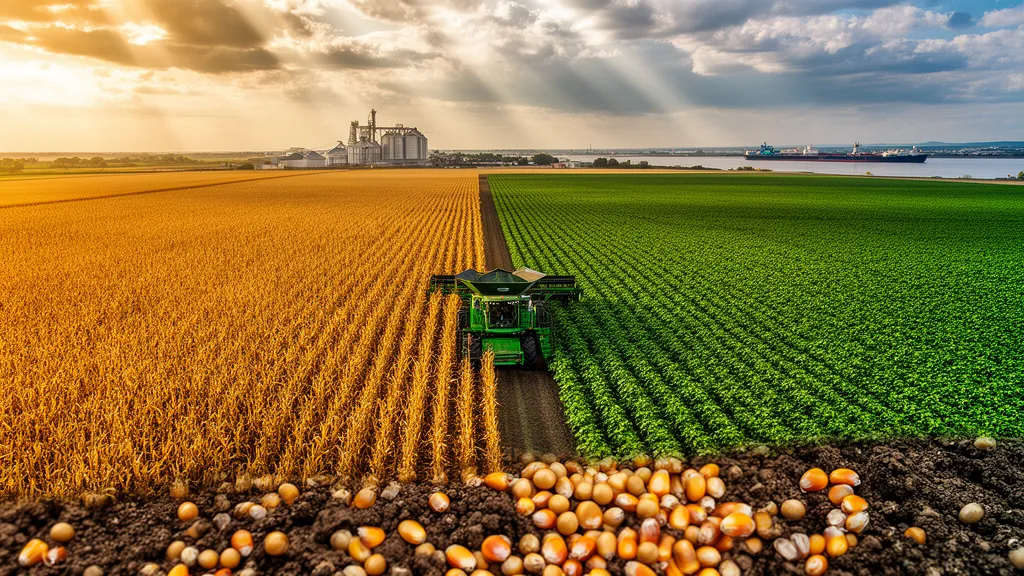
- Corn acreage cut: USDA projects U.S. corn plantings to fall 4.8 million acres to 94 million in 2026, from an 89-year high in 2025.
- Soybean expansion: Soybean area is forecast to rise 3.8 million acres to 85 million, driven by strong domestic renewable fuel demand.
- Near-record crops: Corn and soybean harvests are projected at 15.755 and 4.450 billion bushels respectively, both the second-highest on record.
- Stocks adjustment: Corn ending stocks are seen declining to 1.837 billion bushels by August 2027, while soybean stocks edge up to 355 million bushels.
- Trade shifts: Lower U.S. corn exports and higher soybean exports reshape global flows, opening space for Black Sea corn but adding pressure to global oilseeds.
USDA 2026 Acreage and Production Outlook
The U.S. Department of Agriculture expects a notable rebalancing of corn and soybean planted area in 2026 as farmers respond to weak prices, rising input costs, and shifting demand patterns. Corn plantings are projected to decline from 98.8 million acres in 2025—an 89-year high—to 94 million acres, while soybean area expands from 81.2 million to 85 million acres.
Despite the acreage cut, corn production in 2026/27 is forecast at 15.755 billion bushels, the second-largest crop on record. Soybean production is likewise projected at a near-record 4.450 billion bushels, supported by higher planted area and solid yields.
| Crop | 2025 Planted Area (million acres) | 2026 Planted Area (million acres) | Change (million acres) |
|---|---|---|---|
| Corn | 98.8 | 94.0 | -4.8 |
| Soybeans | 81.2 | 85.0 | +3.8 |
| Crop | 2026/27 Production (billion bushels) | Ending Stocks (billion bushels) |
|---|---|---|
| Corn | 15.755 | 1.837 |
| Soybeans | 4.450 | 0.355 |
U.S. Farm Economics and Demand Drivers
The acreage shift unfolds against a backdrop of global oversupply, depressed commodity prices, and higher input costs for seeds and fertilizer. U.S. farm incomes are expected to decline by 0.7% in 2026, even as near-record government support payments make up nearly 29% of producer revenues, cushioning the impact of weaker market returns.
For corn, exports in the 2026/27 marketing year are forecast at 3.1 billion bushels, 200 million below 2025/26, as South American suppliers expand their global footprint. Strong buying from exporters and biofuel producers, however, is expected to limit deeper acreage cuts and keep overall demand relatively firm.
Soybean demand is increasingly anchored by domestic renewable fuel mandates and processing capacity. U.S. crushers are projected to use a record 2.655 billion bushels, while exports reach 1.7 billion bushels, a two-year high, despite ongoing trade frictions with China and competition from Brazil’s large soybean crops.
Implications for Global Balance Sheets
U.S. corn ending stocks are expected to fall from a seven-year high of 2.127 billion bushels to 1.837 billion bushels by August 31, 2027, signaling a modest tightening of U.S. supply. In soybeans, ending stocks are projected to increase slightly, from 350 million to 355 million bushels, reflecting strong but balanced demand growth.
| Crop | Previous Ending Stocks (billion bushels) | 2026/27 Ending Stocks (billion bushels) | Change (billion bushels) |
|---|---|---|---|
| Corn | 2.127 | 1.837 | -0.290 |
| Soybeans | 0.350 | 0.355 | +0.005 |
Black Sea Market Impact
For Black Sea corn, the USDA outlook is neutral to marginally bearish. On one hand, lower U.S. ending stocks tend to support international prices. On the other, the projected reduction in U.S. corn exports—driven by competition from South America—creates space for Black Sea origins to capture additional market share, especially in traditional U.S. demand centers.
In oilseeds, the sizeable U.S. soybean acreage increase and near-record crop could weigh on global oilseed and protein meal prices. This may indirectly pressure Black Sea sunflower complex values and margins, especially where U.S. soy products and Black Sea sunflower oil and meal compete head-to-head.
Traders should track shifts in destination buying patterns and freight dynamics into North Africa and the Middle East, where U.S. and Black Sea exporters frequently vie for the same tenders. Changes in U.S. export volumes could influence basis levels, freight spreads, and relative competitiveness across origins.
Source: Market Data
Leave a Reply