
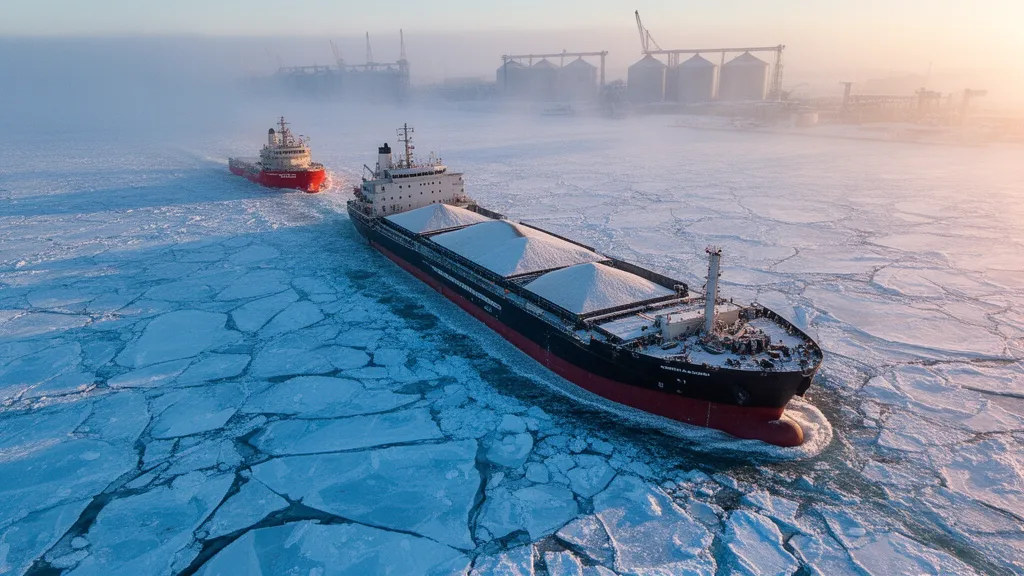
- Russian Baltic exports disrupted: Severe ice in the Gulf of Finland is slowing vessel movements, extending escort times to 8–12 hours and risking full navigation halt from February 19.
- Ukraine shifts to value-added exports: Overall agricultural exports fell 9% to $22.71 billion in 2025, but processed products surged to $4.4 billion, nearly 20% of export value.
- Caspian corridor expansion: Russia’s Port of Olya will add an offshore grain transshipment complex by spring 2026 with 3,000 t/day capacity, supporting North-South Corridor grain flows to Iran.
Black Sea and Baltic Freight Market Update
Russian grain exports via the Baltic Sea face imminent disruption as ice thickness in the Gulf of Finland reaches critical levels. Since February 16, non-ice-class vessels at the Big Port of St. Petersburg and Ust-Luga require icebreaker escorts, with the Ministry of Transport deploying 11 icebreakers and considering a nuclear unit. Escort times have stretched to 8–12 hours per vessel, and navigation may cease entirely from February 19 if ice thickness reaches 30–50 cm, threatening schedule reliability and elevating freight costs.
Ukraine’s agricultural trade in 2025 totaled $31.83 billion, down 3% year-on-year. Exports fell 9% to $22.71 billion, while imports grew 13% to $9.12 billion, largely due to reduced EU shipments after several changes to Ukraine’s trade regime with the bloc. Despite the headline decline, processed agricultural exports—including finished food products, dairy, flour, starch, and margarine—reached $4.4 billion, accounting for nearly 20% of total agricultural export value and indicating a gradual move toward higher-margin value-added goods.
In the Caspian region, Russia is expanding logistics capacity through an offshore grain transshipment complex at the Port of Olya. Developed by Astra LLC and slated for launch in spring 2026, the facility will operate using ship-to-ship loading two nautical miles west of the Volga-Caspian Seaway Canal exit. With approximately 6 m water depth, standard capacity of 3,000 tons per day, and a targeted annual throughput of at least 80,000 tons, the project is designed to support Russian wheat exports via the International North-South Transport Corridor, particularly toward Iran.
Market Impact and Strategic Implications
Bearish for Russian Baltic exports: Ice-related delays and possible navigation suspension create immediate bottlenecks, pushing freight rates higher and tightening FOB availability from Baltic ports. Traders may see upward pressure on Russian wheat and oilseed prices, while alternative routing via Novorossiysk risks congestion and longer laytimes.
Neutral to bullish for Ukraine: While export volumes declined, the rising share of processed agricultural goods improves value capture per tonne and diversifies revenue away from bulk commodities. However, regulatory uncertainty in EU trade relations will remain a key risk factor for Ukrainian exporters through at least 2028.
Bullish for Caspian routing: The Port of Olya development underscores Russia’s intent to diversify export corridors beyond the Black Sea. Once operational, the offshore complex could redirect 80,000+ tons of grain annually through the Caspian, alleviating pressure on southern terminals and strengthening Russia’s positioning in Iranian and broader Middle Eastern markets.
Action Points for Freight and Trade Participants
Freight coordinators should closely track Baltic ice forecasts and port authority advisories, prioritize ice-class tonnage where possible, and prepare contingency routings via Black Sea or alternative Russian ports. Ukrainian exporters may continue to pivot further into processed food segments, focusing on margin resilience and diversified market access. For longer-term planning, grain traders and logistics providers should evaluate Caspian routing options via Olya as the North-South Corridor infrastructure comes online.
Source: Market Data
Leave a Reply