
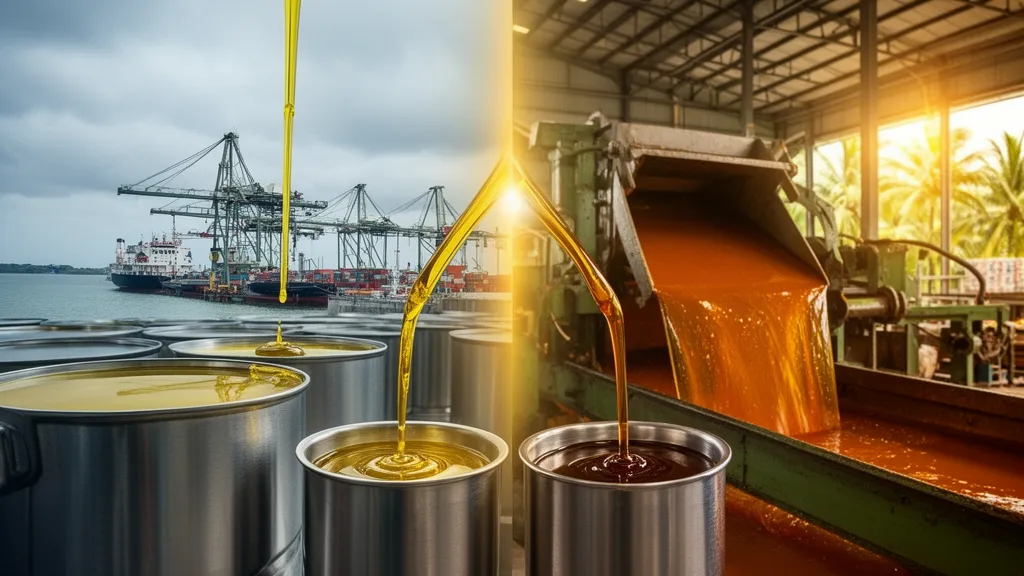
- Shift to palm oil: Major importers in South Asia, including India, Pakistan, and Bangladesh, are replacing soybean oil with cheaper palm oil alternatives.
- Pakistan demand collapse: Pakistan’s soybean oil imports fell 84% year-on-year to just 28,000 tonnes in October–January 2025/26.
- EU demand support: Ukraine increased soybean oil shipments to the European Union to 169,000 tonnes in October–January 2025/26, partially offsetting weaker Asian demand.
- Market tone: Overall outlook is neutral to bearish for Black Sea soybean oil producers as price competition from palm oil limits export growth.
Market Update: Global Soybean Oil Trade Shifts
Global soybean oil exports are under pressure as buyers pivot toward more competitively priced palm oil. This trend is particularly visible across South Asia, where key importing countries such as India, Pakistan, and Bangladesh have scaled back soybean oil purchases in favor of cheaper alternatives.
Oil World data show that combined soybean oil shipments from major exporters—Argentina, Brazil, Paraguay, the United States, Ukraine, and China—to India held up relatively well in January but started to weaken in February and March. The most dramatic change occurred in Pakistan, where imports collapsed to just 28,000 tonnes in October–January 2025/26, a steep decline from 170,000 tonnes during the same period a year earlier.
While Asian demand has softened, European Union-bound flows have strengthened. Ukraine redirected significant volumes toward the EU, shipping 169,000 tonnes of soybean oil in October–January 2025/26, while Argentina supplied a further 68,000 tonnes to the bloc. North American imports from Argentina and Paraguay reached 145,000 tonnes over the same period, with nearly all volumes destined for Canada.
Trade Flows Overview
| Route / Market | Period | 2025/26 Volume (tonnes) | 2024/25 Volume (tonnes) | Change |
|---|---|---|---|---|
| Pakistan Soybean Oil Imports | Oct–Jan | 28,000 | 170,000 | -84% |
| Ukraine → EU | Oct–Jan 2025/26 | 169,000 | N/A | Higher year-on-year |
| Argentina → EU | Oct–Jan 2025/26 | 68,000 | N/A | Stronger flows |
| Argentina & Paraguay → North America | Oct–Jan 2025/26 | 145,000 | N/A | Mostly to Canada |
Analysis: Neutral to Bearish Outlook for Black Sea Exporters
The current environment is neutral to bearish for Black Sea soybean oil producers. Although Ukraine has managed to redirect volumes toward the European Union, the global balance is increasingly shaped by the price advantage of palm oil, which continues to displace soybean oil in cost-sensitive markets.
This competitive pressure is expected to constrain export growth opportunities for soybean oil in the near term. For Ukrainian and other Black Sea exporters, the priority will be defending EU market share and selectively targeting North American demand, even as total global volumes face headwinds from sustained palm oil competition.
Source: Market Data
Leave a Reply