
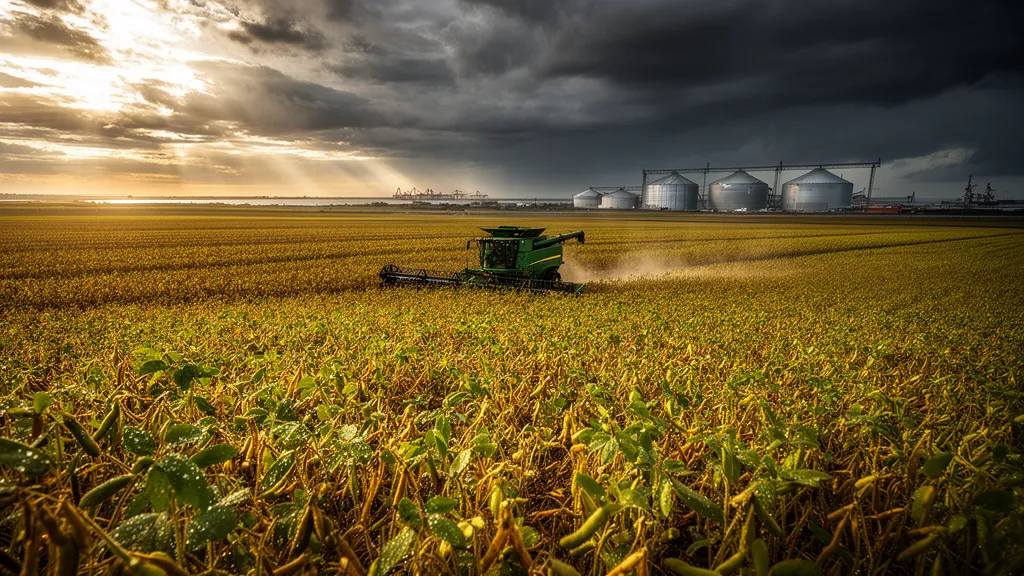
- Argentina’s 2023/24 soybean harvest forecast raised by 1 million tonnes to 48 million tonnes on improved weather.
- Critical rains of 25–100 mm expected in key producing areas over the next week will help determine final yields.
- Corn production projection held at a record 62 million tonnes, reinforcing Argentina’s export availability.
- Global oilseed balance turns looser at the margin, slightly pressuring soybean and vegetable oil price sentiment.
Argentina Soybean & Corn Production Update
The Rosario Grain Exchange (BCR) has increased its estimate for Argentina’s soybean harvest to 48 million tonnes, a 1 million tonne upward revision supported by recent favorable weather across western and northern growing regions. Soybean crops are currently in a key yield formation phase, making short-term weather patterns especially important for final output.
Meteorological forecasts point to 25–75 mm of rainfall across northern Argentina over the next seven days, with the province of Santa Fe potentially receiving up to 100 mm. Weather developments during the next 10–15 days will be decisive for confirming or revising current yield expectations. In contrast, the corn harvest projection is unchanged at a record 62 million tonnes, underscoring strong supply potential for the 2023/24 season.
| Commodity | Latest Forecast (million tonnes) | Previous Forecast (million tonnes) | Change (million tonnes) |
|---|---|---|---|
| Soybeans | 48 | 47 | +1 |
| Corn | 62 | 62 | 0 |
Market Impact & Black Sea Context
The upward revision to Argentina’s soybean crop slightly increases global soybean availability during the South American harvest window (March–May). While Argentina is not a direct competitor to Black Sea origins for soybeans, a larger exportable surplus may cap rallies in global soybean prices and indirectly weigh on vegetable oil markets if soybean oil values soften.
For Black Sea exporters, the signal is neutral to slightly bearish. Some demand could be diverted toward competitively priced Argentine soybeans and by-products, marginally reducing buying interest in alternative oilseeds such as sunflower and rapeseed. However, the outlook remains highly weather-dependent, and the forecast rains must materialize before markets fully price in the larger crop, limiting aggressive selling pressure in the near term.
Source: Market Data
Leave a Reply