
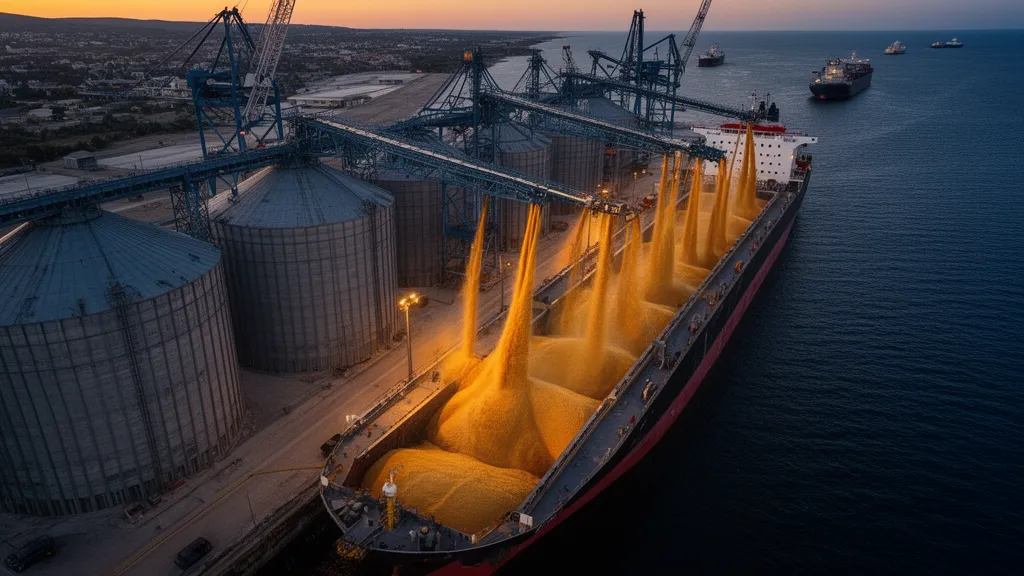
- Bullish – Russian grain exports: Russian grain shipments rose 6% to 4.5 million tons in January 2026, with wheat exports up 18% to 2.8 million tons, strengthening Russia’s regional market share.
- Bearish – Kazakhstan competitiveness: Kazakhstan’s new Tax Code cuts VAT refunds on agricultural exports to just 3.2%, creating a 12.8% cost burden and an estimated 120 billion tenge revenue loss for farmers.
- Freight shift: Rising Russian exports to Turkey, Lebanon, Central Asia, and even Kazakhstan itself point to stronger demand for Russian Black Sea and Azov freight and weaker outlook for Kazakh export flows.
Russian Grain Export Performance – January 2026
Russian grain and processed product exports reached 4.5 million tons in January 2026, a 6% increase versus January 2025, driven primarily by wheat, which climbed 18% to 2.8 million tons. Additional support came from strong growth in soybeans, soybean cake, and sorghum.
| Commodity | January 2026 Volume (tons) | Year-on-Year Change |
|---|---|---|
| Total grain & processed products | 4,500,000 | +6% |
| Wheat | 2,800,000 | +18% |
| Soybeans | 128,400 | 2x |
| Soybean cake | 71,400 | +69% |
| Sorghum | 2,000 | 4x |
Geographically, Russian exports saw especially sharp gains into Cameroon (sevenfold increase), while deliveries to Kazakhstan, Latvia, Kyrgyzstan, and Mongolia tripled. Shipments to Lebanon and Afghanistan doubled, and exports to Turkey were up 97%, underscoring broad-based regional demand for Russian-origin grain.
Kazakhstan’s New VAT Regime and Export Competitiveness
From January 2026, amendments to Article 484 of Kazakhstan’s Tax Code significantly altered VAT treatment for agricultural exports. Exporters purchasing from agricultural producers now pay 16% VAT but can offset only 20% of that amount, leaving 12.8% non-refundable, whereas previously exporters could claim full VAT refunds on zero-rated export transactions.
| VAT Parameter | Previous Regime | New Regime (from Jan 2026) |
|---|---|---|
| VAT paid on purchases from agricultural producers | 16% | 16% |
| Refundable/offsettable VAT | 16% (100% of VAT) | 3.2% (20% of VAT) |
| Non-refundable VAT cost | 0% | 12.8% |
| Estimated farmer revenue loss (annual) | – | 120 billion tenge |
Exporter Batyrbek Akilzhanov notes that VAT refunds will drop from 12.8% to just 3.2%, effectively adding a 12.8% cost layer to Kazakh exports. Market participants expect this to either push Kazakh products out of core destinations such as China, Iran, and Central Asia or push domestic farm-gate prices lower as the burden shifts to producers.
Industry estimates based on 2024–2025 volumes suggest farmer revenue losses could reach 120 billion tenge in 2026, with likely knock-on effects including weaker farm balance sheets, reduced sown areas, and lower investment in agricultural capacity.
Market Impact: Russia’s Advantage and Freight Rebalancing
The combination of expanding Russian grain supply and Kazakhstan’s restrictive VAT policy creates a pronounced competitive shift in regional grain trade. The 12.8% structural cost disadvantage on Kazakh exports makes Russian grain more attractive in overlapping markets, particularly across Central Asia, where Russian exports already tripled in January 2026.
Freight demand is poised to tilt further toward Russian Black Sea and Azov ports as buyers in Turkey, Lebanon, Kazakhstan, Kyrgyzstan, and Mongolia increase reliance on Russian-origin cargoes. The threefold increase in Russian exports to Kazakhstan itself highlights both potential re-export flows and displacement of domestic Kazakh production.
Logistics and Strategy Implications
Logistics coordinators and traders active in Central Asian and Black Sea corridors should reassess routing, capacity allocation, and counterparty exposure. If Kazakhstan’s VAT burden remains unchanged through 2026, Kazakh export volumes are likely to decline, while Russian-origin flows gain further traction in regional tenders and private purchases.
Source: Market Data
Leave a Reply