
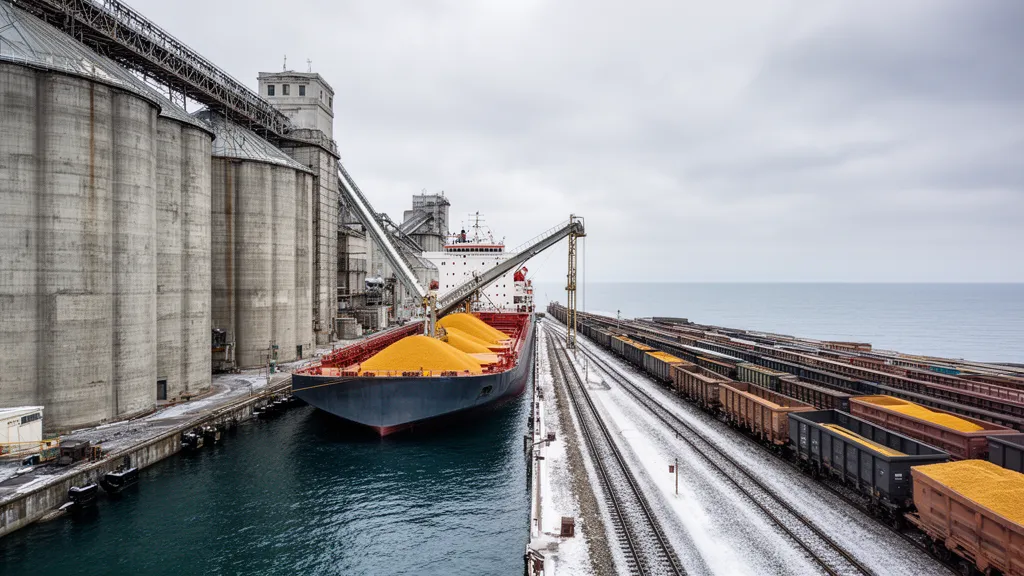
- Exports Decline: Russian grain exports fell 18.9% year-on-year in January 2026 to 2.99 million tonnes, driven mainly by steep drops in corn and barley shipments.
- Logistics Strain: Kazakhstan’s rail bottlenecks, with railcar idle times above 10 days at Kostanay, are creating significant delivery risks and cost pressures for regional exporters.
- Price Competitiveness: Russian wheat remains attractively priced at $232/tonne versus $238/tonne for French wheat, supporting demand despite shrinking export geography and intensified global competition.
- Market Consolidation: Fewer destination countries (22 vs. 33) and exporters (31 vs. 49) highlight ongoing consolidation in Russia’s grain export sector.
- Regional Resilience: Siberian regions such as Altai Krai and Omsk Oblast show robust planting plans and strong oilseed export growth, partly offsetting broader market headwinds.
- Sentiment: Overall market sentiment is neutral to bearish, with logistics inefficiencies and lower export volumes limiting upside despite competitive pricing.
Russian Grain Export Performance
Russian grain exports totaled 2.99 million tonnes in January 2026, an 18.9% decline compared to January 2025. Wheat exports held steady at 2.7 million tonnes, but corn shipments fell more than 50% to 197,300 tonnes, and barley exports declined fivefold to 109,000 tonnes. Egypt was the largest buyer at 895,000 tonnes, with Turkey and Sudan also taking notable volumes at 201,000 tonnes.
Across the July 2025–January 2026 marketing year, Russia exported 34.3 million tonnes of grain, down 16.3% year-on-year. Wheat exports specifically fell 13% to 30.6 million tonnes, pressured by stronger competition from the EU, Australia, and Argentina. Export flows became more concentrated, with Russian wheat shipped to just 22 countries, down from 33 a year earlier, and the number of active exporting companies contracting from 49 to 31.
The product mix also narrowed, with the assortment of exported crops decreasing from 24 to 12. This consolidation reflects a sector adapting to tighter margins and more intense global competition, even as Russian wheat pricing remains competitive on a FOB basis.
Price Competitiveness
| Origin | Commodity | Price (FOB, $/tonne) |
|---|---|---|
| Russia | Wheat | $232 |
| France | Wheat | $238 |
Russian wheat retains a pricing edge at $232/tonne versus $238/tonne for French wheat, helping sustain demand despite shrinking country coverage and volume declines. This discount limits upside for global prices while cushioning Russian exporters against more aggressive competition from alternative origins.
Kazakhstan Rail and Logistics Update
Kazakhstan’s agricultural exporters continue to face acute logistics challenges, particularly on rail routes through Kostanay station. Industry participants report railcar idle times exceeding 10 days, constraining the flow of grain and oilseeds to key destinations such as China, Uzbekistan, and Afghanistan.
Kazakhstan Temir Zholy (KTZ) acknowledges the deterioration of the locomotive fleet and is implementing upgrades, but current capacity remains insufficient. Rail transit to Uzbekistan improved nominally from 30 to 35 train pairs after December negotiations, yet actual loadings surpassed 11,000 railcars against a planned capacity of just 6,600, highlighting systemic underestimation of demand.
Until fleet modernization and network capacity expansions materialize, traders using Kostanay-linked routes should incorporate 10+ day delays into logistics planning and contract execution schedules.
Regional Resilience in Siberia
Despite wider regional headwinds, Siberian export regions show relative strength. Altai Krai plans to maintain 5.3 million hectares of arable land for spring sowing, signaling stable production potential. Omsk Oblast’s agricultural exports exceeded $340 million in 2025, supported by robust oilseed trade.
Flaxseed exports from Omsk surged 62% to more than $37 million, while rapeseed oil shipments climbed 22% to approximately $32 million. These gains underscore a diversification trend toward higher-value oilseeds and processed products, partially offsetting weaker grain export dynamics.
Market Sentiment and Outlook
Market sentiment is neutral to bearish. Russian export volumes are under pressure from global competition and narrowing market geography, while Kazakhstan’s logistics bottlenecks raise freight costs and delivery risks. At the same time, competitive Russian wheat pricing and resilient Siberian exports help cap outright downside. In the near term, traders should prioritize route diversification, factor in extended rail transit times through Kazakhstan, and monitor further consolidation in Russia’s export sector.
Source: Market Data
Leave a Reply