
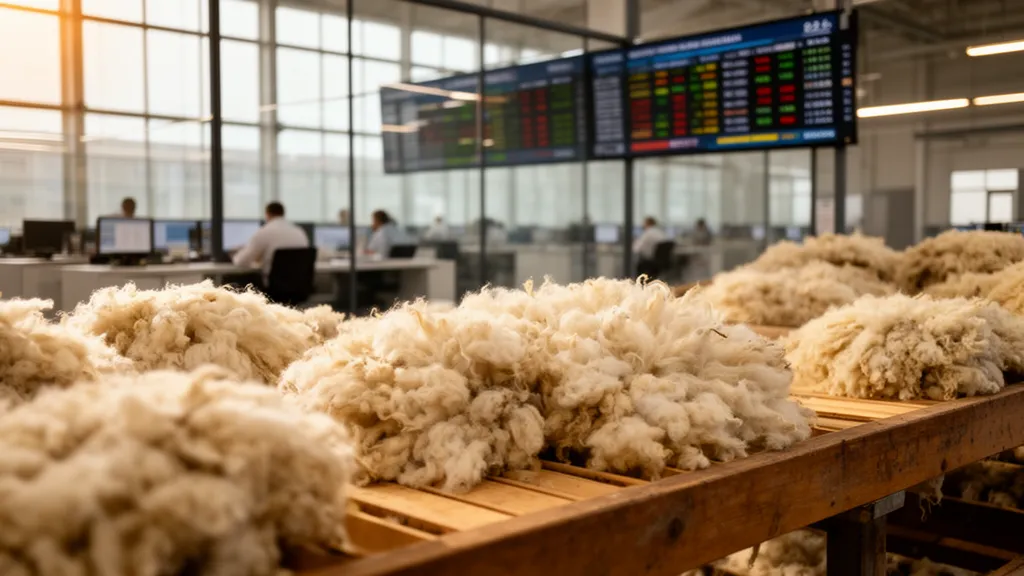
- Policy focus: Russia plans to launch wool exchange trading to create transparent, indicative pricing and consolidate purchasing.
- Underutilized capacity: Of 43,000 tons of wool produced annually, less than 10% is processed domestically, with the rest exported or wasted.
- Growth target: Authorities aim to increase wool production by 25% by 2030 through better logistics and aggregator infrastructure.
- Broader template: Successful wool exchange trading could be replicated across other agricultural commodities in the Black Sea region.
- Grain market impact: Immediate impact on grain and oilseed markets is assessed as neutral, but signals a continued shift toward domestic value-added processing.
Russia Proposes Wool Exchange Trading
Russia’s Ministry of Industry and Trade and Ministry of Agriculture have proposed launching wool exchange trading to establish transparent pricing, consolidate purchasing, and improve market structure. The initiative was presented during parliamentary hearings in the State Duma, with Minister of Industry and Trade Anton Alikhanov emphasizing the need for standardized sorting and classification of wool through agricultural aggregators before it reaches trading platforms.
The proposed exchange mechanism aims to deliver indicative price benchmarks and reduce opacity in current transactions. By concentrating volumes and applying unified quality standards, policymakers expect to improve market signals for both producers and processors, encouraging investment in domestic processing capacity.
Current Wool Market Structure and Inefficiencies
Russia produces around 43,000 tons of wool each year, exporting primarily to China, India, and Latin American markets. Despite this sizeable output, only about one-third of the volume is processed into wool fabric domestically, and less than 10% of total production undergoes domestic processing in a consistent, value-added way. The remainder is either stored for long periods or written off as waste, which leaves many primary producers operating at a loss.
Deputy Chair of the State Duma Committee on Agrarian Issues Yulia Ogloblina highlighted that this combination of low utilization and weak local demand undermines profitability along the value chain. First Deputy Minister of Agriculture Elena Fastova added that the core constraint is not the quality or quantity of raw material—Russia has some of the world’s strongest sheep breeds—but rather gaps in logistics, infrastructure, and domestic sales channels.
Government Roadmap and Production Targets
The government’s roadmap for the sector includes long-term contracting between agricultural producers and processing plants to stabilize supply flows and underpin investment. Authorities have set a target to increase Russia’s wool production by 25% by 2030, largely by improving aggregation, transportation, and classification infrastructure.
In parallel, a similar policy approach is being advanced in the flax sector, where the government aims to reach 10,000 tons of flax yarn production by 2036. Both initiatives align with a broader strategy to deepen domestic processing, reduce waste, and capture more value within Russia’s agricultural and textile supply chains.
| Indicator | Current Level | Target / Note |
|---|---|---|
| Annual wool production | 43,000 tons | Baseline output |
| Domestic wool processing share | < 10% | Remainder mostly exported or wasted |
| Domestic wool fabric output | ≈ 1/3 of total wool | Significant underutilization |
| Wool production target | +25% by 2030 | Driven by logistics and infrastructure upgrades |
| Flax yarn production target | N/A (developing) | 10,000 tons by 2036 |
Implications for Agricultural Markets
While wool exchange trading does not directly affect grain and oilseed pricing, it is an indicator of Russia’s broader shift toward formalized commodity markets and enhanced domestic processing. If the wool exchange succeeds, it could provide a blueprint for similar mechanisms in other agricultural sectors, particularly in the Black Sea region.
The emphasis on standardized classification systems, aggregator infrastructure, and long-term contracts may also influence how grain and oilseed logistics are structured over time, including potential improvements in handling efficiency, storage, and pricing transparency. For now, the immediate impact on grain markets is assessed as neutral, but the policy trajectory reinforces Russia’s commitment to value-added processing rather than raw material export dependence across its agricultural complex.
Source: Market Data
Leave a Reply