
- Feed flows at risk: 15,000 tons of Kazakh feed meal detained at China’s Altynkol-Khorgos checkpoint over new <1.2mm particle size rules, highlighting rising technical barriers to trade.
- Surging Russian capacity: Russia has lifted mineral fertilizer production capacity by 23% since 2022, while European output capacity has contracted by 9% overall.
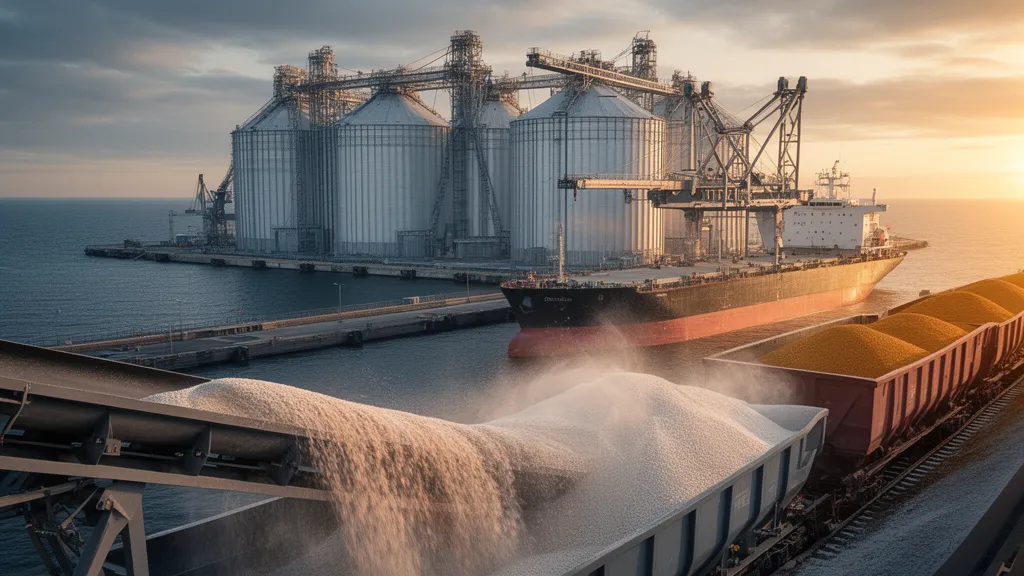
- Export infrastructure boost: The Port Favor terminal in Ust-Luga is set to add up to 13 million tons of annual dry fertilizer export capacity from summer 2026, with transshipment speeds far above current market averages.
- Neutral to slightly bearish for regional feed: Regulatory friction could slow Central Asian feed shipments or force costly upgrades to Kazakh milling technology despite strong export growth to China.
- Bullish for Russian fertilizers: Expanded production and faster port logistics improve Russia’s global competitiveness, although sanctions and geopolitical risks remain limiting factors.
Kazakhstan–China Feed Meal Trade Disruption
Chinese customs has detained around 15,000 tons of Kazakh animal feed meal at the Altynkol-Khorgos checkpoint, citing non-compliance with new milling standards that require feed wheat flour particle size below 1.2mm. These specifications conflict with current Kazakhstani processing technology, including plants built with Chinese investor participation over the last two years.
The National Association of Exporters KazGrain notes that Chinese authorities are not recognizing Kazakh certification documents, though feed meal exports as a whole have not been formally suspended. APK-Inform reports that Kazakhstan shipped 1.8 million tons of feed flour to China in the first four months of the 2025/26 marketing year, a 3.6-fold increase versus the same period a year earlier, underscoring how quickly this trade has scaled.
Russian Fertilizer Capacity and Export Infrastructure
In fertilizers, Russia is consolidating its position as a major global supplier. First Deputy Prime Minister Denis Manturov reports a 23% increase in domestic mineral fertilizer production capacity since 2022. Over the same period, European capacity has fallen by about 9%, led by sharp cuts in Germany (-25%), the Netherlands (-20%), and Great Britain (-12%), reflecting high energy costs and restructuring.
The Port Favor terminal in Ust-Luga is central to Russia’s export strategy. Designed for up to 13 million tons of dry mineral fertilizer throughput per year, it will operate at transshipment speeds of roughly 2,400 tons per hour—nearly three times the market average of 800–900 tons per hour. Dry fertilizer shipments are slated to begin in summer 2026, adding to existing ammonia handling capacity of about 560,000 tons.
Market Impact Assessment
The Kazakhstan–China dispute is neutral to slightly bearish for regional feed flows. While the 15,000 tons of detained cargo represent less than 1% of quarterly volumes, the episode signals more stringent quality enforcement and potential non-tariff barriers that could slow shipments or force capital-intensive upgrades to Kazakh milling lines.
For fertilizers, the combination of expanded Russian production capacity and faster, higher-volume export logistics is structurally bullish for Russia’s market share and pricing power, especially as European producers scale back. However, geopolitical tensions and sanctions remain key constraints on how fully Russia can translate these physical advantages into global market dominance.
| Region / Asset | Metric | Change / Value |
|---|---|---|
| Kazakhstan → China feed flour exports | Volume, first 4 months 2025/26 MY | 1.8 million tons (3.6x year-on-year) |
| Detained Kazakh feed meal | Cargo volume | 15,000 tons |
| Russian mineral fertilizer capacity | Change since 2022 | +23% |
| European fertilizer capacity | Overall change since 2022 | -9% |
| Germany fertilizer capacity | Change since 2022 | -25% |
| Netherlands fertilizer capacity | Change since 2022 | -20% |
| Great Britain fertilizer capacity | Change since 2022 | -12% |
| Ust-Luga Port Favor terminal | Planned dry fertilizer throughput | 13 million tons/year |
| Ust-Luga Port Favor terminal | Transshipment speed | 2,400 tons/hour (vs. 800–900 tons/hour market average) |
| Ust-Luga Port Favor terminal | Ammonia handling | 560,000 tons |
| Ust-Luga Port Favor terminal | Dry fertilizer start date | Summer 2026 (planned) |
| China particle size requirement | Feed wheat flour standard | < 1.2mm |
Source: Market Data
Leave a Reply