
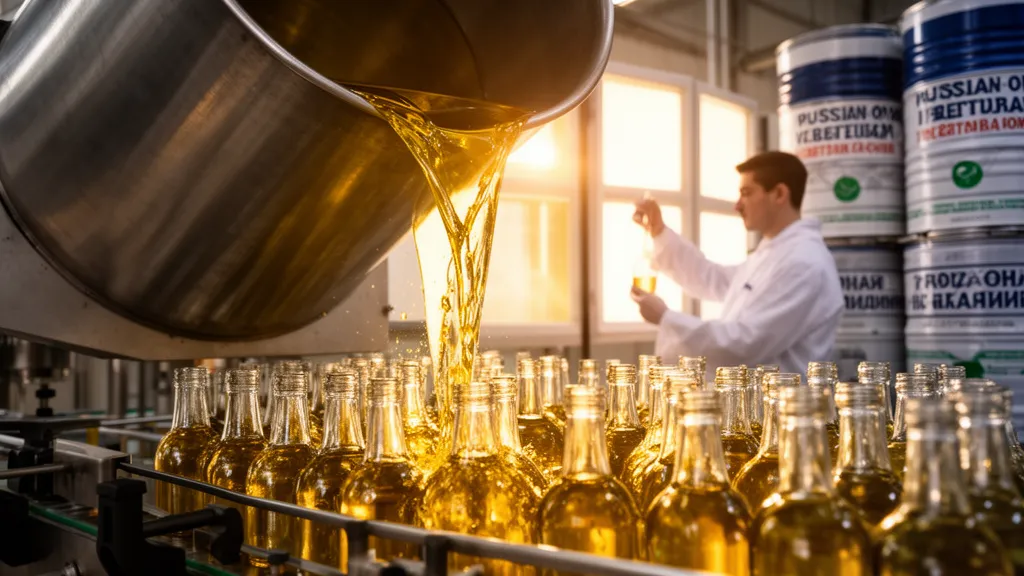
- Bullish: Russia’s vegetable oil exports to the UAE surged 2.8-fold to 21,500 tons in 2025, led by sunflower and soybean oil, diversifying demand away from traditional markets.
- Bearish: Rapid growth in Russian meal production, five times the global average, is pressuring domestic and Black Sea meal prices amid weaker German meal exports.
Russian Vegetable Oil Expansion in the UAE
Russia significantly expanded its vegetable oil presence in the UAE in 2025, exporting over 21,500 tons valued at $26.5 million—a 2.8-fold increase in volume and 3.5-fold rise in value versus 2024. The shift underscores Russia’s growing role as a competitive supplier into Middle Eastern refining and food sectors.
| Product | Destination | Period / Year | Volume (tons) | Value (USD million) | Change vs Previous Year |
|---|---|---|---|---|---|
| Total vegetable oils | UAE | 2025 | 21,500 | 26.5 | Volume: 2.8x | Value: 3.5x |
| Sunflower oil | UAE | 2025 | 13,500+ | ~18.0 | Volume: 2.4x | Value: 3.0x |
| Rapeseed oil | UAE | 2025 | 900+ | ~1.0 | First-time exports |
| Soybean oil | UAE | 2025 | 7,000 | 8.0 | Volume: 3.6x | Value: 4.6x |
Sunflower oil remained the core of Russian shipments, accounting for more than 13,500 tons and nearly $18 million in revenue. Russia also opened a new channel by sending over 900 tons of rapeseed oil to the UAE for the first time, while soybean oil posted the strongest relative growth, reaching 7,000 tons and $8 million.
Weakening German Meal Exports
In contrast, German oilseed meal exports declined in the 2025/26 marketing year. From July to November 2025, soybean meal shipments fell 11% to 741,000 tons, while rapeseed meal exports dropped 22% to 537,000 tons. The pattern signals either softer EU crushing activity or stronger internal demand absorbing more product domestically.
| Commodity | Destination | Period (Jul–Nov 2025) | Volume (tons) | Y/Y Change |
|---|---|---|---|---|
| Soybean meal (total) | All | 2025/26 | 741,000 | -11% |
| Rapeseed meal (total) | All | 2025/26 | 537,000 | -22% |
| Rapeseed meal | Netherlands | 2025/26 | ~200,000 | -30% |
| Rapeseed meal | Denmark | 2025/26 | 87,000 | -2% |
| Soybean meal | Czech Republic | 2025/26 | 148,000 | Largest buyer |
| Soybean meal | Poland | 2025/26 | 106,000 | Up from 96,000 |
The Netherlands remained the key outlet for German rapeseed meal at roughly 200,000 tons, though volumes slid 30% year-on-year. Denmark held second place at 87,000 tons, only slightly lower versus the prior season. Exports to Sweden, Finland, and Switzerland also weakened, while for soybean meal the Czech Republic stayed Germany’s top buyer and Poland modestly expanded intake from 96,000 to 106,000 tons.
Competitive Dynamics and Price Signals
Russia’s record oilseed harvest is driving oil and meal production growth at a pace five times the global average, exerting downward pressure on domestic meal prices and by extension Black Sea export values. The aggressive expansion into the UAE and broader Middle Eastern markets strengthens Russia’s demand base for vegetable oils, but for meal the supply overhang remains a neutral-to-bearish factor for Black Sea pricing.
Simultaneously, the decline in German meal exports tightens EU-origin availability for regional feed buyers, potentially creating space for Black Sea suppliers to expand market share in traditional European destinations. Overall, the set-up is neutral to bearish for Black Sea meal prices due to abundant Russian supply, while vegetable oils are more balanced as new export outlets partially offset global competition.
Source: Market Data
Leave a Reply