
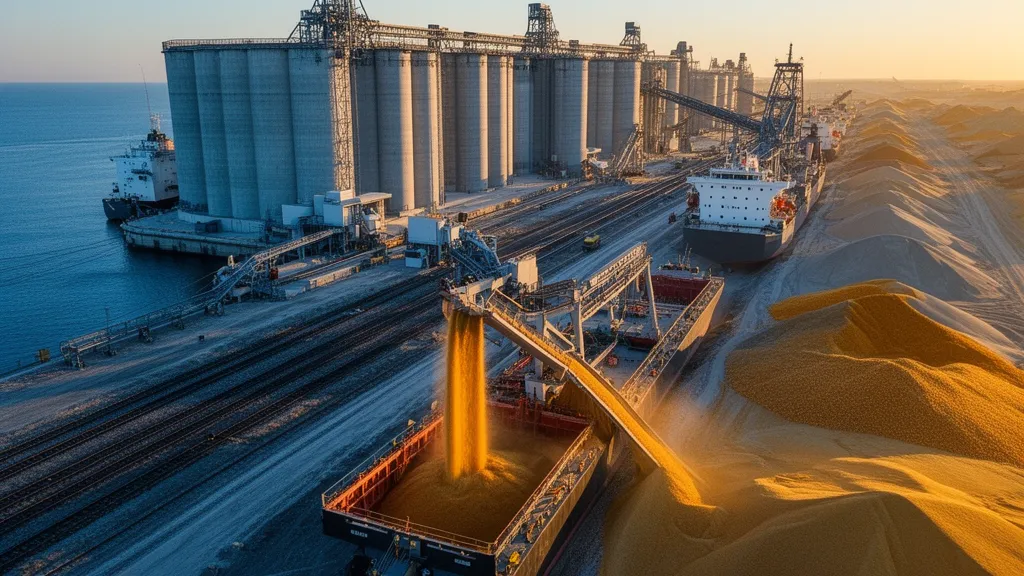
- Bearish: Russia’s projected 55 million tons of grain exports in 2026 add significant supply pressure to Black Sea wheat and corn markets.
- Bearish: Record regional harvests and strong logistics, particularly in Omsk and Krasnodar, support sustained high exportable surpluses.
- Neutral: Growing focus on value-added processing in Krasnodar may reduce raw grain availability for export but is offset by overall larger harvest volumes.
- Neutral: Diversified oilseed and processed product exports from Tatarstan and Bashkortostan broaden Russia’s agri-export mix, spreading price impacts across multiple markets.
Market Update: Russia’s Grain and Oilseed Exports
Russia’s 2025 agricultural season underpins a substantial export program heading into 2026, with grain and oilseed flows expanding across multiple key producing regions. Strong harvests, diversified export destinations, and increasing emphasis on value-added processing are shaping a complex but generally supply-heavy outlook for international markets.
Omsk Region: Record Grain Harvest and Expanding Domestic Flows
Omsk Region reported a historic harvest of 4.2 million tons of grain in 2025. Governor Vitaly Khotsenko indicated that around 2 million tons are earmarked for domestic processing and internal regional needs, supporting local industry and food security. Grain supplies shipped to other Russian regions doubled to 905,000 tons, demonstrating strengthened inter-regional logistics and internal market integration. Omsk currently exports to 47 countries, reinforcing its role as a growing contributor to Russia’s exportable surplus.
National Grain Export Outlook for 2026
At the national level, Russian Agriculture Minister Oksana Lut confirmed that the 2025 grain harvest reached 139 million tons. This volume enables Russia to plan exports of approximately 55 million tons of grain in 2026. While the minister acknowledged a “difficult market situation,” the government signaled readiness to maintain supplies to all partners. This large export program reinforces Russia’s position as a key global grain supplier and is likely to weigh on Black Sea and broader international price benchmarks.
Tatarstan: Oilseed and Processed Product Expansion
Tatarstan strengthened its position in oilseed and product exports in 2025, shipping about 47,000 tons to 12 countries. The export basket included sunflower, rapeseed, mustard, and hemp, serving primary destinations such as China, Belarus, and Poland. Oilseeds accounted for nearly 25% of the region’s agricultural exports, while grain crops represented 43%. This balance highlights Tatarstan’s role in both raw commodity and value-added segments of Russia’s agri-export portfolio.
Bashkortostan: Dominance of Oil and Fat Products
Bashkortostan’s agricultural exports preliminarily exceeded 530,000 tons by the end of 2025, reaching 35 countries. Oil and fat products dominated the regional export structure at 67%, followed by food and processing industry products at 20%. Main markets included Kazakhstan, Turkey, Uzbekistan, China, and Azerbaijan. This composition underscores the region’s emphasis on processed high-value products rather than bulk raw grains.
Krasnodar Krai: Ambitious Export Growth and Value-Added Focus
Krasnodar Krai set a 2026 agricultural export target of $2.78 billion, representing a roughly 33% increase from 2025. The region currently exports to 115 countries, underscoring its global reach. Advanced grain processing products to Uzbekistan, Belarus, and Kazakhstan rose by 30%, while rice exports surged by 51%. Krasnodar is prioritizing value-added products, particularly vegetable oils for food industry and biofuel applications, which may slightly tighten raw grain availability but enhance margins and market resilience.
Regional Export and Production Snapshot
| Region / National | Metric | 2025 Volume / 2026 Target | Notes |
|---|---|---|---|
| Russia (national) | Grain harvest (2025) | 139 million tons | Enables ~55 million tons grain exports in 2026 |
| Russia (national) | Planned grain exports (2026) | 55 million tons | Positions Russia as major supplier in Black Sea markets |
| Omsk Region | Grain harvest (2025) | 4.2 million tons | Historic record for the region |
| Omsk Region | Domestic processing & regional needs | ~2 million tons | Supports internal demand and processing capacity |
| Omsk Region | Supplies to other Russian regions | 905,000 tons | Volume doubled year-on-year |
| Tatarstan | Oilseeds & processed exports (2025) | 47,000 tons | Shipments to 12 countries |
| Tatarstan | Oilseeds share of ag exports | ~25% | Key crops: sunflower, rapeseed, mustard, hemp |
| Tatarstan | Grain crops share of ag exports | 43% | Grain remains main export category |
| Bashkortostan | Total ag exports (2025, preliminary) | >530,000 tons | Deliveries to 35 countries |
| Bashkortostan | Oil & fat products share | 67% | Dominant export category |
| Bashkortostan | Food & processing products share | 20% | Reflects focus on higher-value goods |
| Krasnodar Krai | Ag export target (2026) | $2.78 billion | ~33% increase vs. 2025 |
| Krasnodar Krai | Export destinations | 115 countries | Highly diversified market base |
| Krasnodar Krai | Advanced grain processing exports | +30% (to UZB, BLR, KAZ) | Growth in value-added grain products |
| Krasnodar Krai | Rice exports | +51% | Significant expansion in regional rice trade |
Market Impact: Neutral to Mildly Bearish Bias
The combined data point to a neutral to mildly bearish outlook for Black Sea wheat and corn. Russia’s large 139 million ton 2025 harvest and planned 55 million ton grain export program in 2026 create sustained downside pressure on regional prices. While Krasnodar’s pivot toward value-added processing could marginally tighten spot availability of raw grain for export, the overall surplus remains ample. Strong internal logistics, reflected by Omsk’s doubling of inter-regional shipments, may also redirect some flows domestically but do not fundamentally alter Russia’s capacity to maintain high seaborne exports. Traders should watch for potential aggressive pricing strategies from Russian exporters in response to the “difficult market situation,” which could further challenge competing origins such as Ukraine and Romania.
Source: Market Data
Leave a Reply