
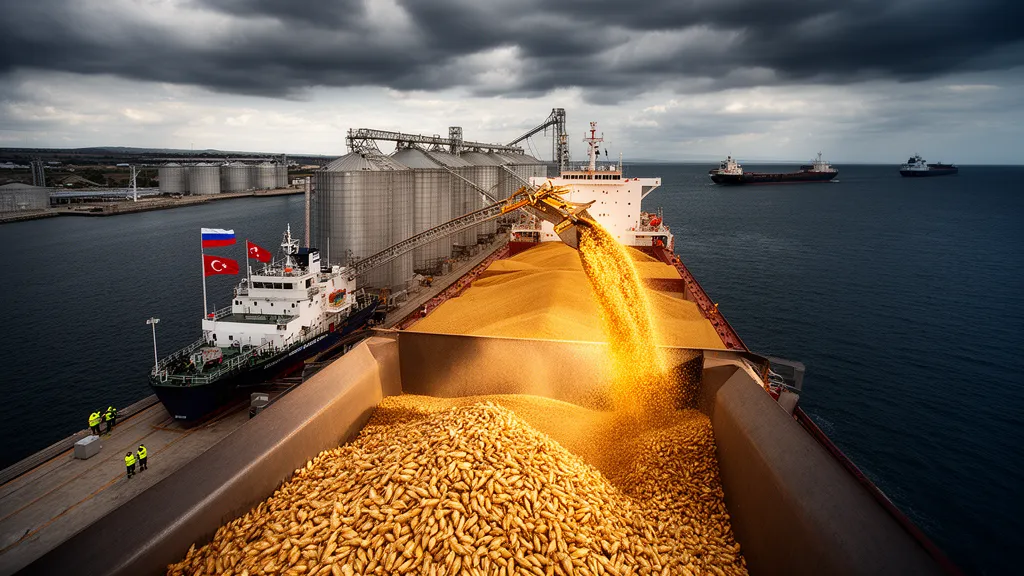
- Turkey has already secured around 70% of its 2025/26 barley import needs (0.9 Mt contracted versus 1.3 Mt projected imports) after a 13% drop in domestic output to 6.1 Mt.
- Russia is the dominant supplier, holding over 50% of Turkey’s barley import market and lifting shipments to 0.5 Mt in H1 2025/26 from 0.2 Mt a year earlier.
- Ukraine’s barley exports are weakening: volumes fell to 1.32 Mt (vs. 2.0 Mt a year ago), with 1.2–1.3 Mt still to place in H2 amid tightening demand from China.
- Chinese buyers are shifting to Australian and Canadian barley after improved trade relations, eroding demand for Black Sea origins despite China still taking 42% of Ukrainian barley exports.
- The EU barley crop rose to 56 Mt in 2025/26, the largest since 2016/17, adding to global supply pressure and reinforcing a bearish outlook for Ukrainian barley.
Turkey’s Barley Import Position
Turkey has secured approximately 0.9 million tonnes of barley via tenders in 2025/26, covering about 70% of its projected 1.3 million tonnes of import demand. This heightened import requirement follows a 13% decline in domestic barley production, from 7.0 to 6.1 million tonnes. The stronger import pull has tightened regional balances and reshaped trade flows, particularly from the Black Sea.
Supplier Breakdown and Trade Flows
Russia has emerged as Turkey’s primary barley supplier, capturing more than half of the import market. Russian shipments to Turkey surged to 0.5 million tonnes in the first half of 2025/26, up from 0.2 million tonnes in the same period a year earlier, outpacing Ukraine, Romania, and Germany. This reflects Russia’s competitive pricing, logistical advantages in the Black Sea, and steady exportable surplus.
Turkey has also become a key growth market for Ukrainian barley. Between July and November 2025, Turkish purchases of Ukrainian barley rose 6.4 times, from 36,000 to 233,000 tonnes. Turkey now accounts for around 20% of Ukrainian barley exports, ranking as the second-largest destination behind China, which holds a 42% share.
Ukrainian Barley Export Dynamics
From July 1 to January 17, Ukraine exported 1.32 million tonnes of barley, down from 2.0 million tonnes over the same period last season. This leaves an estimated 1.2–1.3 million tonnes available for shipment in the second half of the marketing year. Limited deep-sea port availability is underpinning firm Ukrainian FOB values in local currency and in US dollar terms, even as export volumes slow.
| Origin / Market | Period | Volume (Mt) | YoY Change |
|---|---|---|---|
| Turkey Barley Production | 2024/25 → 2025/26 | 7.0 → 6.1 | -0.9 Mt |
| Turkey Barley Imports (Projected) | 2025/26 | 1.3 | +1.15 Mt vs. 0.15 Mt prior |
| Russia → Turkey Barley Shipments | H1 2024/25 → H1 2025/26 | 0.2 → 0.5 | +0.3 Mt |
| Ukraine → Turkey Barley Exports | Jul–Nov 2024 → Jul–Nov 2025 | 0.036 → 0.233 | 6.4x |
| Total Ukrainian Barley Exports | Jul 1–Jan 17 | 2.0 → 1.32 | -0.68 Mt |
| China Share of Ukrainian Barley | 2025/26 to date | 42% | -31% YoY in volume |
| Turkey Share of Ukrainian Barley | 2025/26 to date | 20% | +Significant |
| EU Barley Harvest | 2025/26 | 56 | +5.7 Mt vs. prior year |
Price Overview
Restricted port capacity and a slower export pace are currently supporting Ukrainian barley FOB prices, quoted in a firm range of 10,500–10,800 UAH/t, equivalent to roughly $214–220/t. However, this support is increasingly at odds with the broader global supply backdrop, where both Australian and EU harvests are weighing on forward price expectations.
| Origin | Price Range | Currency |
|---|---|---|
| Ukraine Barley FOB | 10,500–10,800 | UAH/t |
| Ukraine Barley FOB (approx.) | $214–220 | USD/t |
China’s Demand Shift and Global Supply Context
China remains the largest buyer of Ukrainian barley with a 42% share of exports, but its volumes are down 31% year-on-year. Improved trade relations with Canada and a record Australian barley harvest are encouraging Chinese buyers to pivot away from Black Sea origins in the second half of the season. This shift will likely reduce Ukraine’s access to its key premium market, intensifying competition for alternative destinations such as Turkey and the Middle East.
At the same time, the EU’s barley harvest has risen to 56 million tonnes in 2025/26, an increase of 5.7 million tonnes and the largest crop since 2016/17. This additional European supply adds to already abundant global feed grain availability, reinforcing downward pressure on international feed barley values over the medium term.
Market Sentiment: Bearish for Ukrainian Barley
Overall sentiment for Ukrainian barley is turning bearish. Turkish demand and constrained port capacity are providing near-term price support, but these factors are unlikely to offset emerging structural headwinds. As China diverts more demand to Australian and Canadian origins and EU supply expands, Ukraine will face mounting challenges to sustain export volumes and maintain current FOB price levels through the remainder of 2025/26.
Source: Market Data
Leave a Reply