
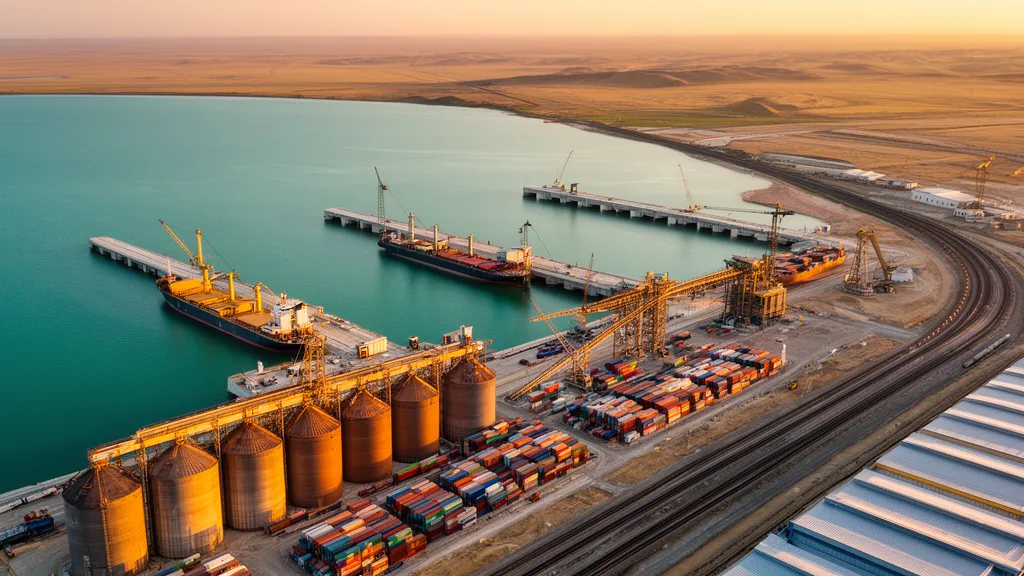
- Investment Scale: Kuryk Port’s development is set to attract up to $1.1 billion, with $300 million allocated for Phase 1 construction starting in 2024.
- Capacity Expansion: Phase 1 will handle 180,000 TEU, 180,000 vehicles, and 2–3 million tons of bulk cargo annually, enhancing Middle Corridor logistics.
- Timeline: The port complex is scheduled for commissioning in 2028, limiting short-term impact but reshaping longer-term freight flows.
- Market Impact: Neutral to mildly positive implications for Black Sea grain and oilseed logistics as alternative Caspian–Caucasus–Europe routes develop.
Kuryk Port Investment and Capacity Overview
NC KAZAKH INVEST JSC and Guoyou Materials Group are moving ahead with a large-scale infrastructure project at Kuryk Port on Kazakhstan’s Caspian Sea coast. The multifunctional port complex is a core element of the China–Caspian–Caucasus–Europe logistics chain, supporting the broader Middle Corridor development strategy.
| Project Metric | Value |
|---|---|
| Total Planned Investment | $1.1 billion |
| Phase 1 Investment | $300 million |
| Container Capacity (Phase 1) | 180,000 TEU/year |
| Vehicle Capacity (Phase 1) | 180,000 vehicles/year |
| Bulk Cargo Capacity (Phase 1) | 2–3 million tons/year |
| Construction Start | 2024 |
| Planned Commissioning | 2028 |
The first phase of the project requires approximately $300 million, with total capital deployment expected to reach $1.1 billion across all stages. Planned infrastructure includes seven berths, modern warehouse facilities, and integrated rail and road connections, supported by digital cargo management systems such as a TOS platform and EDI integration.
Once Phase 1 is operational, Kuryk Port is projected to handle 180,000 TEU of containers, 180,000 vehicles, and 2–3 million tons of bulk cargo annually. Construction and installation work is scheduled to begin in 2024, with the facility targeted to become fully operational by 2028.
Implications for Black Sea Grain and Oilseed Logistics
The Kuryk Port expansion has neutral to slightly positive implications for Black Sea grain and oilseed logistics. Although located on the Caspian rather than the Black Sea, the project strengthens the Middle Corridor by creating an alternative route for Central Asian and Kazakh agricultural exports that have traditionally moved via Black Sea ports.
The projected 2–3 million tons of annual bulk capacity could, over time, divert a portion of grain and oilseed volumes away from traditional Black Sea corridors. However, the 2028 commissioning timeline limits any immediate impact on regional balances, freight demand, or basis levels.
For traders and logistics planners, Kuryk’s development is more relevant for medium- to long-term strategy than for near-term pricing. As the Middle Corridor matures, competition between Caspian–Caucasus–Europe routes and established Black Sea channels may influence freight rates, routing preferences, and risk diversification strategies for Eurasian agricultural commodities.
Source: Market Data
Leave a Reply