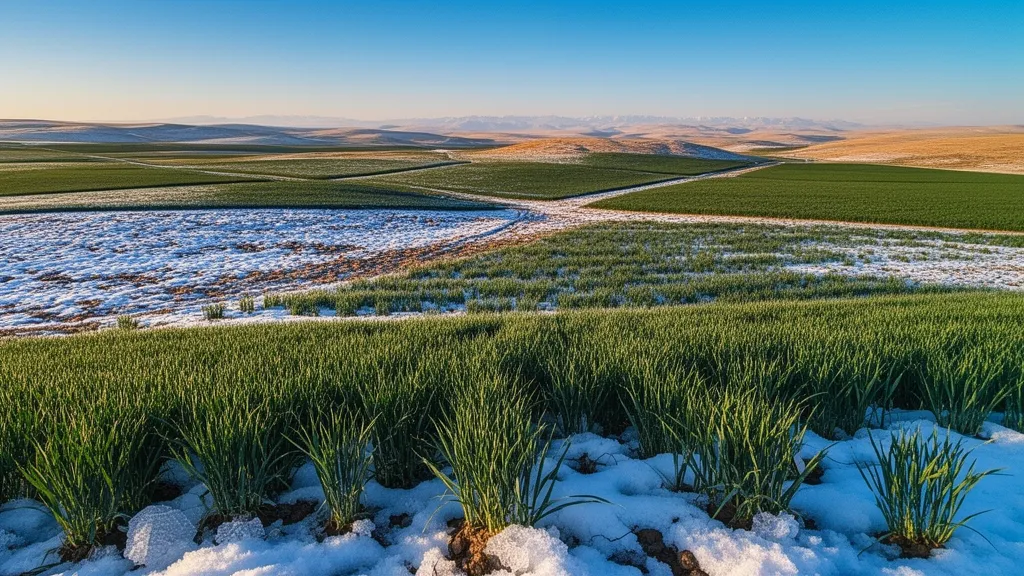
- Crop resilience: Winter wheat in southern and southeastern Kazakhstan overwintered safely in early January, with no reported freeze damage.
- Weather support: Air temperatures ran 2–4°C above normal, maintaining tillering node temperatures mostly above critical thresholds across key regions.
- Moisture risk: Below-normal precipitation and thin snow cover (<5 cm) in some areas pose localized risk if severe frosts occur later in winter.
- Market impact: Production risk for the 2025 crop is reduced, mildly pressuring Black Sea wheat prices but with moisture deficits limiting any strong bearish reaction.
Kazakhstan Winter Wheat Weather and Crop Update
Kazhydromet’s early January agrometeorological review indicates Kazakhstan’s winter wheat crop in southern and southeastern regions has successfully entered dormancy without freeze damage. Temperatures during the first ten days of January were 2–4°C above the long-term norm, preventing exposure to critical cold that could threaten plant viability.
Across the major growing regions, overwintering conditions are described as satisfactory. While temperature profiles and snow cover depth varied by region, all remained within safe limits for winter wheat at this stage of the season.
Regional Weather Conditions
| Region | Min Air Temp (°C) | Tillering Node Temp (°C) | Snow Cover (cm) | Soil Freezing Depth (cm) |
|---|---|---|---|---|
| Almaty | -8 to -11 | -6 | 4–9 (locally <5) | 19–44 |
| Zhetisu | -13 to -19 | Not specified | 10–18 (up to 21) | To 19 |
| Zhambyl | -5 to -8 | +3 | Snow melt in places | 2–16 |
| Turkestan | -5 to -8 | -3 | Thin/patchy | 4–6 (isolated) |
In Almaty region, minimum air temperatures reached -8 to -11°C, while tillering node temperatures held at -6°C, remaining above the critical thresholds for winterkill. Snow cover generally ranged from 4–9 cm. However, Kazhydromet highlights that underdeveloped wheat in areas with less than 5 cm of snow is vulnerable if severe frosts arrive later. Soil freezing extended to 19–44 cm but has not yet caused damage.
Zhetisu experienced the coldest air temperatures at -13 to -19°C, but a relatively deep snowpack of 10–18 cm (locally up to 21 cm) provided strong insulation, limiting soil freezing to about 19 cm. This snow cover is a key protective factor, preventing temperature stress at the tillering node level.
In Zhambyl region, conditions were milder, with air temperatures of -5 to -8°C and positive tillering node temperatures of +3°C, indicating secure overwintering despite areas of snowmelt. Soil freezing was shallow at 2–16 cm. Turkestan was the mildest, with air temperatures of -5 to -8°C, tillering node temperatures around -3°C, and largely thawed soils with only isolated frozen layers of 4–6 cm.
Precipitation across all regions came in below long-term norms, with Zhambyl district the sole exception, recording above-normal moisture. While this has not yet translated into acute stress for winter wheat, it does set up a need for timely spring rainfall to support vegetative growth.
Market Implications and Sentiment
Market Sentiment: Neutral to Slightly Bullish
The latest overwintering report lowers production risk for Kazakhstan’s 2025 winter wheat crop. With no freeze damage reported and generally adequate snow insulation, the probability of a normal to above-average harvest has improved, assuming acceptable spring moisture. This supports expectations for stable or stronger export availability in the next marketing year.
For the broader Black Sea complex, Kazakhstan’s role as a secondary exporter means the news exerts only marginal downward pressure on regional wheat values. The offsetting factor is subpar precipitation: moisture deficits, if extended into March–April, could cap yield potential and prevent any pronounced bearish shift in prices.
Traders and risk managers should continue to monitor precipitation trends heading into spring, with particular attention to regions showing thin snow cover or early-season dryness. A transition to a wetter pattern would reinforce the mildly bearish supply outlook, while ongoing dryness could shift sentiment back toward supportive or even bullish pricing for Black Sea wheat.
Source: Market Data
Leave a Reply