
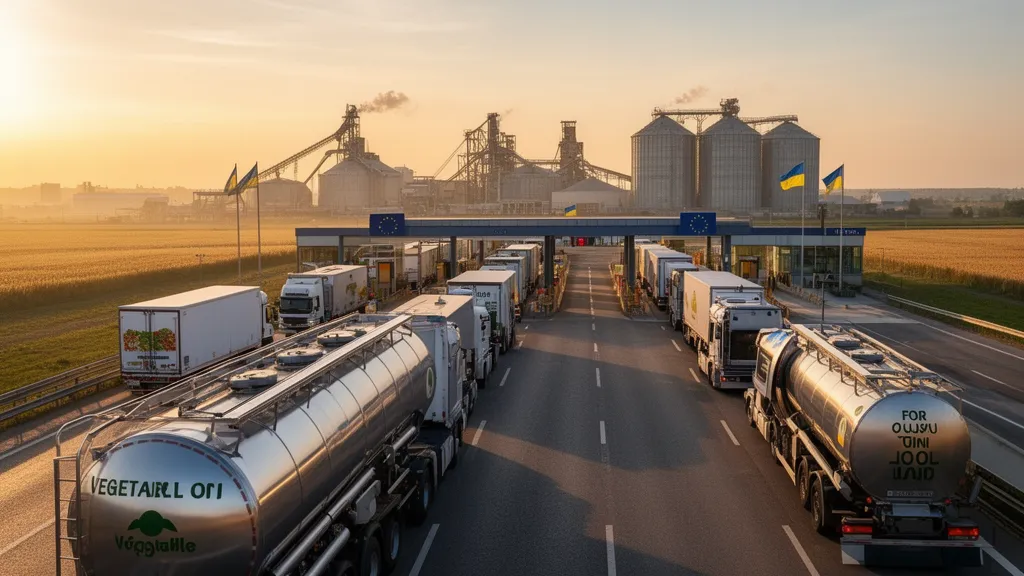
- Volumes: Ukrainian Q1 2024 agricultural road exports rose 41% q/q to 333.2 thousand tons by March, the highest level since November 2023.
- Value-added shift: Processed products such as sunflower oil, poultry meat, sugar, and oilseed meals dominate the export mix, signaling stronger domestic processing activity.
- Logistics corridors: Poland and Romania remain key land routes, jointly handling up to 9.2 thousand tons of agricultural exports per day in March.
- Market tone: Growing road freight capacity and stable processing support a neutral-to-bullish outlook for Ukrainian export availability despite elevated logistics costs.
Ukraine Q1 2024 Agricultural Road Export Trends
Ukraine’s agricultural exports by road posted solid growth through Q1 2024, underscoring the sector’s adaptability amid ongoing Black Sea disruptions. Monthly road freight volumes climbed from 235.7 thousand tons in January to 281.7 thousand tons in February and 333.2 thousand tons in March, delivering a 41% quarter-on-quarter increase and marking the strongest monthly performance since November 2023.
| Month 2024 | Road Export Volume (thousand tons) |
|---|---|
| January | 235.7 |
| February | 281.7 |
| March | 333.2 |
The export basket is increasingly weighted toward higher-margin, value-added products. In March, shipments were concentrated in sunflower oil (30.9 thousand tons), poultry meat (27.8 thousand tons), sugar (20.4 thousand tons), soybean cake (20.8 thousand tons), ethyl alcohol (20.5 thousand tons), and soybean oil (17.7 thousand tons). The fact that combined oil and meal exports now exceed raw soybean volumes highlights Ukraine’s continued shift toward downstream processing and domestic value capture.
Product Mix: Processed Exports Lead the Flows
| Product | March 2024 Volume (thousand tons) |
|---|---|
| Sunflower oil | 30.9 |
| Poultry meat | 27.8 |
| Sugar | 20.4 |
| Soybean cake | 20.8 |
| Ethyl alcohol | 20.5 |
| Soybean oil | 17.7 |
This product structure confirms that crushing, refining, and processing capacity inside Ukraine remains functional, allowing exporters to prioritize higher value chains over raw commodity exports. For market participants, this supports more stable supply of refined vegetable oils, meals, and animal protein flows via land corridors.
Regional Logistics Update
Land-based corridors through EU neighbors are central to Ukraine’s export strategy. In March, Poland handled approximately 4.5–5.6 thousand tons of agricultural cargo per day, while Romania managed around 2.4–3.6 thousand tons daily. These corridors now function as core outlets for Black Sea-origin commodities, partially offsetting constrained seaborne capacity.
| Route | Daily Volume Range (thousand tons) |
|---|---|
| Ukraine–Poland | 4.5 – 5.6 |
| Ukraine–Romania | 2.4 – 3.6 |
The increased dependence on these land routes has several implications: heightened importance of EU border-crossing efficiency, persistent upward pressure on freight rates relative to traditional Black Sea shipping, and increased sensitivity of flows to regulatory or logistical bottlenecks along the Polish and Romanian corridors.
Market Outlook
Rising road freight volumes and the dominance of processed exports contribute to a neutral-to-bullish outlook for Ukrainian export availability via alternative corridors. While logistics costs remain elevated versus seaborne routes, the demonstrated resilience of processing and overland transport networks suggests continued capacity to supply key agricultural products into European and global markets, barring major disruptions at critical border crossings.
Source: Market Data
Leave a Reply