
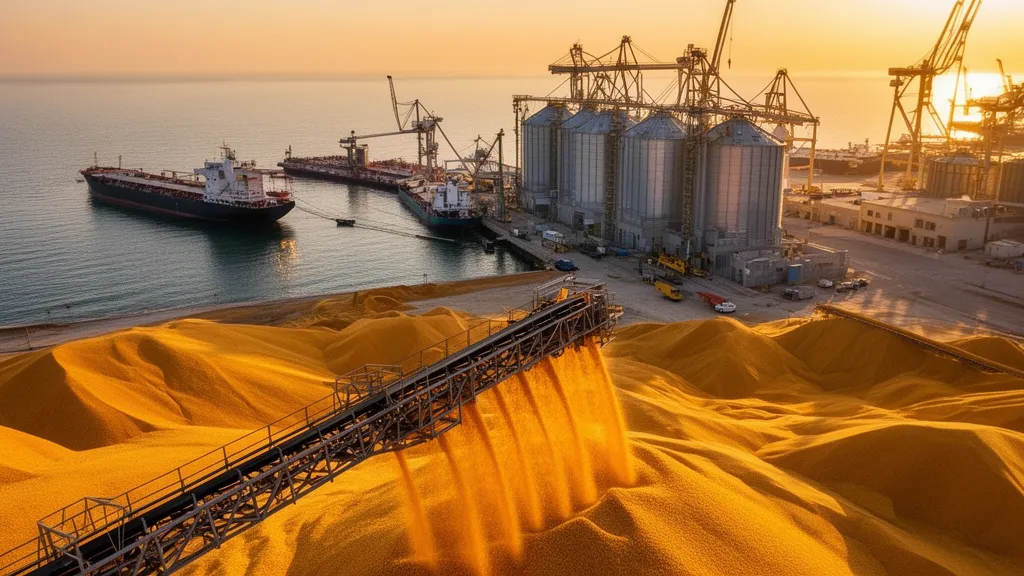
- Export Growth: Ukraine’s corn exports for 2025/26 are forecast at 23.8 million tons, up 8.3% year-on-year.
- Production Recovery: Corn harvest is projected at 29.9 million tons, an 11.2% increase but still 6.8% below the five-year average.
- Firm Feed Demand: Domestic consumption is estimated at 6.2 million tons, with 5.2 million tons going to animal feed.
- Market Tone: Outlook is mildly bullish for Black Sea corn exports as logistics normalize and volumes rise.
Ukraine Corn Outlook for 2025/26
The Ukrainian Agribusiness Club (UCAB) projects that Ukraine will export 23.8 million tons of corn in the 2025/26 marketing year, an 8.3% increase from the previous season. The forecast points to a gradual recovery in export capacity from the Black Sea region as the country adapts to ongoing conflict-related disruptions.
Harvest volumes are expected to reach 29.9 million tons, up 11.2% year-on-year. Despite this improvement, output remains 6.8% below the five-year average, underscoring that a full return to pre-conflict production levels has not yet been achieved.
Domestic Consumption Breakdown
Total domestic corn consumption is forecast at 6.2 million tons in 2025/26. Animal feed dominates usage with 5.2 million tons, while seed production is expected to require 182,000 tons and non-food processing 418,000 tons, leaving the bulk of supply available for export.
| Category | 2025/26 Forecast (million tons) | Year-on-Year Change | Comment |
|---|---|---|---|
| Corn Production | 29.9 | +11.2% | Still 6.8% below five-year average |
| Corn Exports | 23.8 | +8.3% | Key driver of Black Sea supply growth |
| Total Domestic Consumption | 6.2 | N/A | Stable internal demand profile |
| Animal Feed Use | 5.2 | N/A | Accounts for majority of domestic use |
| Seed Production | 0.182 | N/A | Input for future crop cycles |
| Non-Food Processing | 0.418 | N/A | Industrial and other non-food uses |
Market Sentiment and Trade Implications
Market sentiment for Black Sea corn is mildly bullish as higher Ukrainian export volumes are expected to improve global supply availability in 2025/26. Increased flows from Ukraine could heighten competition for other major exporters while granting importers more flexibility in origin choice.
Nonetheless, output remaining below historical norms signals that structural constraints tied to the conflict persist. Logistics coordinators should prepare for gradually rising volumes through Black Sea routes, while traders may find opportunities in forward positions as Ukraine’s export corridor continues to stabilize.
Source: Market Data
Leave a Reply