
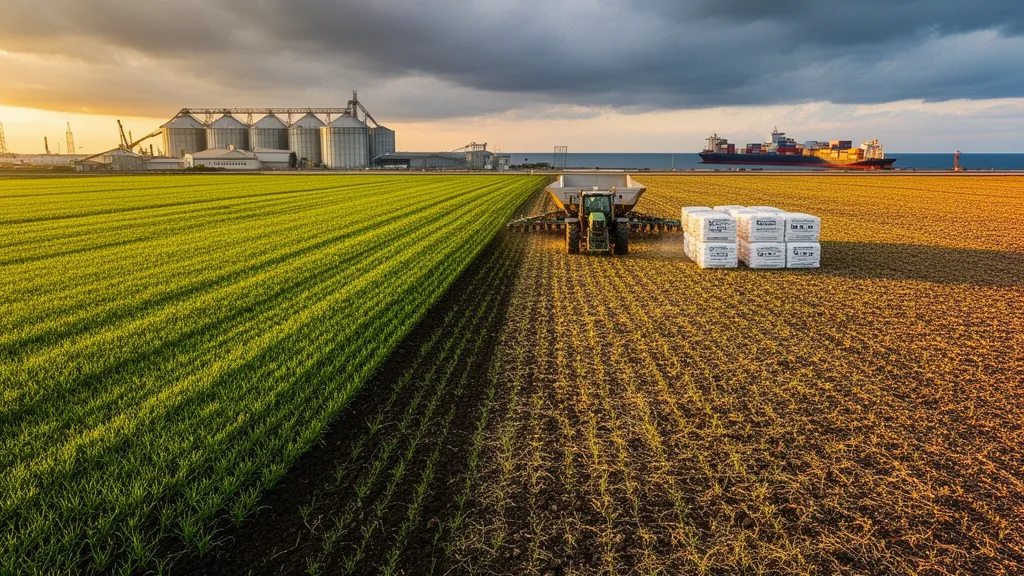
- Bearish Ukraine: Delayed approval of calcium ammonium nitrate imports risks a 20% decline in spring crop yields and tens of billions of hryvnias in lost export revenue.
- Structural Risk: Domestic Ukrainian fertilizer output has fallen roughly 50% since the war, leaving the sector heavily reliant on timely import approvals.
- Russian Constraint: Despite 73% domestic market share in crop protection, fungicides cover only 33.6% of cultivated area, with under 3% coverage on sunflower.
- Market Impact: Black Sea grain and sunflower oil supply could tighten in 2025, supporting global prices but limiting Ukraine’s and Russia’s ability to expand exports.
Ukraine Fertilizer Bottleneck Threatens Spring Sowing
The All-Ukrainian Agrarian Council (AAR) warns that regulatory delays on calcium ammonium nitrate imports may severely disrupt the 2025 spring sowing campaign. While standard ammonium nitrate remains restricted on security grounds, AAR officials stress that calcium ammonium nitrate is considered explosion-proof and safe by expert assessment, yet approvals are still pending.
Spring wheat, corn, and sunflower are most exposed, and these crops form the backbone of Ukraine’s export income. With agricultural goods accounting for 56–60% of total exports, a projected 20% crop loss would translate into tens of billions of hryvnias in forgone foreign currency earnings at a time when Ukraine is heavily dependent on farm-sector revenues.
Domestic fertilizer production has been sharply curtailed by the war. Annual output has fallen from about 2 million tons pre-war to just over 1 million tons, leaving the market structurally short and dependent on imports. The AAR has appealed to the Ministry of Economy to fast-track a resolution as the optimal planting window approaches.
Russia’s Fungicide Gap Limits Yield Potential
In Russia, Salis Karakotov of Shchelkovo Agrokhim highlights that domestic crop protection production has expanded 8.4-fold over the past 15 years, with Russian products now covering 73% of the national market. Despite this progress, fungicide use remains critically low relative to agronomic needs.
Only 33.6% of cultivated area receives fungicide applications, and less than 3% of sunflower acreage is treated. Karakotov estimates that to achieve adequate disease control across major crops, fungicide production would need to rise from 26.8 million tons to roughly 80 million tons per year, underscoring a significant underinvestment in disease management.
Market Implications for Grains and Oilseeds
Ukraine: The fertilizer import bottleneck is bearish for Ukrainian grain and oilseed export volumes. A 20% output shortfall in spring wheat, corn, and sunflower would tighten Black Sea availabilities, likely offering price support to global markets but reducing Ukraine’s export capacity and foreign exchange inflows.
Russia: For Russian oilseeds, particularly sunflower, chronically low fungicide usage is a key factor behind stagnant yields. This constraint limits Russia’s ability to offset any Ukrainian supply losses, preserving structural tightness in Black Sea sunflower oil balances and capping potential export growth.
Overall, the combination of Ukraine’s fertilizer constraints and Russia’s fungicide deficit points to continued supply-side risk in Black Sea grain and vegetable oil flows into 2025.
Source: Market Data
Leave a Reply