
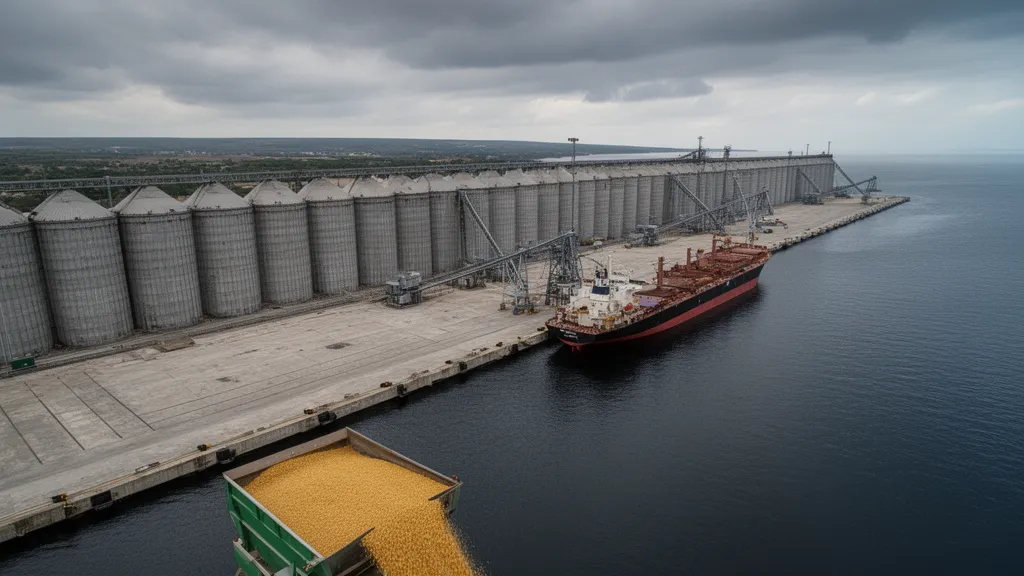
- Bearish: Russian grain export volumes through key Black Sea terminals fell sharply in 2025 due to significantly tighter state export quotas.
- Bearish: Taman grain terminal throughput collapsed 57%, highlighting underutilized infrastructure and constrained global grain supply from Russia.
- Neutral: Novorossiysk Grain Terminal cushioned the impact by expanding transshipment of molasses and fatty acids, partially offsetting lower grain flows.
- Bearish: The steep quota reduction from 29 million tons in 2024 to 10.6 million tons in H1 2025 points to continued policy risk for Black Sea grain exporters and traders.
Russian Grain Export Terminals: 2025 Performance Overview
Russian Black Sea grain logistics faced a notable downturn in 2025 as Demetra Holding’s key export terminals reported sizeable declines in throughput. The Taman grain terminal complex saw exports plunge 57% year-on-year to 2.42 million tons, down from 5.6 million tons in 2024. This contraction underscores the direct impact of state-imposed export restrictions on physical flows.
Novorossiysk Grain Terminal (NZT) also recorded weaker grain volumes, handling 5.47 million tons in 2025, a 24.4% decrease versus the previous year. Despite the slowdown in grains, NZT increased its handling of molasses and fatty acids, more than doubling transshipment in these segments as the terminal diversified its cargo mix.
Export Quota Dynamics
The performance of both Taman and NZT was heavily shaped by Russia’s tighter grain export quota regime. The quota in force from February 15 to June 30, 2025 was set at 10.6 million tons, a 63.4% reduction compared with the 29 million ton ceiling applied in 2024. This sharp cut constrained available export volumes and left significant infrastructure capacity idle across the Black Sea corridor.
| Item | Period | Volume (million tons) | Year-on-Year Change |
|---|---|---|---|
| Taman grain terminal exports | 2024 | 5.60 | — |
| Taman grain terminal exports | 2025 | 2.42 | -57.0% |
| Novorossiysk Grain Terminal exports | 2024 | 7.24 (approx.) | — |
| Novorossiysk Grain Terminal exports | 2025 | 5.47 | -24.4% |
| Russian grain export quota | 2024 | 29.0 | — |
| Russian grain export quota | Feb 15–Jun 30, 2025 | 10.6 | -63.4% |
Market Implications and Trading View
Bias: Bearish. The reduced throughput at Taman and NZT highlights a policy-driven squeeze on Russian grain exports, particularly via the Black Sea. With one of the region’s strategic export hubs operating well below capacity, international markets are likely to see tighter availability of Russian grain during 2025.
For traders, the underutilization of logistics infrastructure may lead to increased competition among terminals once quotas are relaxed, potentially improving terms for exporters in the medium term. In the near term, however, quota risk remains a headwind for Russian-origin grain flows, while the expansion into molasses and fatty acids at NZT signals a gradual shift toward more diversified agri-exports.
Source: Market Data
Leave a Reply