
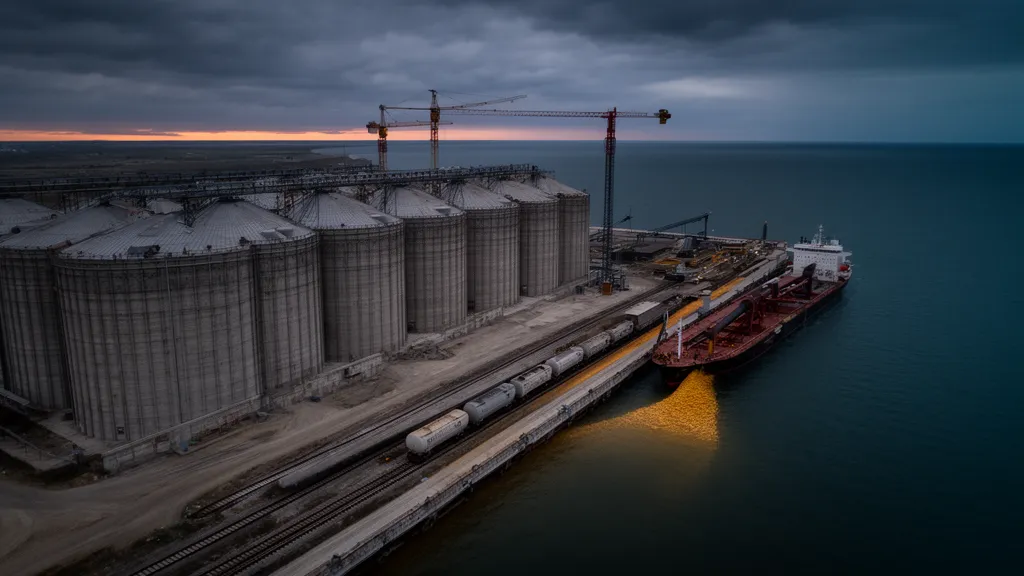
- Sharp volume declines: Taman Grain Terminal Complex exports dropped 56.8% to 2.42 million tons in 2025, while Novorossiysk Grain Terminal volumes fell 24.4% to 5.47 million tons.
- Quota-driven constraints: Russian grain export quota for Feb 15–Jun 30, 2025 was cut to 10.6 million tons versus 29 million tons in 2024, materially limiting flows.
- Capex amid headwinds: Ongoing infrastructure upgrades at TGC aim to boost future capacity and efficiency despite current throughput pressure.
- Market tone: Near-term Russian export availability through Black Sea terminals is tighter, keeping the outlook neutral to slightly bearish for seaborne grain flows.
Russian Grain Export Terminals: 2025 Volume Snapshot
| Terminal | Operator | Export Volume 2024 (mn tons) | Export Volume 2025 (mn tons) | Change (mn tons) | Change (%) |
|---|---|---|---|---|---|
| Taman Grain Terminal Complex (TGC) | Demetra Holding | 5.60 | 2.42 | -3.18 | -56.8% |
| Novorossiysk Grain Terminal | Demetra Holding | 7.24 | 5.47 | -1.77 | -24.4% |
| Export Quota Period | Quota 2024 (mn tons) | Quota 2025 (mn tons) | Change (mn tons) | Change (%) |
|---|---|---|---|---|
| Feb 15 – Jun 30 | 29.0 | 10.6 | -18.4 | -63.4% |
Market Update
The Taman Grain Terminal Complex (TGC), part of Demetra Holding, processed 2.42 million tons of grain for export in 2025, down sharply from 5.6 million tons in 2024. Over the year, the terminal handled 72 vessels and processed 81,000 road vehicles.
According to the company, the main driver of reduced throughput was the grain export quota in force from 15 February to 30 June 2025. The quota was set at 10.6 million tons, far below the 29 million tons allocated for the same period in 2024, materially constraining outbound grain shipments.
The Novorossiysk Grain Terminal, also operated by Demetra Holding, reported a more moderate but still substantial decline, handling 5.47 million tons of grain crops for export in 2025. This represents a 24.4% reduction versus the previous year, underscoring the broad impact of quota limits on Russian Black Sea export capacity.
Infrastructure and Capacity Developments
Despite weaker volumes, TGC continued to execute its infrastructure development program through 2025. Investment is focused on modernizing port facilities, improving loading and unloading efficiency, and shortening road transport processing times, all aimed at raising future effective capacity and reducing bottlenecks.
Current projects include expansion of railway infrastructure with enhanced rail unloading capabilities, construction of additional grain silos, berth reconstruction and dredging operations, and the addition of a new loading line. The comprehensive expansion program is scheduled for completion in 2028, positioning the terminal for higher throughput once policy constraints ease.
Analysis: Market Impact
Market Impact: Neutral to Slightly Bearish
The steep reduction in throughput at major Russian Black Sea grain terminals highlights the constraining effect of the 2025 export quota regime. With the February–June quota cut by more than 60% year-on-year, Russian grain export availability via these routes is comparatively tighter, limiting seaborne supply even as physical infrastructure continues to be upgraded.
For traders, this translates into a neutral to slightly bearish outlook for freight flows from Russia in the near term: physical capacity is underutilized, and policy rather than logistics is the binding constraint. The completion of TGC’s expansion by 2028 could materially increase regional export capacity, but until then, quota policy will remain the key variable shaping Russian grain exports through Black Sea terminals.
Source: Market Data
Leave a Reply