
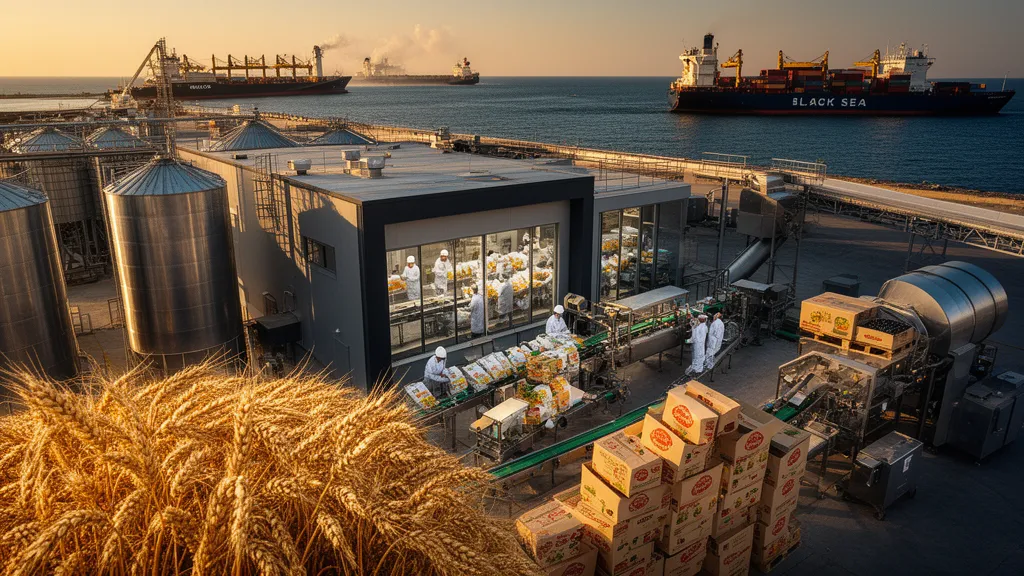
- Exports Down but Still Dominant: Ukraine’s agricultural exports fell 9% to $22.71 billion in 2025 but still accounted for 56% of total exports.
- Shift to Value-Added Goods: Processed agricultural products grew to about 20% of total agri exports, signaling a move toward higher-margin, value-added trade.
- Imports Rising: Agricultural imports rose 13% to $9.12 billion, pushing total agri trade turnover to $31.83 billion despite overall softness.
- Market Tone: Neutral to slightly bearish for bulk freight and traditional flows, with potential support from growing processed-product exports.
Market Update
Ukraine’s agricultural sector generated $22.71 billion in export revenue in 2025, a 9% decline compared with 2024, according to the National Scientific Center "Institute of Agrarian Economics." Despite this contraction, agricultural and food products maintained a 56% share of Ukraine’s total exports, the third-highest level since independence, underscoring the sector’s enduring strategic importance.
Total foreign trade turnover in agricultural products (commodity groups 1–24 of the Ukrainian Classification of Goods for Foreign Economic Activity, plus casein, albumin, hides, fur, and wool) reached $31.83 billion in 2025, down 3% year-on-year. Within this total, imports climbed 13% to $9.12 billion, based on data from Ukraine’s State Customs Service, signaling robust domestic demand and rising dependence on foreign supplies.
Deputy Director of the Institute and Academician of the National Academy of Sciences, Nikolai Pugachev, pointed to a meaningful structural shift toward higher-margin products. The share of processed agricultural goods rose to roughly one-fifth of total agricultural exports in 2025, indicating that Ukraine is deepening value-added processing even as overall export volumes face constraints.
Trade Structure and Key Figures
| Indicator | 2025 Value (USD bn) | Y/Y Change | Notes |
|---|---|---|---|
| Agricultural exports | $22.71 | -9% | 56% of Ukraine’s total exports |
| Agricultural imports | $9.12 | +13% | Driven by strong domestic demand |
| Total agricultural trade turnover | $31.83 | -3% | Includes commodity groups 1–24 plus casein, albumin, hides, fur, wool |
| Share of processed agricultural exports | ~$4.54 | Higher share | Approx. 20% of total agricultural exports |
| Share of agriculture in total exports | — | Near record | Third-highest level since independence at 56% |
Market Analysis
Overall Tone: Neutral to Slightly Bearish
The 9% decline in agricultural exports reflects persistent operational and security challenges in the Black Sea region, which are likely curbing bulk shipment volumes and weighing on freight demand. At the same time, the sector’s continued 56% share of national exports underscores that Ukraine remains heavily reliant on agriculture as a foreign-exchange earner, even in a constrained logistics environment.
The expansion of processed agricultural goods to around 20% of total agricultural exports signals a gradual strategic pivot away from pure raw-commodity dependence. This shift toward higher value-added production could, over time, reduce sensitivity to unit freight costs and bulk corridor disruptions, while supporting more diversified export channels and potentially higher margins for producers.
The 13% increase in imports, pushing total agricultural trade turnover to $31.83 billion, points to resilient domestic consumption and some supply gaps in local production. For traders and logistics operators, the Institute’s expectation of broadly stable trade levels in 2026 suggests that the market may be settling into a new equilibrium, with less upside for bulk volumes but growing opportunities in processed and branded food exports.
From a freight and corridor-utilization perspective, the evolving export mix implies potential softness in traditional grain and oilseed bulk flows, offset partially by more containerized or specialized shipments linked to processed goods. Monitoring the balance between raw and processed exports, as well as any regulatory or infrastructure changes in Black Sea and alternative corridors, will be critical for positioning in both physical and paper markets.
Source: Market Data
Leave a Reply