
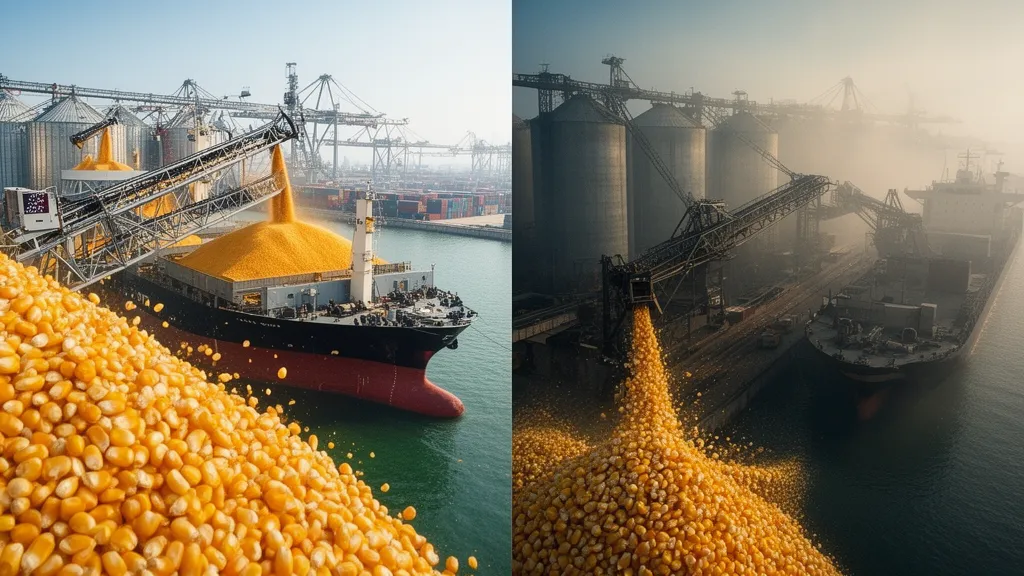
- US corn gains EU ground: US corn shipments to the EU rose by 6.5 million tons between 2023/24 and 2024/25, while Ukrainian exports fell by 7.5 million tons, signaling a major reshaping of Atlantic trade flows.
- Trade deals lock in US market access: New US agreements with Japan, South Korea, and Southeast Asian buyers secured contractual market access and duty-free terms, making displacement of Ukraine structural rather than cyclical.
- Turkey is Ukraine’s key stronghold: Ukraine now supplies about 75% of Turkey’s corn imports, supported by strict GMO rules that effectively block US corn and concentrate Ukrainian export risk in a single market.
- Spillover to soybeans: Ukrainian soybean exports to Egypt collapsed six-fold to 38,000 tons in the first four months of 2025/26 from 246,000 tons a year earlier, highlighting broader competitive pressure from US supplies.
- Bearish outlook for Ukraine: Contract-based US trade infrastructure and regulatory headwinds suggest a prolonged, bearish environment for Ukrainian corn exports in the EU, Asia, and MENA regions.
Market Update
The United States has rapidly expanded its corn export footprint in 2025–2026 through a series of strategic trade agreements, directly displacing Ukrainian volumes in key destinations. The sharpest change has been in the EU, where US corn shipments increased by 6.5 million tons while Ukraine’s exports declined by 7.5 million tons between the 2023/24 and 2024/25 marketing years, signaling a structural reallocation of Atlantic corn flows.
US market expansion goes well beyond Europe. South Korea has more than doubled its corn imports from the US, and Washington has secured duty-free access to Indonesia alongside direct purchasing agreements with Vietnam, Thailand, the Philippines, Bangladesh, and Taiwan. Japan has committed to $8 billion in annual purchases of US agricultural products, anchoring long-term demand for US grains and oilseeds.
Regulatory and policy changes have underpinned these shifts. The EU’s new “balanced trade” framework with the US removed key non-tariff barriers, improving conditions for US corn and bioethanol. A similar arrangement with the UK is creating parallel advantages, further strengthening US positioning at the expense of Ukrainian exporters.
Ukraine has retained only limited positions in markets such as Spain, South Korea, Vietnam, and Israel. Turkey has emerged as Ukraine’s primary stronghold, now accounting for roughly 75% of Turkish corn imports. Strict Turkish GMO regulations effectively exclude US corn due to the high likelihood of unapproved traits and hybrid mixing in US supply chains, giving Ukraine a regulatory edge but also concentrating its export exposure in a single buyer.
The pressure on Ukraine is not confined to corn. In soybeans, Ukrainian exports to Egypt collapsed to just 38,000 tons in the first four months of 2025/26, down from 246,000 tons in September–December 2024—a six-fold decline that mirrors the broader loss of market share to US-origin supplies.
Trade Flow Shifts: EU and Key Destinations
| Region / Market | Change in US Corn Exports | Change in Ukrainian Corn Exports | Notes (2023/24 to 2024/25) |
|---|---|---|---|
| European Union | +6.5 million tons | −7.5 million tons | EU “balanced trade” deal removed non-tariff barriers for US corn and bioethanol. |
| South Korea | More than doubled | Limited presence | New trade arrangements favored US origin. |
| Turkey | Near-total exclusion | ~75% market share | Strict GMO rules block most US corn; Ukraine dominates. |
| Southeast Asia (Indonesia, Vietnam, Thailand, Philippines, Bangladesh, Taiwan) | Significant increase | Reduced competitiveness | Duty-free access and direct purchase agreements for US corn. |
| Japan | Higher US agricultural imports | Weaker relative position | Japan committed to $8 billion/year in US agricultural purchases. |
Ukrainian Soybean Export Shift
| Destination | Period | Ukrainian Soybean Exports (tons) | Change vs. Prior Year |
|---|---|---|---|
| Egypt | Sep–Dec 2024 | 246,000 | Baseline |
| Egypt | First four months of 2025/26 | 38,000 | −208,000 (approx. six-fold decrease) |
Analysis and Outlook
Bearish for Ukrainian Corn Exports: The displacement of Ukrainian corn is structural. US gains are anchored in formal trade agreements, duty-free access, and established logistics rather than temporary price advantages. This significantly limits the scope for a rapid Ukrainian comeback in the EU, Asian, and Middle Eastern markets.
Turkey’s GMO-based protection offers Ukraine a crucial but concentrated lifeline. With roughly three-quarters of Turkish corn imports sourced from Ukraine, any change in Turkey’s demand, regulations, or political stance represents a major swing factor for Ukrainian export volumes in 2025/26.
The 14 million ton net swing in EU corn flows (a 6.5 million ton US increase plus a 7.5 million ton Ukrainian decline) underscores a deep reordering of Atlantic trade patterns. Traders should closely monitor Turkish import behavior, EU policy evolution, and further US trade diplomacy as key variables shaping price spreads, basis levels, and freight flows through the 2025/26 season.
Source: Market Data
Leave a Reply