
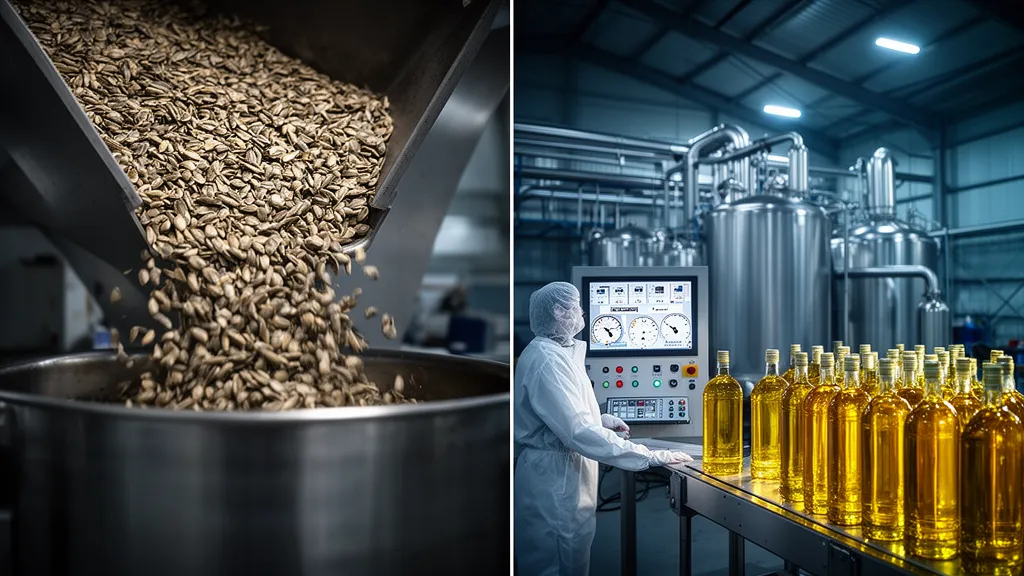
- Policy tension: Kazakhstan’s competition agency urges cutting the 20% sunflower seed export duty, saying it harms farmers, while processors warn of domestic price spikes.
- Domestic prices at risk: Processors project retail sunflower oil could jump to 1,200–1,300 tenge/liter if the duty is reduced, versus current 786–814 tenge/liter.
- Capacity expansion: Refining capacity is set to rise to 481,000 tons in 2025 and 1 million tons by 2028, lifting refined oil’s export share from 18% in 2024 to 27% in 2025.
- Regional trade impact: Keeping the duty is neutral to bearish for Kazakhstan’s export availability; a cut would be bullish for regional sunflower seed trade and Black Sea crushers.
Kazakhstan Sunflower Duty Debate
Kazakhstan is reconsidering its 20% export duty on sunflower seeds (minimum €100/ton), in place since February 2023. An audit by the Agency for the Protection and Development of Competition, presented by MP Nurzhan Ashimbetov, found that while oil exports have risen 70% since the duty was introduced, agricultural producers have incurred losses, leading to a recommendation to reduce the duty.
The National Association of Oilseed Processors (NAPMC) opposes changing the duty. Under a memorandum with the Ministry of Trade and Ministry of Agriculture, processors are committed to holding wholesale sunflower oil at 730 tenge/liter through 2026. Current retail prices for domestic brands in Almaty stand at 786–814 tenge/liter, compared with over 1,000 tenge/liter for Russian imports, keeping Kazakh oil competitively priced for consumers.
Processors argue that reducing the duty would incentivize raw seed exports, worsen domestic raw material shortages, and push mills—already running at roughly 40% capacity—into deeper underutilization. NAPMC estimates that domestic retail prices could climb to 1,200–1,300 tenge/liter by summer if the duty is eased, effectively aligning local prices more closely with elevated international levels.
Refining Capacity and Export Structure
Kazakhstan’s refining sector is on a steep growth path. By 2025, annual refining capacity is expected to reach 481,000 tons, up 68% versus 2021. Four projects totaling 370,000 tons of annual capacity are scheduled to start this year, with an additional 100,000 tons planned for 2027 in Shymkent and Ust-Kamenogorsk. Looking further ahead, total refining capacity is projected to approach 1 million tons annually by 2028.
This build-out is reshaping export flows toward higher value-added products. Refined sunflower oil’s share in total exports is projected to rise from 18% in 2024 to 27% by the end of 2025, signaling Kazakhstan’s emergence as a more prominent refined oil supplier in the region.
Price and Capacity Snapshot
| Indicator | Value | Notes |
|---|---|---|
| Sunflower seed export duty | 20% (min €100/ton) | In force since Feb 2023 |
| Increase in oil exports since duty | +70% | Versus pre-duty period |
| Wholesale sunflower oil price (memorandum) | 730 tenge/liter | Fixed through 2026 |
| Domestic retail sunflower oil (Almaty) | 786–814 tenge/liter | Local brands |
| Russian imported sunflower oil | >1,000 tenge/liter | Retail level |
| Projected domestic price if duty cut | 1,200–1,300 tenge/liter | NAPMC forecast by summer |
| Mills’ current operating rate | ~40% capacity | Due to raw material shortage |
| Refining capacity 2025 | 481,000 tons/year | +68% vs 2021 |
| New capacity starting 2024 | 370,000 tons/year | Four projects |
| Additional capacity 2027 | 100,000 tons/year | Shymkent & Ust-Kamenogorsk |
| Target refining capacity 2028 | ~1,000,000 tons/year | Planned total |
| Refined oil share of exports 2024 | 18% | Baseline |
| Refined oil share of exports 2025 | 27% | Projected by end-2025 |
Regional Market Implications
The duty decision will shape Black Sea sunflower seed and oil flows. Maintaining the current regime supports domestic refiners and consumer price stability but limits raw seed availability for export, making the outlook neutral to bearish for Kazakhstan’s sunflower oil export volumes. A reduction would free up seeds for export, tightening domestic supply yet turning bullish for regional seed trade and crushers in neighboring markets.
In the wider context of a 47% rise in European sunflower oil prices since May 2023, processors’ concern is that any duty cut would accelerate domestic price convergence with international levels. Traders should closely track policy signals from Nur-Sultan, as changes will directly affect regional raw material competition, crush margins, and refined product flows across the Black Sea and into Europe.
Source: Market Data
Leave a Reply