
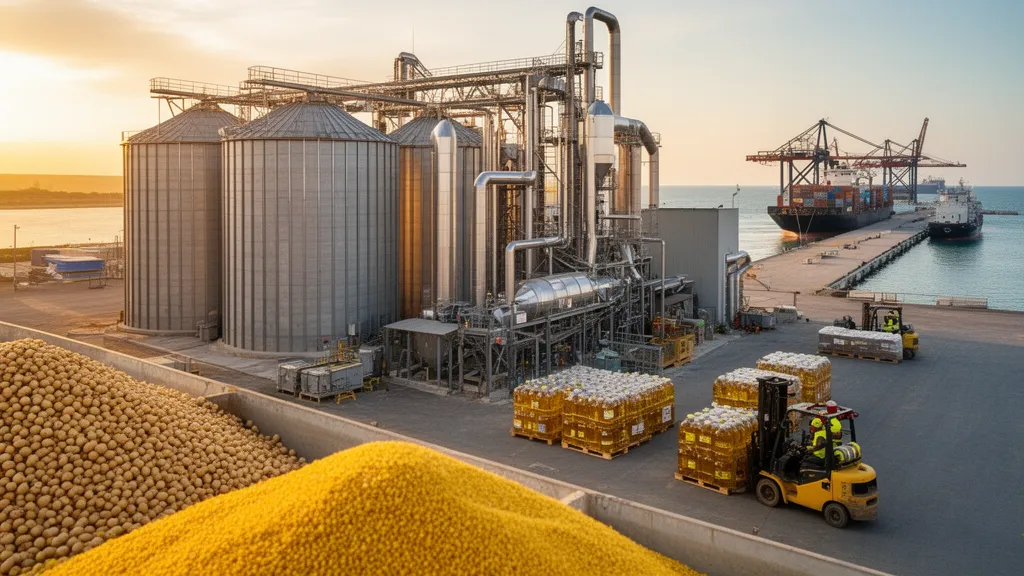
- Record Processing: Ukraine targets all-time high processing of 3 million tons of soybeans (60% of crop) and 1.7 million tons of rapeseed (50% of harvest) in 2025/26.
- Export Revenues Rising: Soybean oil output and exports grew over 22% year-on-year, with foreign exchange earnings from soybean and rapeseed oil up 1.5–2.2 times.
- Policy-Driven Shift: Export duties on raw soybeans and rapeseed are steering volumes into domestic crushing, boosting value-added exports of oils and meals.
- EU Biofuel Pivot: Proposed EU rules would phase out soybean oil-based biofuels by 2030 while preserving rapeseed oil as the only cultivated biomass oil eligible for renewable energy quotas.
- Mixed Outlook: The new EU framework is structurally bullish for Ukrainian rapeseed processing but introduces medium-term headwinds for soybean oil exports into the EU.
Market Update: Record Oilseed Processing in Ukraine
Ukraine is on track for record oilseed processing in the 2025/26 marketing year, driven by export duties on raw soybeans and rapeseed and expanding crushing capacity. Industry association Ukroliyaprom projects soybean processing at 3 million tons, equivalent to over 60% of the domestic crop, and rapeseed processing at 1.7 million tons, representing more than half of the gross harvest.
The capacity build-out is already reflected in recent performance. In July–December 2025, soybean oil production rose 22.4% year-on-year, with exports up 23.3% and foreign exchange receipts increasing 1.5 times. Rapeseed processing into vegetable oil expanded 1.8 times compared with the previous season, while rapeseed oil exports climbed at the same pace and foreign exchange earnings advanced 2.2 times.
For the full marketing year, total output is projected at around 600,000 tons of soybean oil and 720,000 tons of rapeseed oil—both record volumes for Ukraine. Revenue from soybean oil sales reached $587.5 million, and rapeseed oil generated $398.4 million, underscoring the impact of shifting from raw seed exports to value-added processing.
The policy backdrop is pivotal. Export duties on raw soybeans and rapeseed are incentivizing domestic crushing, with processed soybean volumes (oil and meal) exceeding exports of unprocessed beans by 3.7%. This is gradually repositioning Ukraine as a supplier of refined vegetable oils rather than a pure raw material exporter.
EU Biofuel Policy Shift and Its Impact
While domestic processing trends are strongly supportive, external demand dynamics are shifting. The European Commission has launched a public consultation on amendments to Delegated Regulation (EU) No. 2019/807 that would fully eliminate soybean oil-based biofuels from EU renewable energy quotas by 2030. The draft regulation sets progressive reduction thresholds for soybean oil biofuel use: 71.4% in 2026, 42.8% in 2027, and 14.3% in 2029, leading to a complete phase-out by 2030.
This comes on top of earlier moves by France, the Netherlands, and Germany, which removed palm oil-based biofuels from their national programs in 2023. From 2030 onward, rapeseed oil will remain the only cultivated biomass oil eligible for EU renewable energy quotas, structurally favoring rapeseed over soy in the bloc’s biofuel mix.
Data Summary: Ukrainian Oilseed Processing and Export Revenues
| Metric | Commodity | Value | Period / Note |
|---|---|---|---|
| Projected processing volume | Soybeans | 3.0 million tons | 2025/26 MY; >60% of domestic crop |
| Projected processing volume | Rapeseed | 1.7 million tons | 2025/26 MY; >50% of gross harvest |
| Oil output (projected) | Soybean oil | 600,000 tons | 2025/26 MY; record volume |
| Oil output (projected) | Rapeseed oil | 720,000 tons | 2025/26 MY; record volume |
| YoY production change | Soybean oil | +22.4% | July–December 2025 vs. prior year |
| YoY export change | Soybean oil | +23.3% | July–December 2025 vs. prior year |
| FX earnings change | Soybean oil | 1.5× | July–December 2025 vs. prior year |
| Processing growth | Rapeseed into oil | 1.8× | Current season vs. prior season |
| Export growth | Rapeseed oil | 1.8× | Current season vs. prior season |
| FX earnings change | Rapeseed oil | 2.2× | Current season vs. prior season |
| Export revenues | Soybean oil | $587.5 million | Most recent reported period |
| Export revenues | Rapeseed oil | $398.4 million | Most recent reported period |
| Processing vs raw exports | Soybeans | +3.7% | Processed volumes exceed raw exports by 3.7% |
Strategic Analysis
The current policy mix is clearly supportive for Ukraine’s oilseed processing sector. Export duties on raw soybeans and rapeseed are reinforcing domestic value addition, allowing crushers to capture higher margins and driving record utilization rates. As a result, Ukraine is consolidating its role as a competitive exporter of processed vegetable oils and meals rather than unprocessed seeds.
However, the EU’s proposed soybean oil biofuel phase-out introduces medium-term uncertainty for Ukrainian soybean oil flows into Europe. While near-term profitability for both soybean and rapeseed crushing remains solid, the regulatory trajectory tilts future returns in favor of rapeseed, which will enjoy exclusive access to EU renewable energy quotas from 2030. Ukrainian processors will likely respond by prioritizing rapeseed crushing for the EU biofuel market, while soybean oil increasingly targets alternative destinations or pivots toward food-grade and industrial demand segments outside the EU.
Source: Market Data
Leave a Reply