
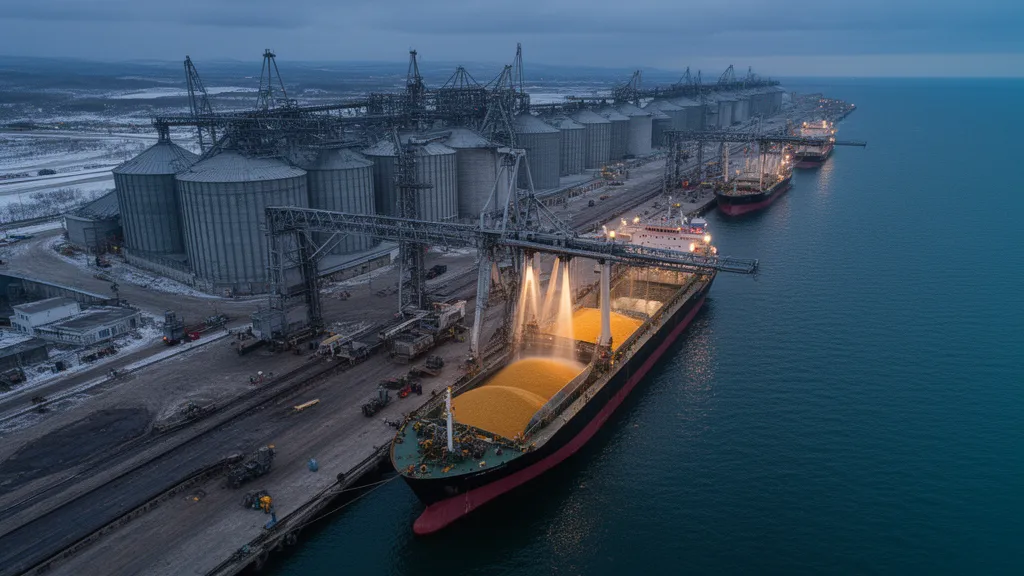
- Bearish logistics signal: Russian seaports’ grain transshipment fell 14.5% y/y in January 2026 to 3.4 million tons, highlighting ongoing pressure on Black Sea export flows.
- Systemic softness: Total port cargo turnover declined 7% y/y, with dry cargo down 10.4% and liquid bulk down 3.8%, indicating broad-based weakness beyond grain.
- Export slowdown: Overall exports through Russian seaports slipped 5.9% y/y to 54.2 million tons, with imports, transit, and cabotage also contracting sharply.
- Potential freight support: If grain volumes rebound later in the marketing year, current reduced port activity could contribute to bottlenecks and firmer regional freight rates.
Russian Seaport Cargo Performance – January 2026
| Category | January 2026 Volume (million tons) | Y/Y Change (%) |
|---|---|---|
| Total cargo turnover | 66.9 | -7.0% |
| Dry cargo (total) | 31.0 | -10.4% |
| Grain | 3.4 | -14.5% |
| Mineral fertilizers | 3.8 | -3.3% |
| Liquid bulk (total) | 35.9 | -3.8% |
| Liquid food cargo | 0.3 | -50.5% |
| Exports | 54.2 | -5.9% |
| Imports | 3.1 | -13.9% |
| Transit | 3.8 | -26.8% |
| Cabotage | 5.8 | -5.0% |
Market Update
Russian seaports saw a broad contraction in throughput in January 2026, with total cargo turnover falling 7% year-on-year to 66.9 million tons, according to the Association of Sea Trade Ports. The downturn was led by dry cargo, which dropped 10.4% to 31 million tons, and by a further pullback in grain and fertilizer volumes.
Grain transshipment reached 3.4 million tons, down 14.5% year-on-year, while mineral fertilizer volumes slipped 3.3% to 3.8 million tons. Liquid bulk cargo also weakened, decreasing 3.8% to 35.9 million tons, with liquid food cargo suffering the steepest segment decline at 50.5% to just 0.3 million tons.
On the trade side, total exports through Russian seaports declined 5.9% to 54.2 million tons in January. Imports contracted 13.9% to 3.1 million tons, transit flows fell 26.8% to 3.8 million tons, and cabotage volumes decreased 5% to 5.8 million tons, underscoring a broad-based softening in seaborne activity.
The January figures contrast with full-year 2025 patterns, when mineral fertilizer transshipment rose 8% year-on-year even as grain throughput registered a steep 31.1% annual decline. The latest data point to continued weakness in grain alongside a cooling in previously resilient fertilizer flows.
Analysis and Implications for Freight
The 14.5% year-on-year drop in January grain transshipment signals persistent pressure on Russian Black Sea export infrastructure at the start of the 2026 marketing year. While current volumes are lower, any subsequent rebound in grain exports could strain port capacity and create localized bottlenecks, providing upside support to regional freight rates.
Because the decline spans dry cargo, liquid bulk, exports, imports, transit, and cabotage, the weakness appears systemic rather than grain-specific. This broad slowdown may reflect a combination of logistical constraints, weaker trade flows, or regulatory and geopolitical factors affecting Russian seaborne trade.
For traders and shipowners, the key question is whether January’s data capture temporary seasonal softness or the start of a more sustained downturn. Monitoring February and Q1 2026 throughput will be critical for gauging regional vessel availability, chartering conditions, and potential volatility in Black Sea freight pricing.
Source: Market Data
Leave a Reply