
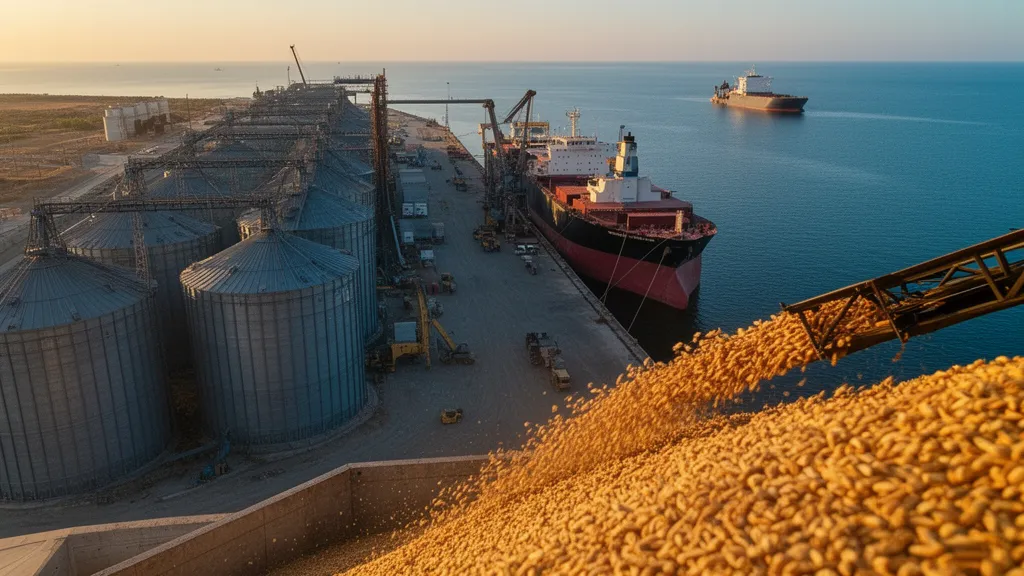
- Bearish: Black Sea grain export flows remain pressured as Russia’s new quota regime is unlikely to be fully utilized and Ukraine’s exports are running 20–34% below last year amid infrastructure bottlenecks.
- Neutral: Large crop potential in both Russia and Ukraine, along with Ukraine’s diversification toward North African and Middle Eastern markets, provides a medium‑term floor for export availability once logistics and policy constraints ease.
- Structural Shift: Both countries are prioritizing value-added agricultural exports, signaling a gradual reduction in raw grain volumes available to global markets over the longer term.
Russian Export Quota Allocation
Russia’s Ministry of Agriculture has allocated 20 million tons of grain export quotas (wheat, meslin, corn) for February 15 – June 30, 2026, across 213 companies. Moscow-based Grain Gates secured the largest individual quota at 3.5 million tons, followed by Aston with 2.1 million tons and OZK-Trading with 1.1 million tons. Thirty companies from the Rostov Region collectively received 4.96 million tons.
Former major exporter Rodnye Polya (ex-TD RIF) was excluded from the current quota list after suspending operations in April 2024 due to quarantine organism findings and subsequent nationalization in January 2025. Market analyst Vladimir Petrichenko (ProZerno) expects actual exports under the quota to reach only 17–18 million tons for the period, implying total Russian grain exports of around 55 million tons or below for the 2025/26 season.
Ukrainian Export Performance and Market Diversification
Ukraine’s grain exports in July–December 2025 lagged the prior year by roughly 30%, constrained by energy shortages, rail congestion, port limitations, and EU tariff quotas. Wheat shipments reached 7.9 million tons (-20% YoY), barley 1.3 million tons (-34% YoY), and October–December corn exports 5 million tons (-29% YoY). USDA FAS projects 2025/26 exports at 14.3 million tons of wheat, 3.1 million tons of barley, and 23.2 million tons of corn.
Despite logistical headwinds, Ukraine has diversified away from EU buyers: wheat exports to Egypt rose to 2 million tons (from 800,000 tons), shipments to Algeria climbed to 1.2 million tons, and exports to Yemen increased to 593,000 tons. This pivot toward North Africa and the Middle East partially offsets lost EU market share but may come at tighter margins due to freight and risk premia.
Russian Export Composition Shift
Grain’s share of Russian agricultural exports fell to about 30% in 2025, declining in both volume (by more than 5 percentage points) and value (by around 10 percentage points). Oil and fat products now account for 22% of agricultural export value, while fish and seafood represent 15%. At the same time, value-added segments expanded: meat exports rose 22%, dairy 13%, confectionery 13%, pasta 25%, and finished meat products 15%.
According to Agriculture Minister Oksana Lut, the drop in grain export value was driven by an unfavorable ruble exchange rate and weaker profitability. Russia aims to reduce grain’s share of agricultural exports further to 25% by 2030 while lifting total agricultural exports to $55.2 billion, reinforcing a long-term shift away from bulk raw grain.
Ukraine’s Long-Term Investment Strategy
The Ukrainian Agrarian Confederation has outlined a 10‑year, $85 billion investment plan designed to increase annual agricultural exports from $24.2 billion to $100 billion. The strategy emphasizes value-added processing over raw material exports, targeting production of 150 million tons of grain and oilseeds, 25 million tons of milk, and 10 million tons of meat.
Proposed investments include $37 billion for food, pharmaceutical, and perfume industries; $18 billion for livestock; $8 billion for crop production; $7 billion for irrigation restoration; $5.5 billion for bioenergy; and $10 billion for logistics, horticulture, and greenhouse farming. Successful execution would structurally increase Ukraine’s share of processed exports and improve resilience to infrastructure and policy shocks.
Trade Balance and Export Value Overview
In 2025, Russian agricultural exports declined 4.1% to $40.9 billion, while imports rose 15% to $43.4 billion, leaving Russia with a modest agricultural trade deficit. The combination of lower grain profitability, quota constraints, and a stronger focus on processed products has tempered overall export growth despite robust production potential.
| Country | Indicator | 2025 Value | YoY Change |
|---|---|---|---|
| Russia | Agricultural export value | $40.9 billion | -4.1% |
| Russia | Agricultural import value | $43.4 billion | +15.0% |
| Russia | Allocated grain export quota (Feb 15–Jun 30, 2026) | 20.0 million tons | N/A |
| Russia | Rostov Region quota share | 4.96 million tons | N/A |
| Ukraine | Wheat exports (Jul–Dec 2025) | 7.9 million tons | -20% |
| Ukraine | Barley exports (Jul–Dec 2025) | 1.3 million tons | -34% |
| Ukraine | Corn exports (Oct–Dec 2025) | 5.0 million tons | -29% |
| Ukraine | Forecast wheat exports 2025/26 | 14.3 million tons | N/A |
| Ukraine | Forecast barley exports 2025/26 | 3.1 million tons | N/A |
| Ukraine | Forecast corn exports 2025/26 | 23.2 million tons | N/A |
| Russia | Target agricultural exports by 2030 | $55.2 billion | Strategic target |
| Ukraine | Planned agri-investment (10 years) | $85.0 billion | Strategic plan |
Market Impact Assessment
Near-term sentiment for Black Sea grain flows is bearish to neutral. Russia’s quota system introduces execution risk, with industry expectations pointing to underutilization versus the 20 million ton cap. Ukraine’s exports are moving roughly 30% slower year-on-year due to persistent infrastructure and regulatory frictions, and both countries are structurally shifting toward higher-value processed exports. Nevertheless, strong underlying production potential and Ukraine’s ongoing market diversification limit the downside for global supply once logistical and policy constraints gradually ease.
Source: Market Data
Leave a Reply